



惯性聚合 高效追踪和阅读你感兴趣的博客、新闻、科技资讯
阅读原文 在惯性聚合中打开

推荐订阅源

J
Java Code Geeks
小众软件
小众软件
博客园 - 叶小钗
宝玉的分享
宝玉的分享
博客园_首页
Hugging Face - Blog
Hugging Face - Blog
人人都是产品经理
人人都是产品经理
钛媒体:引领未来商业与生活新知
钛媒体:引领未来商业与生活新知
S
SegmentFault 最新的问题
B
Blog RSS Feed
Engineering at Meta
Engineering at Meta
N
Netflix TechBlog - Medium
Google DeepMind News
U
Unit 42
F
Fortinet All Blogs
IT之家
IT之家
Y
Y Combinator Blog
Martin Fowler
Martin Fowler
T
The Blog of Author Tim Ferriss
奇客Solidot–传递最新科技情报
奇客Solidot–传递最新科技情报
The GitHub Blog
The GitHub Blog
Stack Overflow Blog
Stack Overflow Blog
Blog — PlanetScale
Blog — PlanetScale
酷 壳 – CoolShell
酷 壳 – CoolShell

DEV Community

Authentication Security Deep Dive: From Brute Force to Salted Hashing (With Java Examples) Why AI Systems Don’t Fail — They Drift Spilling beans for how i learn for exam😁"Reinforcement Learning Cheat Sheet" I Replaced Chrome with Safari for AI Browser Automation. Here's What Broke (and What Finally Worked) How Python Borrows Other People's Work The $40 Architecture: Processing 1 Billion API Requests with 99.99% Uptime Vibe Coding: A Workflow Guide (From Zero to SaaS) Most webhook security guides protect the wrong side. The scary part is delivery. Headless CMS for TanStack Start: Build a Blog with Cosmic EU Age Verification App "Hacked in 2 Minutes" — What Actually Happened Comfy Cloud’s delete function does not actually remove files Running AI Models on GPU Cloud Servers: A Beginner Guide Event-driven media intelligence with AWS Step Functions and Bedrock I scored 500 AI prompts across 8 quality dimensions — here's what broke How to Call Google Gemini API from Next.js (Free Tier, No Backend Needed) The Portal Protocol: Reclaiming Human Connection in the Age of AI How to Fix Your Team's Scattered Knowledge Problem With a Self-Hosted Forum Intro to tc Cloud Functors: A Graph-First Mental Model for the Modern Cloud Designing Multi-Tenant Backends With Both Ownership and Team Access I Built a Neumorphic CSS Library with 77+ Components — Here's What I Learned PostgreSQL Performance Optimization: Why Connection Pooling Is Critical at Scale Cómo construí un SaaS multi-rubro para gestionar expensas en Argentina con FastAPI + Vue 3 🚀 I Built an Ethical Hacking Scanner Tool – Open Source Project I Replaced /usage and /context in Claude Code With a Single Statusline A Pythonic Way to Handle Emails (IMAP/SMTP) with Auto-Discovery and AI-Ready Design I Collected 8.9 Million Polymarket Price Points — Here's What I Found About How Markets Really Move EcoTrack AI — Carbon Footprint Tracker & Dashboard Everyone's Using AI. No One Agrees How. 5 self-hosted ebook managers worth trying in 2026 Building Your First AI Agent with LangChain: From Chatbot to Autonomous Assistant
How to Build an Interactive Grade Calculator from Scratch...
BELLO ABD'QU · 2026-04-29 · via DEV Community
Cover image for How to Build an Interactive Grade Calculator from Scratch Making Use Of If-Else If-Else Statement

BELLO ABD'QUADRI BOLAJI

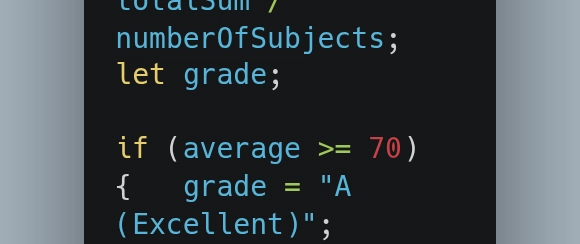
The first part of the program is the Collector. Instead of us telling the computer the scores upfront, we’ve programmed it to ask, then after 5 input continuously, we use an If-Else Chain to filter the average through a series of checkpoints.

What To Understand Clearly:

The Loop: We use a for loop because we know exactly how many times we need to ask (5 times).
The Conversation: The prompt() function pauses the program and waits for the user.

The Conversion: Computers often see user input as "text" (strings). We use parseFloat() to tell the computer to **treat **the input as a number so we can do math with it.

Running Total: Every time a score comes in, we immediately add it to totalSum, It’s like a teacher adding marks to a ledger one by one.

'''Javascript
let scores = [];
let numberOfSubjects = 5;
let totalSum = 0;

for (let i = 0; i < numberOfSubjects; i++) {
let input = prompt("Enter score for subject " + (i + 1) + ":");
let score = parseFloat(input);
scores.push(score);
totalSum += score;
}

let average = totalSum / numberOfSubjects;
let grade;

if (average >= 70) {
grade = "A (Excellent)";
} else if (average >= 60) {
grade = "B (Very Good)";
} else if (average >= 50) {
grade = "C (Credit)";
} else if (average >= 45) {
grade = "D (Pass)";
} else {
grade = "F (Fail)";
}
'''

console.log("Total Score: " + totalSum);
console.log("Average Score: " + average);
console.log("Final Grade: " + grade);

*SUMMARY *
When you run this code on your computer, laptop or phone, you aren't just calculating numbers, you are creating a workflow ✅.

Input: You input the raw data into the system.
Logic: The system organizes and calculates the data.
Output: The computer (system) gives a well readable and understandable result (The Grade).

TAKE NOTE: This is the fundamental structure of almost every professional application.
From Input → Processing → Output.

Can we add a feature that prevents the user from entering a number higher than 100, or calculate the GPA on a 5.0 scale.