








Building a Smart Environmental Monitoring System with Google Cloud (Inspired by NEXT ‘26)
This is a submission for the Google Cloud NEXT Writing Challenge
🌍 Why Google Cloud NEXT ‘26 Caught My Attention
Every year, Google Cloud NEXT brings new ideas, but this time what stood out to me was the strong push toward real-time data processing, AI integration, and scalable cloud-native systems.
As someone working on IoT + web-based systems, I was especially interested in how cloud tools can handle live sensor data efficiently and make it useful.
💡 The Idea: Smart Environmental Monitoring System
Inspired by the announcements around cloud scalability and developer tools, I decided to explore a simple but practical use case:
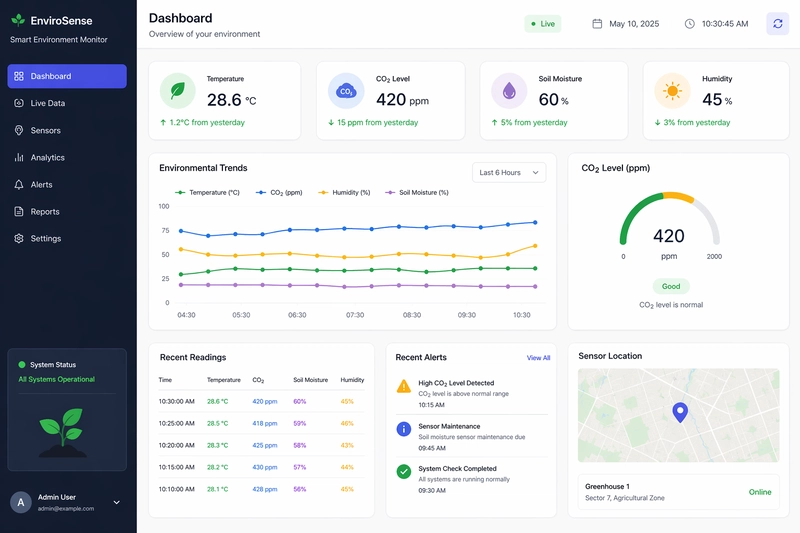
A system that monitors temperature, CO₂ levels, and soil moisture in real time.
This kind of system can be useful for:
- Smart agriculture 🌱
- Indoor air quality monitoring 🏠
- Climate-aware applications 🌍
🛠️ Tech Stack I Used
- Raspberry Pi → Collect sensor data
- Django (Backend) → Handle APIs & data processing
- React.js (Frontend) → Display real-time dashboard
- HTTP Protocol → Send live sensor data
-
Google Cloud (Conceptual Integration):
- Cloud Run / App Engine (deployment ideas)
- Cloud Storage / Firestore (data handling)
- AI/ML possibilities for predictions
⚙️ How It Works
- Sensors connected to Raspberry Pi collect data
- Data is sent via HTTP to a Django backend
- Backend processes and stores the data
- React dashboard displays it in real time
🔍 What I Learned from NEXT ‘26
1. Cloud Makes Real-Time Systems Scalable
Before cloud integration, systems like this are limited locally.
With Google Cloud, this can scale to:
- Thousands of devices
- Multiple locations
- Real-time analytics
2. AI Integration is the Next Step
The real power is not just collecting data, but:
- Predicting trends
- Detecting anomalies
- Automating alerts
For example:
- Predict soil dryness before it happens
- Alert when CO₂ levels become unsafe
3. Developer Experience is Improving
One key takeaway from NEXT ‘26 is how tools are becoming:
- Easier to deploy
- More integrated
- Faster to build with
This reduces the gap between idea → prototype → production.
🤔 My Honest Take
While Google Cloud offers powerful tools, beginners might still face:
- Initial setup complexity
- Understanding pricing
- Choosing the right service
However, once you get past that, the ecosystem is incredibly powerful.
🚀 What I’d Do Next
If I extend this project using Google Cloud:
- Deploy backend on Cloud Run
- Store real-time data in Firestore
- Use AI models for prediction
- Add alerts using cloud functions
📌 Final Thoughts
Google Cloud NEXT ‘26 reinforced one thing for me:
The future is not just about building apps — it’s about building intelligent, scalable systems.
Even a simple IoT project can become powerful when combined with cloud + AI.
💬 What About You?
Did you explore anything from Google Cloud NEXT ‘26?
What feature excited you the most?
Let’s discuss 👇