









Leveraging the Google Agent Development Kit (ADK) and the underlying Gemini LLM to build low code apps with the Python programming language deployed to the Lambda service on AWS.

Aren’t There a Billion Python Agent Demos?
Yes there are.
Python has traditionally been the main coding language for ML and AI tools. The goal of this article is to provide a minimal viable basic working ADK server.
What Is Python?
Python is an interpreted language that allows for rapid development and testing and has deep libraries for working with ML and AI:
Python Version Management
One of the downsides of the wide deployment of Python has been managing the language versions across platforms and maintaining a supported version.
The pyenv tool enables deploying consistent versions of Python:
GitHub - pyenv/pyenv: Simple Python version management
Amazon Lamba
AWS Lambda is a serverless, event-driven compute service that enables users to run code without provisioning or managing servers. With Lambda, developers can focus solely on their code (functions), while AWS handles all underlying infrastructure management, including capacity provisioning, automatic scaling, and operating system maintenance.
Full details are here:
Serverless Computing Service - Free AWS Lambda - AWS
Gemini CLI
If not pre-installed you can download the Gemini CLI to interact with the source files and provide real-time assistance:
npm install -g @google/gemini-cli
Testing the Gemini CLI Environment
Once you have all the tools and the correct Node.js version in place- you can test the startup of Gemini CLI. You will need to authenticate with a Key or your Google Account:
▝▜▄ Gemini CLI v0.33.1
    ▝▜▄
   ▗▟▀ Logged in with Google /auth
  ▝▀ Gemini Code Assist Standard /upgrade
Node Version Management
Gemini CLI needs a consistent, up to date version of Node. The nvm command can be used to get a standard Node environment:
Docker Version Management
The AWS Cli tools need a current version of Docker. If your environment does not provide a recent docker tool- the Docker Version Manager can be used to downlaod the latest supported Docker:
AWS CLI
The AWS CLI provides a command line tool to directly access AWS services from your current environment. Full details on the CLI are available here:
Install Docker, AWS CLI, and the Lightsail Control plugin for containers
Agent Development Kit
The Google Agent Development Kit (ADK) is an open-source, Python-based framework designed to streamline the creation, deployment, and orchestration of sophisticated, multi-agent AI systems. It treats agent development like software engineering, offering modularity, state management, and built-in tools (like Google Search) to build autonomous agents.
The ADK can be installed from here:
This seems like a lot of Configuration!
Getting the key tools in place is the first step to working across Cloud environments. For a deeper dive- a project with a similar setup can be found here:
MCP Development with Amazon Lambda and Gemini CLI
Where do I start?
The strategy for starting low code agent development is a incremental step by step approach.
The agents in the demo are based on the original code lab:
First, the basic development environment is setup with the required system variables, and a working Gemini CLI configuration.
Then, a minimal ADK Agent is built with the visual builder. Next — the entire solution is deployed to Amazon Lambda.
Setup the Basic Environment
At this point you should have a working Python environment and a working Gemini CLI installation. The next step is to clone the GitHub samples repository with support scripts:
cd ~
git clone https://github.com/xbill9/gemini-cli-aws
cd adkui-lambda
Then run init.sh from the cloned directory.
The script will attempt to determine your shell environment and set the correct variables:
source init.sh
If your session times out or you need to re-authenticate- you can run the set_env.sh script to reset your environment variables:
source set_env.sh
Variables like PROJECT_ID need to be setup for use in the various build scripts- so the set_env script can be used to reset the environment if you time-out.
Verify The ADK Installation
To verify the setup, run the ADK CLI locally with Agent1:
xbill@penguin:~/gemini-cli-aws/adkui-lambda$ adk run Agent1
/home/xbill/.pyenv/versions/3.13.13/lib/python3.13/site-packages/authlib/_joserfc_helpers.py:8: AuthlibDeprecationWarning: authlib.jose module is deprecated, please use joserfc instead.
It will be compatible before version 2.0.0.
  from authlib.jose import ECKey
/home/xbill/.pyenv/versions/3.13.13/lib/python3.13/site-packages/google/adk/features/_feature_decorator.py:72: UserWarning: [EXPERIMENTAL] feature FeatureName.PLUGGABLE_AUTH is enabled.
  check_feature_enabled()
Log setup complete: /tmp/agents_log/agent.20260420_230436.log
To access latest log: tail -F /tmp/agents_log/agent.latest.log
/home/xbill/.pyenv/versions/3.13.13/lib/python3.13/site-packages/google/adk/cli/utils/agent_loader.py:277: UserWarning: [EXPERIMENTAL] _load_from_yaml_config: This feature is experimental and may change or be removed in future versions without notice. It may introduce breaking changes at any time.
  if root_agent := self._load_from_yaml_config(actual_agent_name, agents_dir):
/home/xbill/.pyenv/versions/3.13.13/lib/python3.13/site-packages/google/adk/features/_feature_decorator.py:81: UserWarning: [EXPERIMENTAL] feature FeatureName.AGENT_CONFIG is enabled.
  check_feature_enabled()
/home/xbill/.pyenv/versions/3.13.13/lib/python3.13/site-packages/google/adk/cli/cli.py:204: UserWarning: [EXPERIMENTAL] InMemoryCredentialService: This feature is experimental and may change or be removed in future versions without notice. It may introduce breaking changes at any time.
  credential_service = InMemoryCredentialService()
/home/xbill/.pyenv/versions/3.13.13/lib/python3.13/site-packages/google/adk/auth/credential_service/in_memory_credential_service.py:33: UserWarning: [EXPERIMENTAL] BaseCredentialService: This feature is experimental and may change or be removed in future versions without notice. It may introduce breaking changes at any time.
  super(). __init__ ()
Running agent Agent1, type exit to exit.

[Agent1]: Hello! How can I help you today?
[user]: 0.0s 0.0s
Deploying to Amazon Lambda
First authenticate:
aws login --remote
Then cache the credentials locally:
xbill@penguin:~/gemini-cli-aws/adkui-lambda$ source save-aws-creds.sh
Exporting AWS credentials...
Successfully saved credentials to .aws_creds
The Makefile will now automatically use these for deployments.
xbill@penguin:~/gemini-cli-aws/adkui-lambda$
Then start the deployment:
xbill@penguin:~/gemini-cli-aws/adkui-lambda$ make deploy
Exporting AWS credentials...
Successfully saved credentials to .aws_creds
The Makefile will now automatically use these for deployments.
Ensuring IAM role McpLambdaExecutionRole exists...
Checking if ECR repository exists...
Logging in to Amazon ECR...
You can validate the final result by checking the messages:
Updating Function URL to BUFFERED mode (Stateless HTTP)...
{
    "FunctionUrl": "https://u3lvibtqxtj7h3nzzadl7p73dq0ngjql.lambda-url.us-west-1.on.aws/",
    "FunctionArn": "arn:aws:lambda:us-west-1:106059658660:function:adkui-lambda",
    "AuthType": "NONE",
    "CreationTime": "2026-04-20T13:46:11.689938731Z",
    "LastModifiedTime": "2026-04-21T03:06:25.769054157Z",
    "InvokeMode": "BUFFERED"
}
You can then get the endpoint:
xbill@penguin:~/gemini-cli-aws/adkui-lambda$ make status
------------------------------------------------------------
| GetFunction |
+-------------------------------+----------------+---------+
| LastModified | Name | Status |
+-------------------------------+----------------+---------+
| 2026-04-21T03:06:23.000+0000 | adkui-lambda | Active |
+-------------------------------+----------------+---------+
https://u3lvibtqxtj7h3nzzadl7p73dq0ngjql.lambda-url.us-west-1.on.aws/
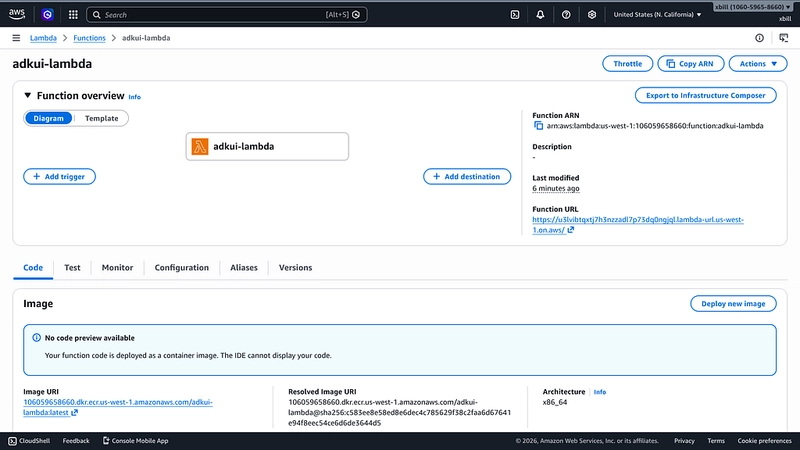
The service will be visible in the AWS Lambda console:
Running the ADK Web Interface
Start a connection to the Lamba Deployed ADK:
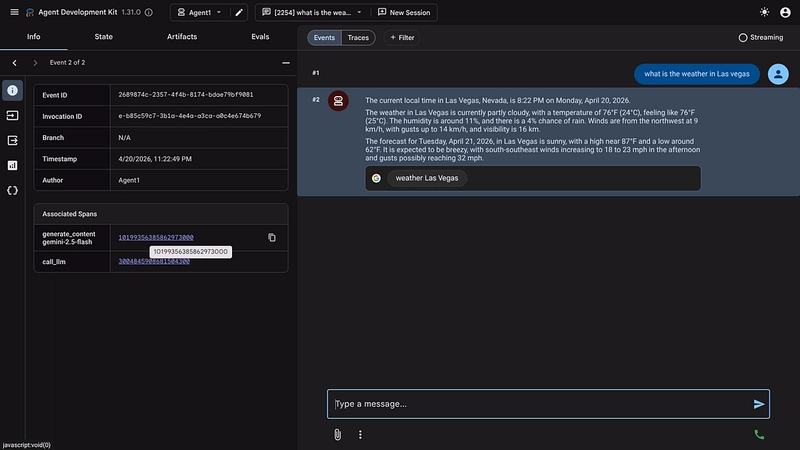
To test the Comic Agent Flow- select Agent 3. This will generate the Comic by using a multi-agent pipeline:

Run the Online Viewer
Once Agent3 has completed — the artifacts are available on the deployment:
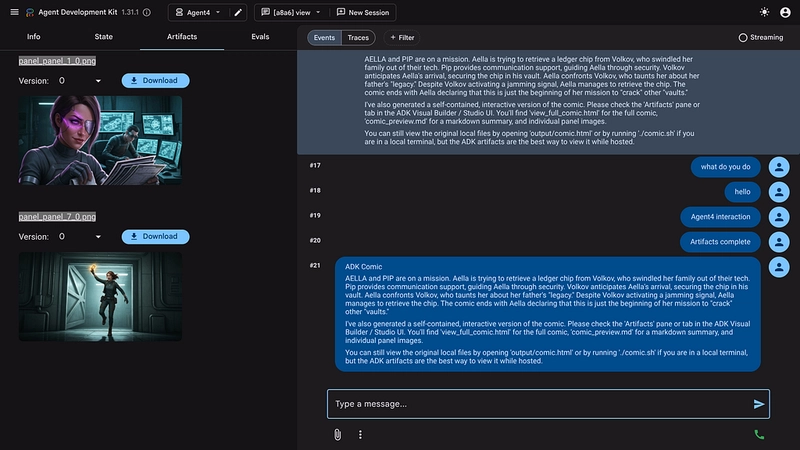
View the Final Artifacts
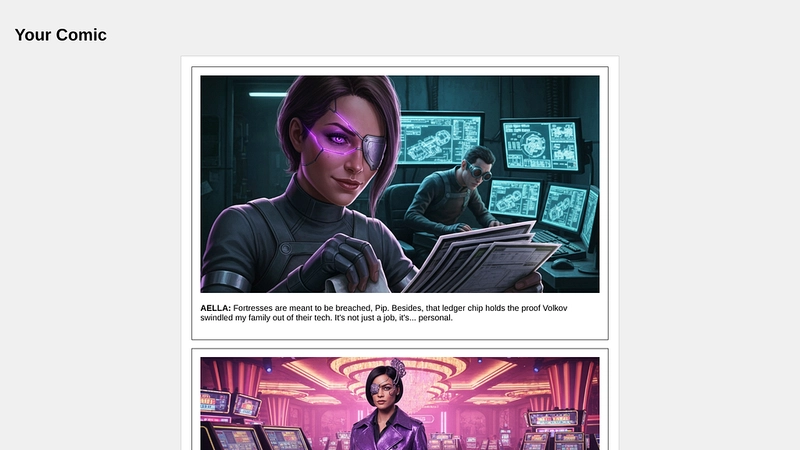
You can use the final comic.html visualize the results of the agent pipeline:
Summary
The Agent Development Kit was used to visually define a multi Agent pipeline to generate comic book style HTML. This Agent was tested locally with the CLI and then with the ADK web tool. Then, several sample ADK agents were run directly from the Lambda deployment in AWS. This approach validates that cross cloud tools can be used — even with more complex agents.