




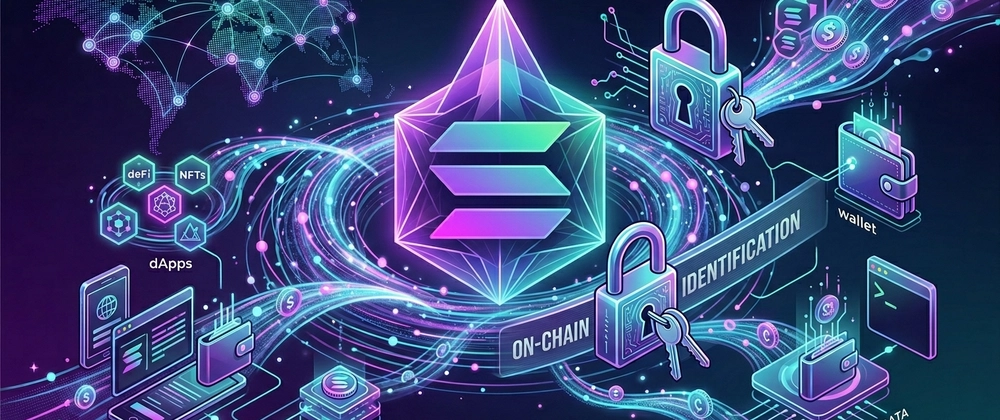

From Web2 to Web3, identity remains an important aspect for authentication and authorization for both users and the server owners. However, the underlying architecture is shifting. In Web2, we rely on usernames and passwords stored on server owner’s hardware or handled by SSO vendors like Auth0, Google or Microsoft. On the other hand, in Web3 we swap databases for cryptographic keys. In this post, we’ll dive into how the Solana network uses these keys for On-Chain Identification.
The Key-pair: Your New Credentials
Solana is a high-performance network powering decentralized finance (DeFi), NFTs and decentralized applications (dApps). Unlike traditional systems where a server “owns” your identity, Solana uses a Public Key as your unique address.
Think of it this way:
- Public Key (Your Username): A unique 32-byte address. This is what people use to send you tokens.
- Private Key (Your Password): A digital signature that stays on your personal device. You use this to “sign” and authorize transactions.
Ed25519 vs. PDAs
Wallets usually use the Ed25519 digital signature, with the exception of Multisig Wallets or Smart wallets (Escrows, etc..), When you create an account, it must be accompanied by a private key that you or a secure third-party vendor maintains.
Solana uses PDAs (Program Derived Addresses), which are unique addresses that is not associated with a private key. Instead, they rely on a Program ID and specific seeds like user ID or user public key for authentication. This allows programs to programmatically sign for accounts. We can think of it like a service account in a cloud environment.
Beyond Usernames: What Identity Enables
On-chain identity isn’t just a replacement for a login, it’s a self-custodied foundation for:
- Token Ownership: Providing what assets you hold.
- Governance: Your right to vote on protocol changes.
- Reputation: Your history on the public ledger is permanent and verifiable.
Because this is cryptographic, it works across every application on the network without needing server permission or an API integration. Your identity allows you to be discovered on the network, receive tokens, and maintain a wallet assignment globally.
The Math: SOL and Lamports
Once you have your identity, you’ll interact with SOL, Solana’s native cryptocurrency. Programmatically, we don’t usually work in whole SOL, we work in Lamports. Lamports are SOL’s smallest fractional unit.
1 SOL = 1,000,000,000 (10⁹) Lamports.
Think of Lamports as cents or pennies and SOL as dollars. This allows for high-precision transactions without the floating-point errors we try to avoid in financial code.
Conclusion: Who Owns The Server?
The biggest shift from Web2 to Web3 is ownership. In Web2, there is one true owner: the entity hosting the servers. In Web3, the network is decentralized and hosted across the globe.
I’m currently participating in the 100 Days of Solana challenge hosted by Major League Hacking (MLH). If you’re a developer looking to move from centralized databases to the blockchain, I highly encourage you to join!
I’d love to hear your feedback on this research in the comments below.
Image Generated By A.I