




What happens when a team ships a million lines of code without writing a single line by hand?

Editor’s Note: This article is based on verified engineering blogs from OpenAI, Anthropic, and Mitchell Hashimoto (2025–2026). All references are linked at the end.
Editor’s Note: This article is based on verified engineering blogs from OpenAI, Anthropic, and Mitchell Hashimoto (2025–2026). All references are linked at the end.
In February 2026, OpenAI engineers revealed they had shipped a million-line codebase in five months — with zero manually-written code. All of it was generated by Codex agents.
When I first read about this experiment, my feelings were complicated. Three engineers, five months, one million lines of code — all written by AI. As someone who’s written code for years, I had to ask: If AI can write code by itself, what’s left for us?
It wasn’t until I understood Harness Engineering that I found the answer:
AI is not replacing engineers; it’s forcing us to level up — from “craftsmen” to “system designers.”
What Is Harness Engineering?
“Harness” originally means horse tack — equipment that both constrains a horse and enables it to pull a cart. You can’t let the horse run wild, but you can’t tie up its legs either. You give it direction.
Mitchell Hashimoto (HashiCorp founder) applied this to AI engineering in early 2026:
“I don’t know if there is a broad industry-accepted term for this yet, but I’ve grown to calling this ‘harness engineering.’ It is the idea that anytime you find an agent makes a mistake, you take the time to engineer a solution such that the agent never makes that mistake again.”
“I don’t know if there is a broad industry-accepted term for this yet, but I’ve grown to calling this ‘harness engineering.’ It is the idea that anytime you find an agent makes a mistake, you take the time to engineer a solution such that the agent never makes that mistake again.”
Traditional debugging: “Something broke, fix it.”
Harness Engineering: “Something broke, build a system to prevent it from happening again.”
For example: If AI keeps calling an API incorrectly, don’t just remind it. Write code that requires API calls to pass type checking — encode human judgment into system constraints.
The core of Harness: Not predicting what mistakes AI will make, but designing an environment where mistakes are hard to occur.
OpenAI’s Experiment: Zero Human-Written Code
In August 2025, a three-person team at OpenAI set a rule: No writing any code — all left to Codex.
The Challenge
Early progress was slower than expected. Not because AI was incapable, but because the environment wasn’t ready. The team spent time not on “using AI,” but on “making AI usable.”
Key insight:
When AI fails, don’t just “let it try again.” Ask: “What capability is missing? How can we make this executable and verifiable?”
When AI fails, don’t just “let it try again.” Ask: “What capability is missing? How can we make this executable and verifiable?”
Three Core Designs
- Progressive Context Management
AI’s context window is limited. OpenAI used structured files like claude-progress.txt to pass state between sessions. Like a relay race baton—each AI reads what the previous "shift colleague" accomplished.
- Feature List: Letting AI Know “It’s Not Done”
AI has a bad habit: thinking it’s done after half the work. The Initializer Agent breaks requirements into 200+ small features, each marked “incomplete.” Coding Agents take one at a time, only changing status after completion.
- Self-Check Mechanism
They equipped AI with Puppeteer (browser automation), letting it interact with its own application — clicking, screenshotting, verifying functionality. Not checking if code is correct, but if the thing actually works.
Results
After five months:
1,500 PRs, all AI-generated
3.5 PRs per engineer per day
Single AI sessions running 6+ hours (often while humans slept)
By the later stages, AI could complete features end-to-end:
Reproduce bug → Record video → Fix bug → Verify → Open PR → Respond to feedback → Merge
Reproduce bug → Record video → Fix bug → Verify → Open PR → Respond to feedback → Merge
This is autonomous software engineering.
Anthropic’s Deep Exploration: Generator + Evaluator
OpenAI proved feasibility. Anthropic went further with harness design for long-running agents.
The Core Challenge
As Anthropic researcher Justin Young noted:
“Imagine a software project staffed by engineers working in shifts, where each new engineer arrives with no memory of what happened on the previous shift.”
“Imagine a software project staffed by engineers working in shifts, where each new engineer arrives with no memory of what happened on the previous shift.”
Every time the context window fills and resets, AI gets amnesia. Anthropic’s solution: “structured handoff” — designing documentation so the next AI can quickly take over.
GAN-Inspired Architecture
Prithvi Rajasekaran from Anthropic Labs designed a Generator + Evaluator dual-agent system, inspired by GANs (Generative Adversarial Networks).
Key discovery: If AI evaluates its own work, it’s lenient — clearly mediocre, but says “pretty good.” Split evaluation into an independent agent, and things change.
Frontend design experiment:
Generator: Produces design drafts
Evaluator: Operates the page using Playwright, scoring on design quality, originality, craftsmanship, functionality
One prompt addition made a difference: “The best designs should be museum quality.” The generator started producing surprisingly creative effects — including once restructuring a Dutch art museum’s website into a 3D spatial experience with walkable exhibition halls.
Full-Stack Application
Rajasekaran expanded to a three-agent system:
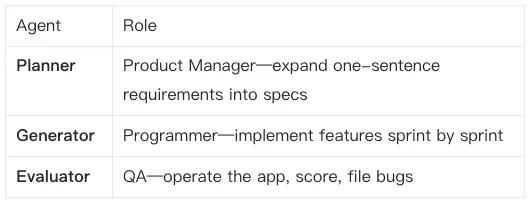
Key: Contract — before each iteration, Generator and Evaluator negotiate “what counts as done.”
Test: Build a “retro game maker.”
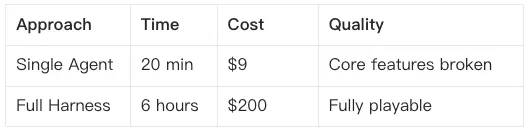
The gap was not small.
The Deeper Logic: Three Paradigm Shifts
1. From “Writing Code” to “Designing Systems”
Traditional growth path: learn to write code → design modules → architect systems.
Harness Engineering reverses this: You must first know how to design systems to use AI for writing code effectively.
This is upgrading, not downgrading. From “craftsman” to “factory designer” — you’re not making less, but what you make has more leverage.
2. “Constraints” Become Creation
Adding constraints to AI doesn’t limit it — clear constraints make AI more creative.
Anthropic’s “museum quality” standard made AI strive in that direction. OpenAI’s architecture constraints let AI write code boldly without breaking things.
Like jazz chord progressions — having the framework lets musicians improvise confidently.
3. Quality Control Paradigm Shift
From the OpenAI team:
“Humans may review pull requests, but aren’t required to. Over time, we’ve pushed almost all review effort towards being handled agent-to-agent.”
“Humans may review pull requests, but aren’t required to. Over time, we’ve pushed almost all review effort towards being handled agent-to-agent.”
AI is reviewing code written by AI. Not because humans got lazy, but because throughput is too high. When AI opens 3.5 PRs per day, humans can’t review them all.
Quality control shifts from “checking every line” to “designing mechanisms for AI self-verification.”
If AI can operate browsers, run tests, and verify functionality — why can’t it review code?
What This Means for Developers
Don’t Panic, But Don’t Wait
Harness Engineering doesn’t mean programmers become unemployed. Those three OpenAI engineers weren’t replaced — they changed their way of working from “people who write code” to “people who design systems and control quality.”
But this transformation won’t wait until you’re ready.
“Boring” Technologies Win
The OpenAI team prefers “boring” technologies — stable APIs, comprehensive documentation, high composability. AI performs better in predictable environments.
Future tech selection: React over Svelte (more documentation), Python over Rust (more training data). Not exciting, but practical.
Soft Skills Become More Valuable
If AI writes code, what’s more valuable?
System Design: Breaking down problems, defining interfaces
Product Sense: Turning vague requirements into clear definitions
Quality Judgment: Knowing “good” versus “just runs”
AI Management: Which tasks suit AI, which need humans
These aren’t new skills, but their importance is changing.
The Future: Orchestrating Agents
Industry trends through 2025–2026 show software engineering shifting from “writing code” to “orchestrating agents.”
Harness Engineering provides a framework: not treating AI as a black box, but as a system component to be designed.
You’re not “conversing” with AI; you’re collaborating — like conducting an orchestra, or managing a team.
Future software engineers may be more like “directors” or “conductors”: not playing every note, but determining the direction and style of the entire piece.
Is this good? I don’t know. But this is what’s happening.
Final Thoughts
If AI can write code by itself, what can programmers do?
We can design systems that let AI write code.
This is not escape — this is evolution.
Harness Engineering doesn’t make engineers lazy; it makes engineers stronger — using system power instead of individual power, design capability instead of coding capability.
Perhaps this is what software engineering was always meant to be.
Your Turn
Where is your AI pipeline breaking first?
Ingestion?
Retrieval?
Evaluation?
Cost control?
Share your experience in the comments. The best harness designs come from real war stories, not textbook theory.
Enjoyed this? Follow for more on AI infrastructure, agentic coding, and the future of software engineering.
References
OpenAI (Feb 2026). “Harness engineering: leveraging Codex in an agent-first world.” https://openai.com/index/harness-engineering/
Hashimoto, Mitchell (2026). “My AI Adoption Journey.” https://mitchellh.com/writing/my-ai-adoption-journey
Fowler, Martin (Feb 2026). “Harness Engineering — first thoughts.” https://martinfowler.com/articles/exploring-gen-ai/harness-engineering-memo.html
Anthropic (Nov 2025). “Effective harnesses for long-running agents.” https://www.anthropic.com/engineering/effective-harnesses-for-long-running-agents
Anthropic (2026). “Harness design for long-running application development.” https://www.anthropic.com/engineering/harness-design-long-running-apps