








Why Your Servo Installation Twitches Before It Starts
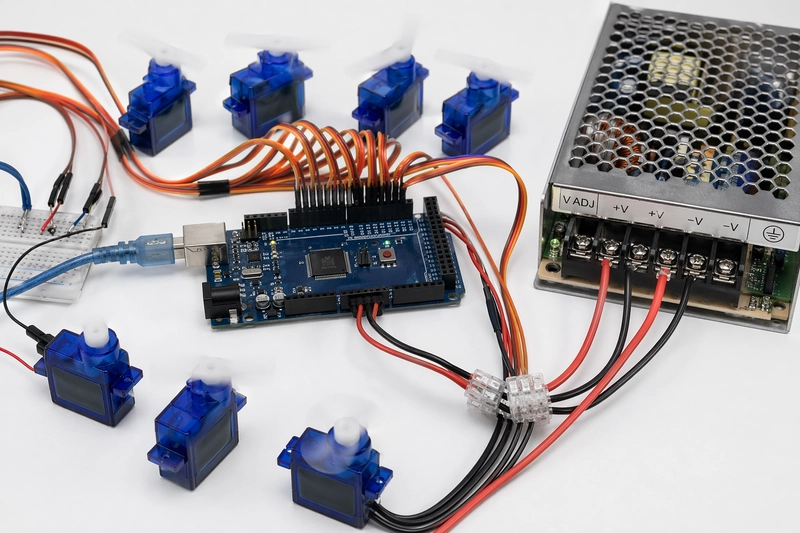
A maker on Arduino Stack Exchange had 48 SG90 servos connected through two Arduino Mega boards and six breadboards. The symptom was simple: some servos were ticking, delayed, and jittered when the computer was unplugged.
Another maker on Electronics Stack Exchange had a competition robot that moved its servos to random positions at startup. That tiny startup twitch would disqualify the robot before the real behavior even began.
This is the part most tutorials skip.
A servo project can have correct code and still feel nervous. The problem is not only angle control. It is startup behavior, power architecture, and whether the object has permission to move yet.
The mistake: treating servo.attach as harmless
Most beginner sketches do this:
#include <Servo.h>
Servo armServo;

void setup() {
  armServo.attach(9);
  armServo.write(90);
}
That looks clean. But at power-up, the servo may see noise, a weak rail, or a control pulse before the system is ready. The horn twitches. The object looks startled.
For a desk toy, this is annoying. For a kinetic sculpture, it looks cheap. For a robot in a competition, it can be an instant failure.
The design rule is simple:
Do not let the actuator move before the interaction has a state.
The real fix has three parts
1. Give servos their own power
Do not power multiple SG90 or MG996R servos from the Arduino 5V pin. Use a separate 5V supply sized for stall current, then connect the supply ground to Arduino ground.
Wiring:
- Servo red wire to external 5V
- Servo brown or black wire to external GND
- Arduino GND to external GND
- Servo signal wire to Arduino pin 9
If the grounds are not shared, the signal has no stable reference. If the supply is weak, the servo jitters when the load changes.
2. Hold the signal quiet until ready
Do not attach and command the servo as the first action. Let power settle, define your safe position, then attach.
3. Move into position slowly
A jump to 90 degrees is not neutral to the viewer. It looks like a panic response. A controlled ramp feels intentional.
Minimal startup-safe sketch
#include <Servo.h>
Servo armServo;

const int servoPin = 9;
int currentAngle = 90;

void setup() {
  // 中文區塊:先讓電源穩定,不立刻驅動馬達
  delay(800);

  // 中文區塊:接上伺服控制訊號後,先送安全角度
  armServo.attach(servoPin);
  armServo.write(currentAngle);
  delay(500);
}

void loop() {
  // 中文區塊:用慢速移動取代突然跳動
  moveServoSmoothly(90, 120, 12);
  delay(1000);
  moveServoSmoothly(120, 90, 12);
  delay(1000);
}

void moveServoSmoothly(int startAngle, int endAngle, int stepDelay) {
  int stepValue = startAngle < endAngle ? 1 : -1;
  for (int angle = startAngle; angle != endAngle; angle += stepValue) {
    armServo.write(angle);
    delay(stepDelay);
  }
  armServo.write(endAngle);
}
This does not solve every servo problem. It solves the first emotional problem: the object no longer looks like it is surprised by its own power switch.
What changes in the interaction
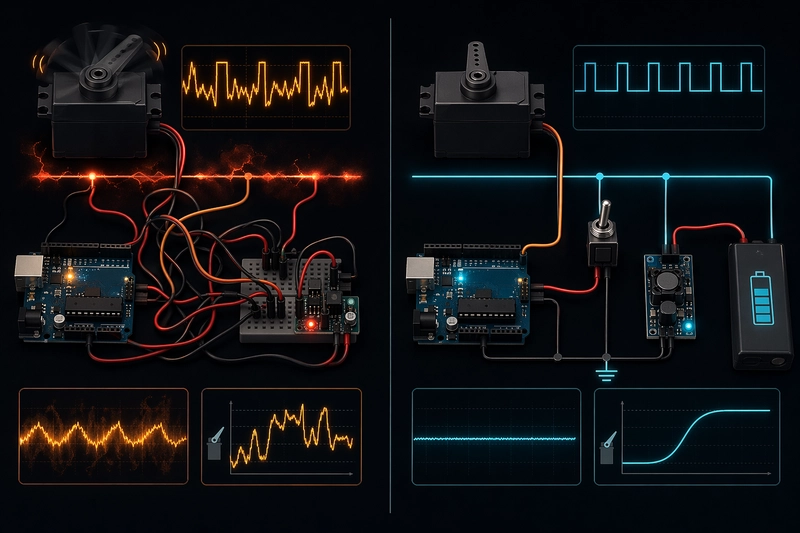
A twitch says:
The machine woke up before it knew what it was doing.
A controlled startup says:
The machine is waiting, then choosing to move.
That difference is why servo timing matters in interactive work. The viewer does not see your power rail. They see hesitation, confidence, or panic.
If your servo project feels cheap, check these before rewriting your whole sketch:
- Is the servo powered from a separate 5V supply?
- Is Arduino GND connected to servo supply GND?
- Does the code wait before attach and first command?
- Does motion ramp instead of jump?
- Is the mechanical load within the servo torque rating?
Start with the right parts
For small interactive builds:
- SG90 Micro Servo: good for lightweight prototypes and motion studies. Amazon
- MG996R Metal Gear Servo: better when the mechanism has load or people might touch it. Amazon
- Dedicated 5V 2A Power Supply: separate servo power prevents many twitch and reset problems. Amazon
I earn from qualifying purchases.
The takeaway
Servo jitter is not just a mechanical issue. It is a design issue.
A servo that twitches at startup tells the viewer the object is uncontrolled. A servo that waits, receives a state, and moves smoothly tells the viewer the object has intention.
The code is small. The feeling is not.