
惯性聚合 高效追踪和阅读你感兴趣的博客、新闻、科技资讯
阅读原文 在惯性聚合中打开

推荐订阅源

TaoSecurity Blog
TaoSecurity Blog
OSCHINA 社区最新新闻
OSCHINA 社区最新新闻
F
Fortinet All Blogs
Cisco Talos Blog
Cisco Talos Blog
D
Darknet – Hacking Tools, Hacker News & Cyber Security
S
Secure Thoughts
美团技术团队
雷峰网
雷峰网
Hugging Face - Blog
Hugging Face - Blog
博客园_首页
C
CXSECURITY Database RSS Feed - CXSecurity.com
Engineering at Meta
Engineering at Meta
人人都是产品经理
人人都是产品经理
月光博客
月光博客
T
Tor Project blog
P
Privacy & Cybersecurity Law Blog
Recorded Future
Recorded Future
I
Intezer
博客园 - 【当耐特】
钛媒体:引领未来商业与生活新知
钛媒体:引领未来商业与生活新知
GbyAI
GbyAI
罗磊的独立博客
V
V2EX
Google DeepMind News
D
DataBreaches.Net
Last Week in AI
Last Week in AI
T
Tailwind CSS Blog
www.infosecurity-magazine.com
A
About on SuperTechFans
Scott Helme
Scott Helme
Vercel News
Vercel News
Spread Privacy
Spread Privacy
T
Threat Research - Cisco Blogs
Recent Announcements
Hacker News: Ask HN
Hacker News: Ask HN
C
CERT Recently Published Vulnerability Notes
G
Google Developers Blog
B
Blog
博客园 - 叶小钗
WordPress大学
WordPress大学
博客园 - 聂微东
Threat Intelligence Blog | Flashpoint
Jina AI
Jina AI
IT之家
IT之家
C
Cybersecurity and Infrastructure Security Agency CISA
P
Palo Alto Networks Blog
小众软件
小众软件
博客园 - Franky
Microsoft Azure Blog
AWS News Blog
AWS News Blog

DEV Community

Authentication Security Deep Dive: From Brute Force to Salted Hashing (With Java Examples) Why AI Systems Don’t Fail — They Drift Spilling beans for how i learn for exam😁"Reinforcement Learning Cheat Sheet" I Replaced Chrome with Safari for AI Browser Automation. Here's What Broke (and What Finally Worked) How Python Borrows Other People's Work The $40 Architecture: Processing 1 Billion API Requests with 99.99% Uptime Vibe Coding: A Workflow Guide (From Zero to SaaS) Most webhook security guides protect the wrong side. The scary part is delivery. Headless CMS for TanStack Start: Build a Blog with Cosmic EU Age Verification App "Hacked in 2 Minutes" — What Actually Happened Comfy Cloud’s delete function does not actually remove files Running AI Models on GPU Cloud Servers: A Beginner Guide Event-driven media intelligence with AWS Step Functions and Bedrock I scored 500 AI prompts across 8 quality dimensions — here's what broke How to Call Google Gemini API from Next.js (Free Tier, No Backend Needed) The Portal Protocol: Reclaiming Human Connection in the Age of AI How to Fix Your Team's Scattered Knowledge Problem With a Self-Hosted Forum Intro to tc Cloud Functors: A Graph-First Mental Model for the Modern Cloud Designing Multi-Tenant Backends With Both Ownership and Team Access I Built a Neumorphic CSS Library with 77+ Components — Here's What I Learned PostgreSQL Performance Optimization: Why Connection Pooling Is Critical at Scale Cómo construí un SaaS multi-rubro para gestionar expensas en Argentina con FastAPI + Vue 3 🚀 I Built an Ethical Hacking Scanner Tool – Open Source Project I Replaced /usage and /context in Claude Code With a Single Statusline A Pythonic Way to Handle Emails (IMAP/SMTP) with Auto-Discovery and AI-Ready Design I Collected 8.9 Million Polymarket Price Points — Here's What I Found About How Markets Really Move EcoTrack AI — Carbon Footprint Tracker & Dashboard Everyone's Using AI. No One Agrees How. 5 self-hosted ebook managers worth trying in 2026 Building Your First AI Agent with LangChain: From Chatbot to Autonomous Assistant Common SOC 2 Failures (Real World) Stop Vibe-Checking Your AI App: A Practical Guide to Evals How to Use SonarQube and SonarScanner Locally to Level Up Your Code Quality Your Next To-Do App Is Dead — I Replaced Mine with an OpenClaw AI Sign a Nostr event in 60 lines of Python using coincurve — no nostr-sdk, no nbxplorer, no rust toolchain ITGC Audit Explained Like You’re in Big 4 Patch Tuesday abril 2026: Microsoft parcha 163 vulnerabilidades y un zero-day en SharePoint Stop scraping everything: a better way to track competitor price changes Listing on MCPize + the Official MCP Registry while routing payments OUTSIDE the marketplace — how I kept 100% of my x402 revenue Building an AI-Powered Risk Intelligence System Using Serverless Architecture Why We Ripped Function Overloading Out of Our AI Toolchain Testing AI-Generated Code: How to Actually Know If It Works SaaS Churn Is Killing Your Business. Here Is What to Do About It (Without a Support Team) The Speed of AI Is No Longer Linear - And Self-Improving Models Are Why How to Implement RBAC for MCP Tools: A Practical Guide for Engineering Teams From Standard Quote to Persuasive Proposal: AI Automation for Arborists I built a CLI that scaffolds complete multi-tenant SaaS apps Axios CVE-2025–62718: The Silent SSRF Bug That Could Be Hiding in Your Node.js App Right Now The dashboard that ended our friendship Data Pipelines Explained Simply (and How to Build Them with Python) The Hidden Cost of AI Systems Nobody Talks About. undefined vs undeclared, and how typeof behaves Switching from file-based jobs to NATS/Kafka in Rust without changing code io_uring Adventures: Rust Servers That Love Syscalls Why Agentic AI is Killing the Traditional Database The POUR principles of web accessibility for developers and designers Quantum Neural Network 3D — A Deep Dive into Interactive WebGL Visualization How To Install Caveman In Codex On macOS And Windows Automation Pipeline Reliability: Why Your Workflow Breaks When Nobody Is Watching I Built an 'Open World' AI Coding Agent — It Works From ANY Folder From Freelancing to Product: A Tech Service Company's SaaS Transformation China's AI Giants: Adding Tencent Hunyuan & ByteDance Doubao to AI University (74 Providers) On the Vibe Coders and Their Lies clerk: Auto-Summarize Your Claude Code Sessions AI Weekly — 2026/04/10–04/17 | The Model Lockdown Is Here, but the Toolchain Is the Real Battleground AI 週報 — 2026/04/10–2026/04/17 模型封鎖潮來了,但工具鏈才是真戰場 Maybe this is how Open-Source apps are born... 🚀 Fine-Tune LLMs with LoRA and QLoRA: 2026 Guide tRPC v11 + Next.js App Router: End-to-End Type Safety Without the Boilerplate ShadCN UI in 2026: Why I Stopped Installing Component Libraries and Started Owning My Components SaaS Billing in React Server Components: Stripe + Supabase Without a Single `useEffect` Join our DEV Weekend Challenge — $1,000 in Prizes Across TEN winners! Submissions Due April 20 at 6:59 AM UTC. Implementing FSRS Spaced Repetition in Flutter + Supabase — Adding Memory Science to an AI Learning App "I Texted My Localhost From the Train — Claude Code Fixed the Bug Before I Got Home" I Built a Sales Prep AI and It Went Deeper Than Expected Design to Code #2: One JSON, Eleven Outputs Solving the 100M-Row Problem: A Summary Table Pattern for High-Volume Push Notification Logs Flutter Web With Wasm: What Actually Changes For Developers I Built 50 Royalty-Free Soundtracks for My Side Project in a Weekend Using AI Music Generation The Vibe Coding Security Checklist: 7 Things to Check Before You Ship Stop Letting Googlebot Guess Fix Your React App's SEO Right Desconstruindo o Streaming do LinkedIn: Como Criar um Engine de Extração de Vídeo de Alta Performance com HLS e FFmpeg (EDA Part-1) EDA (Exploratory Data Analysis) Explained With Real Life — Why Looking at Your Data Is the Most Important Step in Machine Learning Brand Relationship Management at Scale: Our 4-Touch Outreach System for 200+ Brands Why String.fromEnvironment() Might Return an Empty String in Dart JGuardrails 1.0.0 — Hardening Java LLM Apps Against Jailbreaks, Toxicity, and Prompt Injection Plan and Schedule a Full Week of Threads Content From One Claude Conversation Coding Cat Oran Ep3, Five Tables Changed Everything Updated: BFF Pattern I'm done watching freelancers get buried by 200 proposals. So I'm building the alternative. This is my first post BFS Algorithm in Java Step by Step Tutorial with Examples Tracking LLM Pricing Monthly: An Open Dataset for 22 AI Models How We Measure Content ROI on a Comparison Site: Revenue Attribution Without Perfect Data Introducing Nova AI Ops: The AI-Native Operating System for SRE Teams I built a free desktop video downloader for Windows — Grabbit How Talkie OCR Helps Vision-Impaired & Dyslexic Users Read the World Around Them VRCFaceTracking安装和iPhone面捕配置教程,有bug Even CrowdStrike Can't See Your Agents The Automation Gold Rush: What n8n Workflows and Claude Are Opening Up for Developers Right Now
Segurança em nuvem na prática: o que aprendi sobre misconfiguration com Datadog
Diogo Maske · 2026-04-28 · via DEV Community

🇧🇷 O artigo está em PT-BR, fique à vontade para traduzir.
🇺🇲 The article is in PT-BR, feel free to translate it.

☁️☁️☁️

Acabei de terminar o lab Find and Remediate Vulnerable Cloud Resources with Cloud Security Misconfigurations do Datadog Learning Center. E dessa vez o assunto foi segurança, um tema que eu sempre achei meio abstrato até colocar a mão na massa.

Antes de começar, quero deixar claro que não sou especialista em segurança. Então esse curso foi um dos meus primeiros contatos reais com o lado de Cloud Security. Vou contar o que entendi, com a cabeça de quem estava aprendendo do zero.
Arquitetura

O problema que o curso apresenta

Imagine que sua empresa roda centenas de recursos na AWS, buckets S3, instâncias EC2, funções Lambda, roles IAM, políticas de rede... Como você garante que todos estão configurados corretamente do ponto de vista de segurança?

A resposta honesta é: manualmente você não garante. É inviável. Uma role IAM com permissões a mais, um bucket S3 com acesso público habilitado, cada um desses parece pequeno isoladamente, mas qualquer um pode ser o ponto de entrada de um ataque.

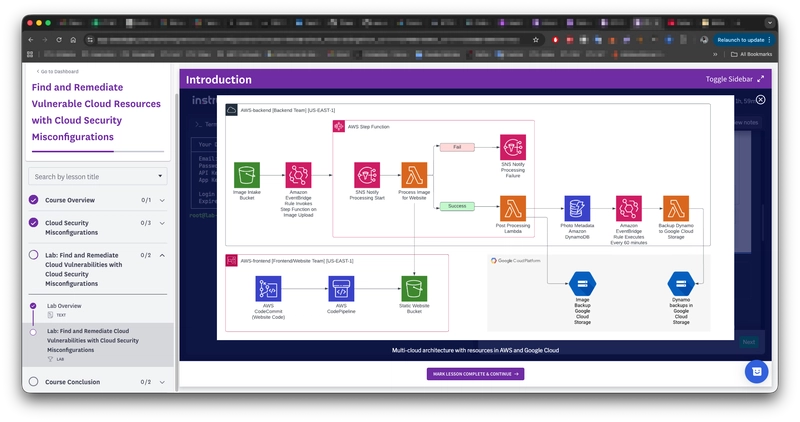
O lab usou um app fictício com arquitetura multi-cloud (parte na AWS, parte no Google Cloud) justamente pra simular esse cenário caótico de verdade. Tinha bucket de imagens, pipeline de CI/CD, DynamoDB com backup... uma bagunça organizada, como é na vida real.


O que é uma misconfiguration, afinal?

Uma misconfiguration é basicamente uma configuração que está tecnicamente funcionando, mas que abre uma brecha de segurança. Não é um bug no código, é uma escolha de configuração errada ou esquecida.

Alguns exemplos que apareceram no lab:

  • Um bucket S3 sem versionamento habilitado. Isso significa que se alguém apagar ou sobrescrever um arquivo por acidente — ou de propósito — não tem como recuperar.
  • Uma policy IAM no GCP que permitia acesso anônimo a um bucket de storage. Qualquer pessoa na internet poderia acessar o conteúdo sem autenticação.
  • MFA não habilitado na conta root da AWS. A conta com mais permissões de todas, sem segunda camada de autenticação.

Cada um desses tem severidade diferente. O bucket público era HIGH. O S3 sem versionamento era LOW. E o Datadog já vem com centenas de regras prontas pra detectar esses casos automaticamente, sem você precisar escrever nada.
misconfiguration

Como o Datadog organiza tudo isso

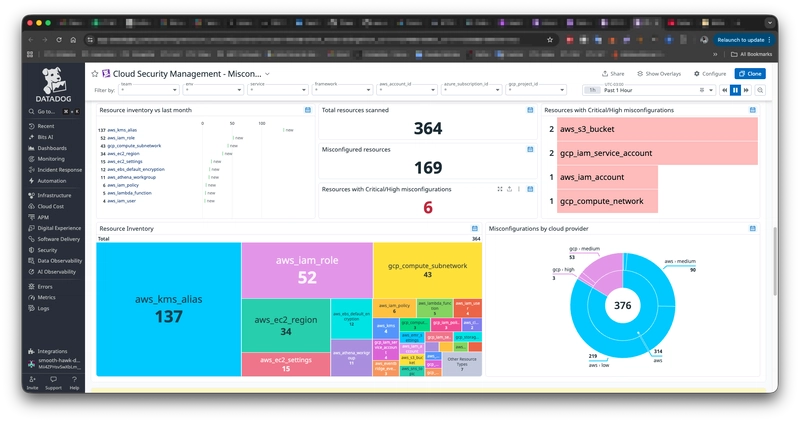
A primeira coisa que me chamou atenção foi o dashboard de Misconfigurations. Num único lugar você vê: 364 recursos escaneados, 169 com alguma misconfiguration, 6 com severidade Critical ou High. Tem até um treemap mostrando a distribuição por tipo de recurso, dava pra ver de cara que aws_kms_alias tinha 137 ocorrências e aws_iam_role tinha 52.

Em vez de ficar caçando problema por problema, você tem uma visão de inventário: onde estão os riscos maiores, quais recursos são novos, o que mudou no último mês.

O Misconfigurations Explorer é onde você investiga cada item. Você filtra por severidade, cloud provider, tipo de recurso, status de triage. Quando abre uma misconfiguration específica, ela mostra: o que aconteceu, desde quando está falhando, em qual recurso exatamente, e o que eu achei mais útil, um botão de Remediation Steps com o passo a passo pra corrigir.

Tem ainda o Security Inbox, que funciona como uma fila priorizada das coisas mais urgentes pra resolver. Pensa como um backlog de segurança, onde o Datadog já fez a triagem inicial pra você. Bizarro haha


Detection Rules: onde mora a inteligência

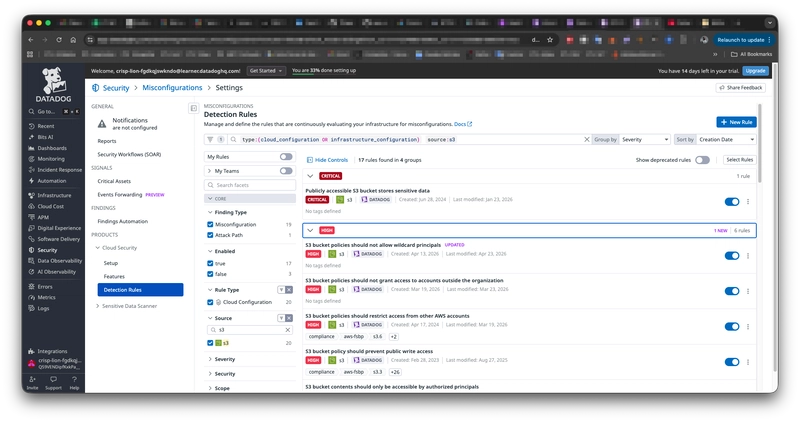
Por baixo de tudo isso estão as Detection Rules,as regras que definem o que é considerado uma misconfiguration. O Datadog já vem com mais de 1.000 regras prontas, mantidas pela equipe deles. No lab, explorei as regras específicas pra S3 e vi que tinha desde uma regra CRITICAL ("bucket S3 publicamente acessível com dados sensíveis") até regras HIGH cobrindo wildcard principals, acesso entre contas, escrita pública.

O interessante é que você também pode criar regras customizadas. Se sua empresa tem uma política interna específica, tipo "todo bucket de produção precisa ter tag de owner" você pode escrever isso como uma regra e o Datadog passa a monitorar automaticamente.
Dashboard

O que ficou de lição

Segurança em nuvem sempre pareceu pra mim uma área separada, de especialistas. Depois desse lab, minha visão mudou um pouco. Não porque ficou fácil, mas porque ficou mais concreto.

Misconfiguration não é um problema abstrato. É o acúmulo de pequenas decisões que, juntas, criam uma oportunidade de ataque real.

O que o Datadog faz é tornar esse acúmulo visível e dar um caminho claro pra resolver. Pra quem está começando na área de DevOps ou SRE, entender que segurança também é responsabilidade do time de infraestrutura (e não só do time de segurança) foi a maior virada de chave desse lab.