


Building LLM-powered applications starts simple.
You pick a model, connect an API, and ship a feature. Maybe it’s a chatbot, a summarizer, or an internal tool. At this stage, everything feels manageable.
Then things grow.
Another team wants to use a different model. Someone asks for cost tracking. Security wants to know where data is going. A provider has an outage, and suddenly your system depends on a single external service.
What started as a straightforward integration turns into a scattered setup of API keys, inconsistent logging, and unclear ownership.
This is where AI Gateways come in.
They’re not just another layer of infrastructure they’re what make LLM systems manageable once you move beyond a single team or use case.
In this article, we’ll break down what to look for in an AI Gateway and compare seven platforms that teams are using today.
What an AI Gateway Actually Does
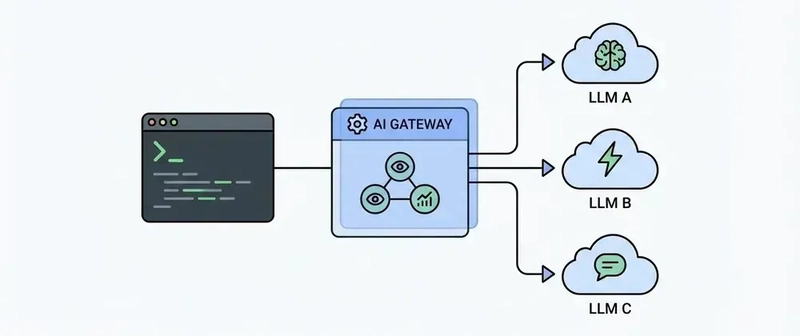
At a high level, an AI Gateway sits between your applications and your model providers.
Instead of every service directly calling OpenAI, Anthropic, or other providers, all traffic flows through a centralized layer.
That layer handles:
- Routing requests across models and providers
- Authentication and access control
- Rate limiting and per-team budgets
- Token-level cost tracking
- Guardrails (PII filtering, prompt injection detection)
- Observability (logs, metrics, tracing)
Think of it as the control point for everything related to LLM usage.
Without it, each team builds its own logic. With it, everything becomes centralized, consistent, and easier to manage.
What to Look for in an AI Gateway
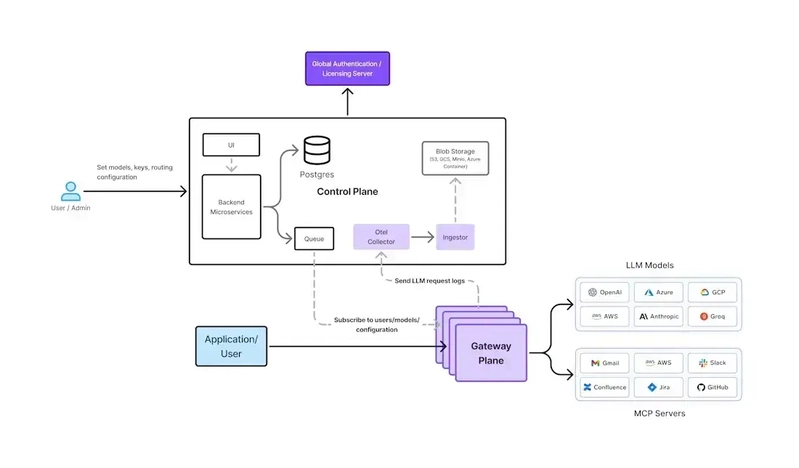
Not all gateways solve the same problems, and this becomes obvious once you start using them in real systems rather than just reading about them.
Some platforms focus heavily on routing between models. Others act more like aggregation layers for APIs. A smaller group is designed with production-scale requirements in mind, where governance, cost control, and reliability actually matter.
In practice, the differences only become clear when you start evaluating them against real system needs like multiple teams, multiple models, and production traffic.
When evaluating platforms, here are the things that actually matter in practice:
1. Multi-Model Routing
You should be able to switch between providers or route traffic dynamically without changing application code.
2. Cost Visibility
LLM usage is priced per token. Without visibility, costs become unpredictable quickly.
A good gateway gives you:
- Cost per request
- Cost per team
- Cost per model
3. Guardrails and Safety
Production systems need protection against:
- PII leaks
- Prompt injection
- Unsafe outputs
This should be enforced centrally, not in every service.
4. Observability
You need to understand:
- What prompts were sent
- What responses were returned
- Where latency or failures occur
Without this, debugging becomes guesswork.
5. Access Control
As teams grow, you need to define:
- Who can use which models
- Which services can access which tools
6. Deployment Flexibility
For many teams, data cannot leave their environment.
Look for support for:
- VPC deployments
- On-prem setups
- Multi-cloud environments
7. Performance Overhead
A gateway sits in the request path, so performance becomes a critical factor in production environments.
- High throughput handling under load
- Minimal added latency per request
- Stable performance even with multiple model calls
- Efficient routing without becoming a bottleneck
7 AI Gateway Platforms for Enterprise AI
Here’s how some of the current platforms compare based on what they’re designed for and where they fit best.
1. TrueFoundry
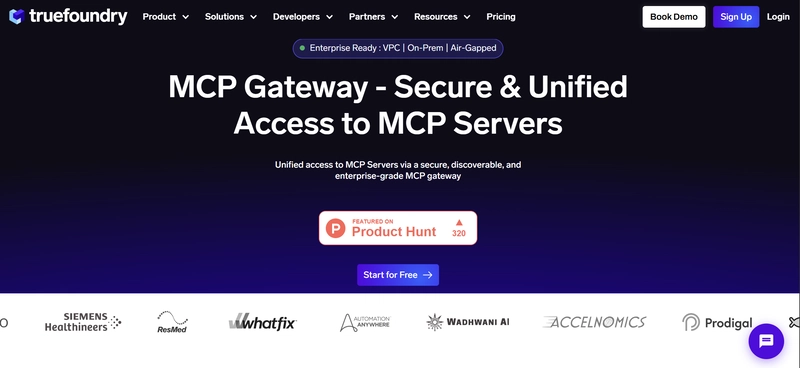
TrueFoundry provides a unified AI Gateway designed for production environments where multiple teams, models, and workflows need to be managed centrally.
Key features
- Unified API across multiple model providers
- Token-level cost tracking and per-team budgets
- Built-in guardrails (PII filtering, prompt injection detection)
- Request-level observability and tracing
- Model fallback across providers
- Deployment options: VPC, on-prem, air-gapped, multi-cloud

Best suited for
- Teams running LLM systems in production
- Organizations with compliance, governance, or cost visibility needs
- Multi-team environments with shared infrastructure
2. AISIX
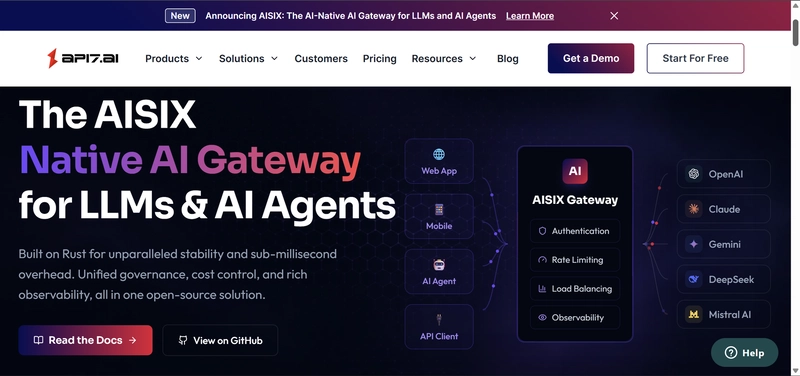
AISIX focuses on AI workflow orchestration, helping teams structure and manage how models and services interact.
Key features
- Workflow-driven AI orchestration
- Integration with multiple AI services
- Structured pipeline management
Best suited for
- Teams building structured AI workflows
- Use cases where orchestration logic is central
- Projects that require coordination across multiple AI services
3. Envoy
Envoy is a high-performance proxy layer widely used in microservices architectures, sometimes extended to handle AI traffic.
Key features
- High-performance request routing
- Advanced traffic control and load balancing
- Proven scalability in distributed systems
Best suited for
- Teams already using Envoy in their infrastructure
- High-throughput environments
- Custom AI gateway implementations built on existing networking layers
4. TokenMix
TokenMix focuses on token usage management and optimization, helping teams understand and control LLM costs.
Key features
- Token usage tracking
- Cost monitoring across model usage
- Optimization insights for LLM consumption
Best suited for
- Teams focused on controlling and analyzing LLM spend
- Cost-sensitive applications
- Early-stage systems needing visibility into token usage
5. Eden AI
Eden AI acts as an aggregation layer, giving access to multiple AI providers through a single API.
Key features
- Unified API for multiple AI providers
- Simplified integration across services
- Broad provider coverage
Best suited for
- Rapid prototyping
- Teams experimenting with multiple AI APIs
- Use cases where ease of integration is a priority
6. AgentGateway.dev
AgentGateway.dev focuses on enabling agent-to-tool communication, particularly in agent-based architectures.
Key features
- Tool integration for AI agents
- Support for agent workflows
- Focus on agent interaction patterns
Best suited for
- Agent-driven applications
- Teams building tool-using AI systems
- Early-stage agent architectures
7. Kagent / Cisco agntcy / Pragatix
These platforms explore enterprise AI infrastructure and agent systems, often integrated into broader ecosystems.
Key features
- Enterprise-focused AI integrations
- Support for agent-based workflows
- Integration with existing enterprise systems
Best suited for
- Large organizations exploring AI at scale
- Teams integrating AI into existing enterprise ecosystems
- Use cases requiring alignment with internal infrastructure
Where Most AI Gateways Fall Short
Looking across these platforms, a pattern starts to emerge.
Most tools solve one part of the problem:
- Routing
- Aggregation
- Cost tracking
- Agent communication
But production systems need all of these working together.
That’s where gaps appear:
- Limited observability across requests
- Weak or missing guardrails
- No centralized governance
- Fragmented tooling across teams
As systems scale, these gaps turn into operational challenges.
Why a Unified Gateway Approach Matters
This is where a unified approach becomes important.
Instead of stitching together multiple tools, some platforms aim to provide a single control plane for AI systems.
TrueFoundry is a good example of this direction.
It doesn’t just handle AI Gateway functionality. It extends into:
- MCP Gateway capabilities for tool access
- Agent Gateway functionality for managing workflows
This matters because real-world systems don’t operate in isolation.
You don’t just route model calls. You:
- Connect agents to tools
- Enforce access policies
- Monitor behavior across workflows
Having all of this in one place reduces fragmentation and makes systems easier to reason about.
Final Thought
MCP addresses a real and growing problem. It standardizes how AI agents interact with tools, reducing the complexity of building integrations and making systems more flexible.
But standardization alone is not enough for production environments.
As soon as multiple teams, tools, and workflows are involved, questions around security, visibility, and control become unavoidable. Who accessed what? Which tool was called? What data was passed? These are not edge cases they are everyday concerns in real systems.
That is where an MCP Gateway becomes necessary.
It adds the operational layer that MCP intentionally leaves out, turning a flexible protocol into something that can be governed, secured, and observed at scale. Without that layer, teams often end up rebuilding the same controls around authentication, logging, and safety just in fragmented ways across services.
This is where platforms like TrueFoundry come in.
By providing a unified MCP Gateway alongside AI and agent gateways, TrueFoundry centralizes how agents interact with tools, how access is controlled, and how every action is tracked. Instead of stitching together multiple systems, teams get a single control point for routing, guardrails, observability, and governance.
The result is not just a cleaner architecture, but a system that is actually manageable in production.
Understanding the difference between MCP and an MCP Gateway is what separates a working demo from a production-ready AI system.
If you’re already dealing with multiple teams, rising costs, or growing infrastructure complexity, introducing a gateway early can save a lot of operational overhead later.
- Try TrueFoundry free → https://truefoundry.com/*
No credit card required. Deploy on your cloud in under 10 minutes.