






I started tracking my work recently.
Not with some system.
Not with some productivity guru method.
Just… writing things down.
Here’s what came out of it.
It wasn’t some big realization.
More like small things… stacking up.
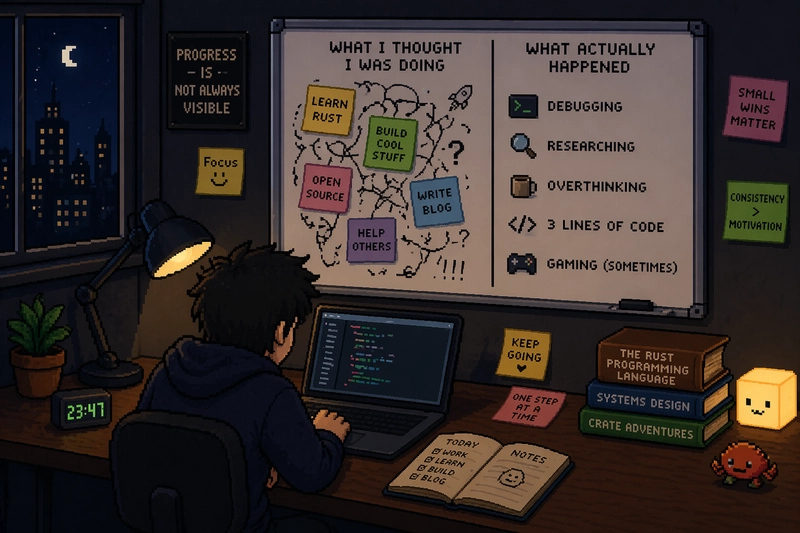
Q: Why did you start tracking your work in the first place?
A:
I think it’s needed.
You need to appreciate your own progress even if nobody else sees it.
Also, I wanted to understand:
At this pace… where am I actually going?
Q: What did you think you were doing well before tracking?
A:
Nothing specific.
But now I think more.
I compare more.
And that makes it easier to decide what’s actually worth doing.
Q: What did tracking immediately prove wrong?
A:
That tracking is some “online coach” thing.
It’s not.
It’s just:
evaluating your own steps without judging yourself.
Just understanding why you made certain decisions.
Friction & Reality
It started to feel like a 20/80 kind of thing.
You see the 20%.
But most of the work lives in the 80%.
Ever had that feeling?
You think you worked all day…
but can’t explain what you actually did.
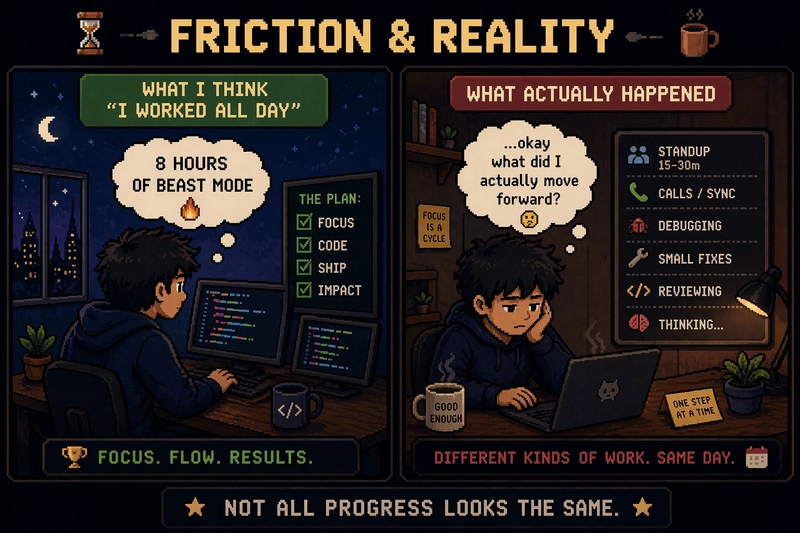
Q: When you say “I worked all day” what does that actually mean?
A:
Depends.
Sometimes “all day” == a few hours of real productivity.
Other times, I can go 8 hours straight on my own projects.
So yeah… “all day” doesn’t mean much by itself.
Q: How much of your time is real output?
A:
At work -> a few hours of focused, real output.
On my own stuff -> I can lock in for much longer.
Different energy.
Patterns I Didn’t Expect
Not in a dramatic way.
Just… quietly.
Q: What pattern kept repeating?
A:
I kept asking myself:
“Why am I not exploring things more?”
I do other hobbies gaming, exploring music, random stuff
but sometimes I skip the kind of work I actually enjoy
(side projects, deeper exploration).
Q: What surprised you about your behavior?
A:
I started questioning how I push myself:
“Am I pushing in the right direction… or just pushing?”
Also had this thought:
maybe I could present something at a Rust conference one day.
And these posts… might actually help with that.
Q: What did you not want to admit?
A:
That I actually have experience.
I’m not some “big” developer.
But I do have things worth sharing.
The Quiet Realization
Q: Did tracking ever “hit” you hard?
A:
Not really.
It’s more like a background process.
I don’t think about it daily.
Only when I sit down to reflect like writing this.
What Actually Got Better
Q: What did tracking help you understand?
A:
My habits.
- what’s actually bad
- what’s just human
- what’s needed to not burn out
Not everything unproductive is “wrong”.
Some of it is just… necessary.
Q: Did anything become clearer?
A:
Yes.
I started focusing on things that actually have an effect.
Small things. Real things.
Not “big ideas influenced by media”.
I see people around me chasing huge things.
I’m building something simple but useful.
No AI hype.
Just coding and solving problems.
And honestly… that feels better.
Final Thought
Q: Tracking my work didn’t make me more productive. It made me realize…
A:
…my habits.
My progress.
And that I should actually appreciate my own effort.
Even small wins.
Even messy ones.
Because they add up.
What’s one thing you noticed about yourself?