


This is a submission for the Google Cloud NEXT Writing Challenge
Building on the cloud has never been easier. With platforms like Google Cloud, developers can deploy scalable applications, integrate AI, and ship features faster than ever before.
But beneath this convenience lies a growing problem.
Speed and abstraction come at a cost: a rapidly expanding attack surface that few fully understand.
Modern cloud applications aren’t just bigger - they’re more interconnected, more dynamic, and far more exposed than they appear. In the age of AI-driven integrations, the gap between what developers build and what they actually secure is widening faster than ever.
What “Attack Surface” Means in Modern Cloud Applications
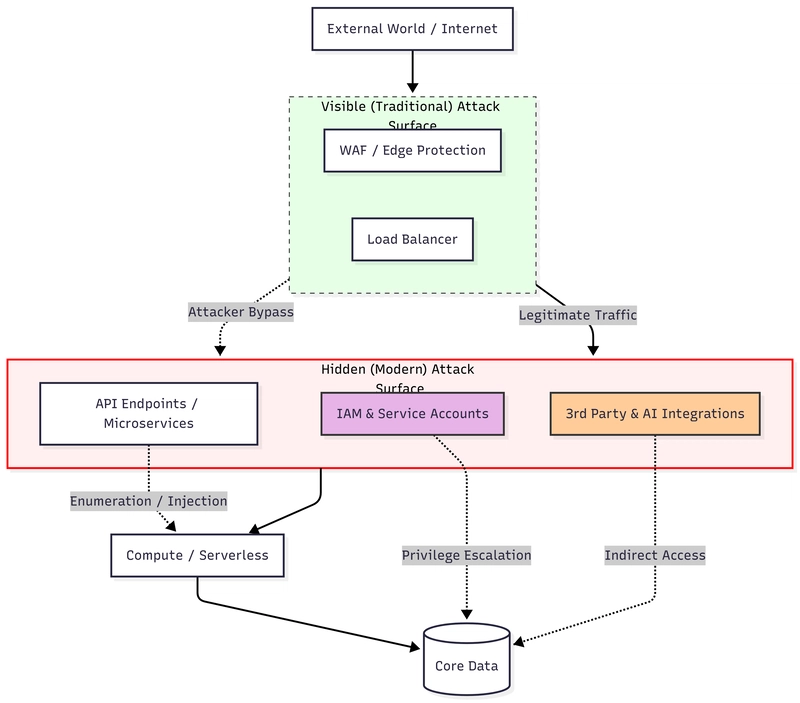
Traditionally, an application’s attack surface was relatively straightforward - open ports, exposed servers, and known network entry points. Security efforts focused on hardening these boundaries which included configuring firewalls, patching systems, and restricting direct access.
But in modern cloud environments, that definition no longer holds.
Today, an application is not a single system but a collection of interconnected services. APIs expose functionality to the outside world, identity and access management (IAM) systems control permissions, serverless functions execute code in response to events, and third-party integrations extend capabilities beyond the core application.
Each of these components introduces its own set of entry points, many of which are not immediately visible.
In this context, the attack surface is no longer just about infrastructure. It includes every API endpoint, every permission granted through IAM, every external service connected to the application, and every automated process that runs behind the scenes.
The challenge is that these elements are often abstracted away by cloud platforms like Google Cloud, making it easier to build systems, but harder to fully understand where the risks lie.
As a result, the modern cloud attack surface is not only larger, but also more distributed and harder to detect. And to understand where the real risks emerge, it’s necessary to look at the individual layers that make up this hidden surface.
The Hidden Layers of the Cloud Attack Surface
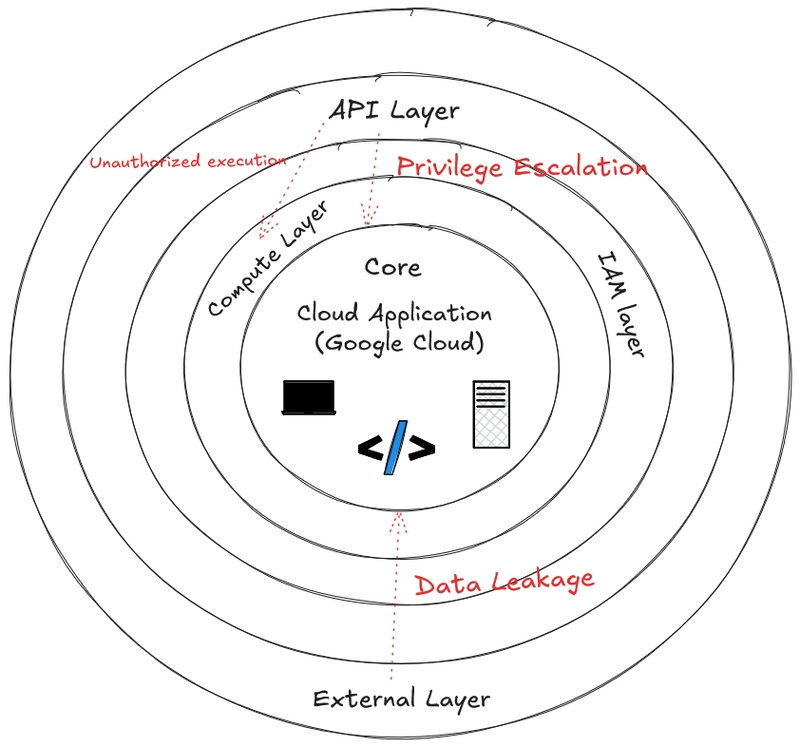
1. APIs: The Front Door That Never Closes
Unlike traditional entry points, APIs are designed to be accessible, often exposed over the internet and expected to handle requests at scale. This makes them one of the largest and most persistent components of the attack surface.
Weak authentication mechanisms, improper validation of inputs, and lack of rate limiting can turn APIs into easy targets. Even when authentication is implemented, improperly scoped tokens or predictable endpoints can allow attackers to enumerate resources or gain unauthorized access.
In many cases, APIs are treated as purely functional components that are built for performance and usability, while security becomes an afterthought. The result is an entry point that is always open, constantly in use, and often insufficiently protected.
2. IAM: The Most Dangerous Misconfiguration
If APIs are the front door, identity and access management (IAM) is the system that decides who gets in and what they can do once inside.
In cloud environments, IAM replaces traditional perimeter-based security with identity-driven access control. Every service, user, and application interacts based on assigned roles and permissions.
The problem arises when these permissions are overly broad. Developers often grant more access than necessary for the sake of convenience, unintentionally violating the principle of least privilege. Service accounts may be given administrative roles, tokens may carry excessive permissions, and access policies may not be regularly audited.
This creates a dangerous scenario: even a small compromise such as a leaked token, can lead to privilege escalation and widespread access across the system.
In platforms like Google Cloud, IAM is powerful and flexible, but that flexibility also makes it one of the most common sources of security risk.
3. Serverless & Managed Services: The Illusion of Safety
One of the biggest advantages of cloud platforms is the ability to offload infrastructure management. Serverless functions and managed services allow developers to focus purely on code, without worrying about servers, scaling, or maintenance.
However, this convenience can create a false sense of security.
While the underlying infrastructure is managed, the logic, configurations, and triggers that control these services are still the developer’s responsibility. Misconfigured event triggers, overly permissive execution roles, or insecure function logic can all introduce vulnerabilities.
Additionally, the ephemeral nature of serverless systems makes them harder to monitor. Functions spin up and shut down dynamically, leaving limited visibility into their behavior. This makes detecting misuse or abnormal activity significantly more challenging.
The result is an environment that feels secure by design, but can still expose critical weaknesses if not carefully managed.
4. Third-Party & AI Integrations: The New Weak Link
Modern applications rarely operate in isolation. They rely heavily on third-party services for functionality right from payment processing to analytics, and increasingly, AI-powered features.
These integrations expand the capabilities of an application, but they also extend its attack surface beyond its original boundaries. API keys, access tokens, and sensitive data are often shared with external systems, creating new trust relationships that are difficult to fully control.
In the age of AI, this risk becomes even more pronounced. Applications are now integrating with external models and tools that process user inputs and data, sometimes with limited visibility into how that data is handled.
A compromised third-party service, an exposed API key, or a misconfigured integration can provide attackers with indirect access to critical systems. Unlike traditional vulnerabilities, these risks do not originate within the application itself but from the ecosystem it depends on.
These external dependencies are becoming one of the most significant and least understood components of the modern attack surface.
Security at the Speed of AI
The common thread connecting these layers is velocity.
In the pre-AI era, security could often be addressed at the deployment stage. Today, that is a recipe for failure. With the rise of AI agents, your application is no longer a static collection of code; it is a dynamic, evolving environment that changes based on the data it consumes.
The insight here is that visibility is the new perimeter. You cannot secure what you cannot see, and in a cloud environment where microservices spin up and down, static security audits are insufficient. The "hidden" nature of these risks comes from the fact that they often exist in the connections between services - the IAM policies, the API integrations, and the data flows, rather than in the services themselves.
An Attack Story: The "SmartAssist" Compromise
To understand how this looks in practice, let’s look at a scenario: SmartAssist.
SmartAssist is a customer support application running on Google Cloud. It uses a serverless backend to process user queries and leverages a third-party AI model to generate responses.
1. The Entry: An attacker discovers that the API endpoint for SmartAssist is vulnerable to indirect Prompt Injection. By crafting a malicious support ticket, they trick the AI into returning the underlying system instructions.
2. The Escalation: These system instructions reveal the name of a Cloud Storage bucket used for logs. Because the developers configured the serverless function with a broad "Storage Admin" role (violating the principle of least privilege), the attacker successfully uses the prompt injection to manipulate the application into executing a command to list the bucket’s contents.
3. The Exfiltration: The bucket contains API keys for a third-party analytics service. The attacker steals these keys, pivots to the analytics platform, and begins exfiltrating the entire user database.
In this story, there was no "hack" in the traditional sense, no firewall was breached, and no server was compromised. Instead, the attacker abused the intended functionality of the integrated components. The security failure happened in the design of the IAM roles and the lack of validation at the API layer.
The Solution: A Zero Trust, Defense-in-Depth Approach
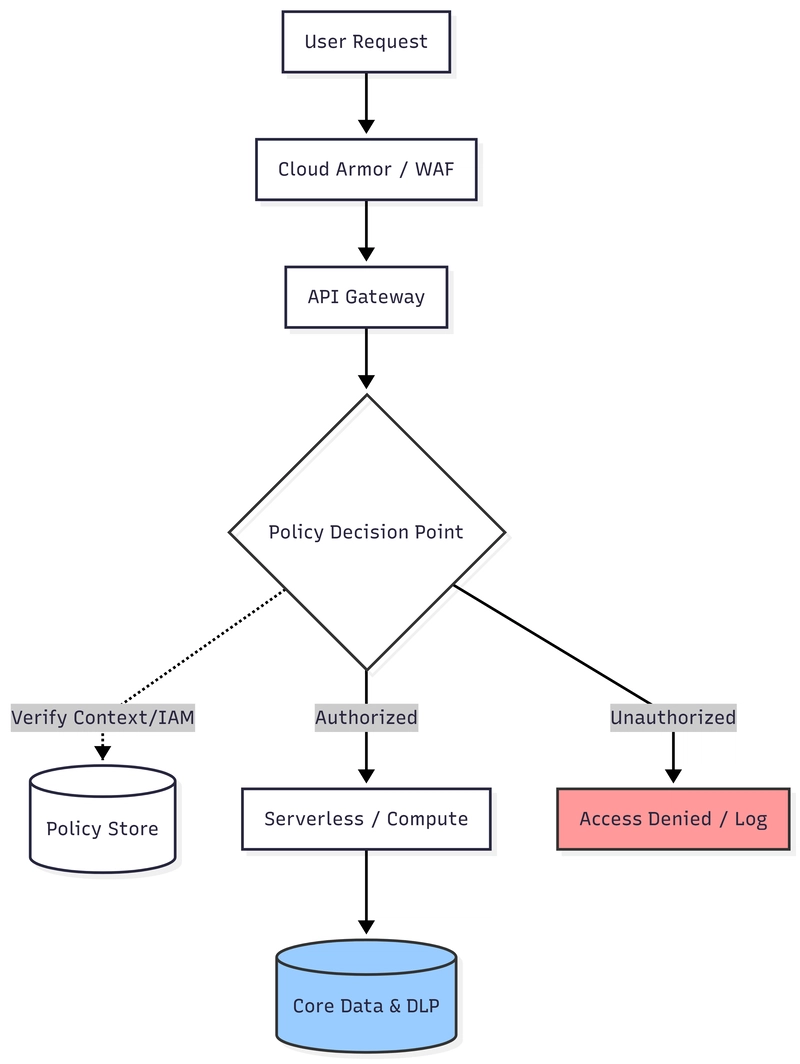
Securing this modern surface requires moving away from the idea that the cloud is "secure by default." Instead, we must embrace a Zero Trust architecture where every request is treated as hostile until proven otherwise.
To mitigate the risks outlined above, consider a framework like this:
1. Enforce Granular Identity (IAM): Use Workload Identity to ensure that your applications and services act with the absolute minimum permissions required. Never use default service accounts.
2. Validate at the Edge: Implement Google Cloud Armor to protect your API endpoints. Use WAF rules to filter out malicious traffic and rate limiting to prevent enumeration attacks.
3. Implement a Policy Decision Point (PDP): As your system scales, centralize access control. A PDP can evaluate the context of every request—the user's identity, the device's security posture, and the sensitivity of the data, before allowing the API to trigger a compute function.
4. Data Loss Prevention (DLP): Use the Cloud DLP API to automatically redact or mask sensitive data before it reaches your AI models. This ensures that even if an attacker successfully prompts the AI to "leak" information, they are only accessing scrubbed data.
Security as a Feature
The "hidden" attack surface is not a bug in cloud computing; it is a byproduct of the incredible agility that the cloud provides.
We cannot expect to stop the advancement of AI or the interconnected nature of modern applications. Instead, we must change our perspective. Security is not an "add-on" that comes after the code is written. In the age of AI, security is a fundamental feature of the architecture.
By moving away from perimeter-based defenses and toward identity-centric, Zero Trust models, developers can embrace the power of the cloud without sacrificing the safety of their users. The "hidden" surface only remains dangerous if we choose not to look at it. Once we map it, secure it, and monitor it, it becomes just another layer in a robust, resilient system.