








Introduction
In technology-driven organizations, engineering is not merely a delivery function — it is the execution engine of the business. Strategic ambition, product vision, commercial commitments, regulatory obligations, and operational reliability ultimately depend on engineering capacity.
As organizations scale, this structural dependency becomes increasingly visible. Engineering leaders often experience a shift in role: from managing teams and technical systems to managing organizational interdependence. The realization that “engineering is everyone’s dependency” reflects how modern companies are architected.
Research supports this structural centrality. The DORA (DevOps Research and Assessment) “Accelerate State of DevOps” reports, now published by Google Cloud, consistently show that high-performing engineering organizations outperform peers in profitability, productivity, customer satisfaction, and resilience.
Similarly, McKinsey research on technology performance indicates that companies with strong engineering and digital capabilities significantly outperform competitors in revenue growth and operating margin.
When engineering performance correlates directly with business outcomes, dependency intensifies. That dependency introduces both leverage and complexity.
Engineering as the Organizational Convergence Layer
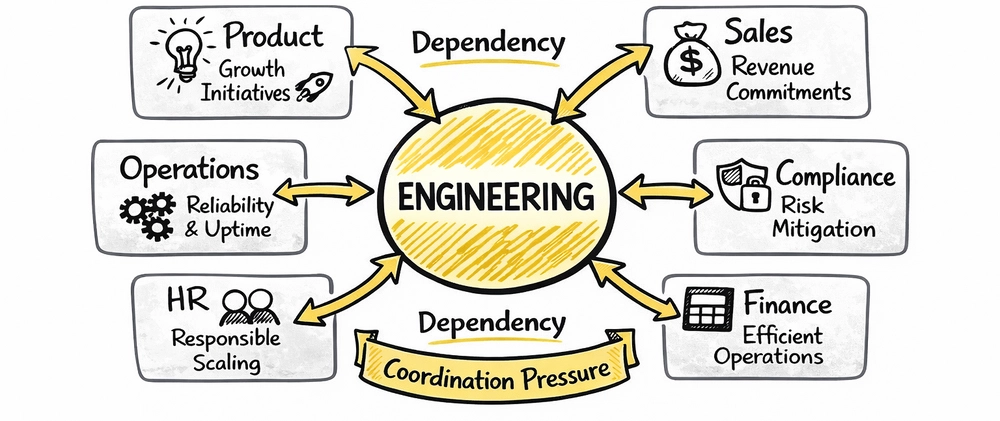
In digital-first companies, every major initiative requires engineering participation:
Product strategy must be validated against technical feasibility.
Sales commitments require implementation capacity.
Security and compliance frameworks require system-level integration.
Financial efficiency initiatives often depend on architectural optimization and automation.
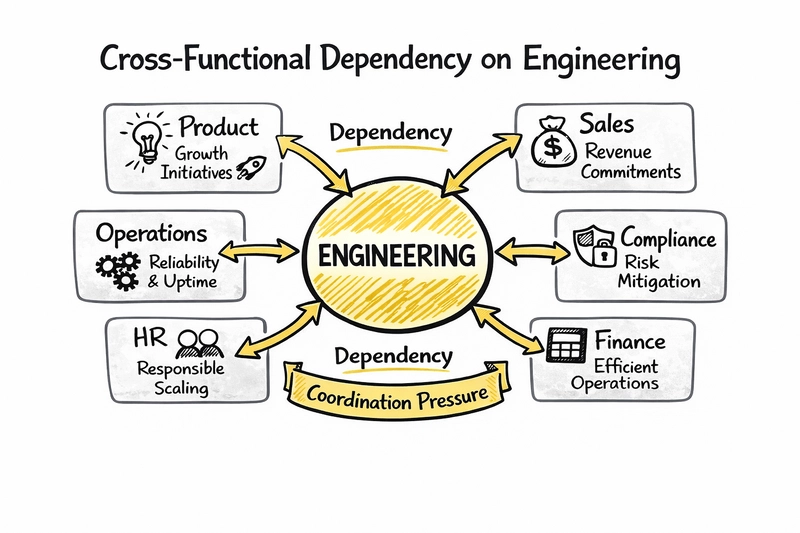
Cross-functional coordination has grown accordingly. A Harvard Business Review analysis on collaboration overload by Rob Cross and colleagues found that time spent on collaborative work has increased dramatically over the past two decades, often consuming more than 50% of managers’ time. In environments where engineering sits at the center of execution, this coordination burden is amplified.
The dependency of multiple functions on engineering does not inherently create dysfunction. However, it does create a system in which engineering leaders must continuously reconcile competing priorities within finite capacity constraints.
The Leadership Role as Translation and Integration
As cross-functional dependency increases, the engineering leader’s role evolves toward translation and integration.
This translation includes:
Commercial urgency into technical feasibility
Regulatory requirements into implementation scope
Architectural constraints into business timelines
Operational risk into product decisions
Each department operates under distinct incentives. Sales may optimize for quarterly revenue. Product may optimize for feature velocity. Security may optimize for risk minimization. Finance may optimize for cost predictability.
Research on organizational misalignment suggests that cross-functional friction increases when incentive systems are not synchronized, for example Harvard Business Review has documented how siloed performance metrics create coordination inefficiencies.
Meaning engineering leaders must therefore create shared decision principles that align incentives around system-wide outcomes rather than local optimization. Without a structured translation, engineering becomes reactive.
Finite Capacity in a System of Expanding Demand and its Cognitive Fallout
One of the defining characteristics of engineering dependency is simultaneous urgency. Growth initiatives, enterprise deals, compliance obligations, reliability improvements, and platform modernization all present as high priority.
However, engineering throughput is bounded. The Theory of Constraints, introduced by Eliyahu Goldratt, provides a useful systems lens: in any production system, throughput is limited by its bottleneck. In software organizations, engineering frequently becomes that constraint.
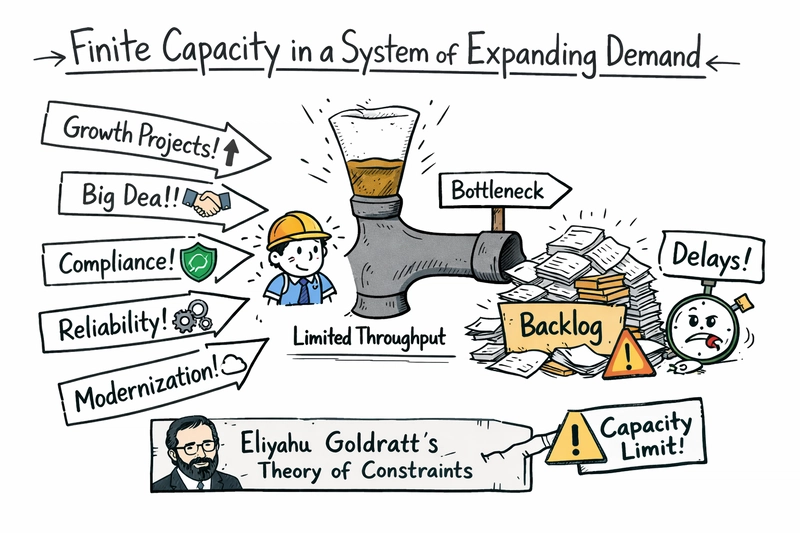
Empirical research reinforces this. The DORA research program highlights that elite-performing teams focus on improving flow efficiency and limiting work in progress rather than maximizing parallel initiatives. Organizations that attempt to advance too many simultaneous priorities experience degraded delivery performance.
When engineering is everyone’s dependency, the leadership challenge shifts from evaluating importance to sequencing work deliberately.
As dependency increases, so does coordination load. Research on “collaboration overload” shows that high-performing individuals often become central nodes in communication networks, leading to disproportionate demand on their time.
Engineering leaders frequently occupy these central positions. Their involvement is requested in roadmap alignment, incident reviews, enterprise negotiations, hiring decisions, governance discussions, and architectural trade-offs. Yet deep technical and strategic thinking requires sustained focus.
Additionally, studies on multitasking and context switching in cognitive psychology demonstrate measurable declines in efficiency and increased error rates when individuals switch frequently between tasks.
If unmanaged, structural dependency can erode strategic bandwidth. Leaders become responsive rather than directional.
Dependency as Organizational Leverage
Dependency is not inherently a liability. It is a form of leverage. However, leverage does not imply universal ownership.
A common failure in scaling organizations is conflating technical dependency with total accountability. Because engineering enables execution, other functions may gradually transfer policy, risk, or coordination ownership to engineering. Over time, engineering becomes the default owner of decisions that properly belong elsewhere.
Effective governance requires explicit distribution of ownership:
Security owns policy and risk appetite.
Compliance owns regulatory interpretation.
Product owns prioritization intent.
Commercial functions own revenue commitments.
Engineering owns architecture, implementation, and system integrity.
Engineering is frequently consulted, but consultation is not equivalent to full domain ownership.
Collaborative research further demonstrates the risk of concentration. Studies on collaboration overload show that central actors absorb disproportionate coordination demand.
Without structural safeguards, clear intake processes, explicit decision rights, work-in-progress limits, and capacity visibility, leverage degrades into overload.
Conclusion
Engineering centrality is not a theoretical claim; it is an observable structural feature of modern enterprises. As revenue, compliance, and operations become software-mediated, engineering performance directly influences business outcomes.
Research across DevOps performance (DORA), digital transformation (McKinsey), collaboration science (Harvard Business Review), and cognitive psychology converges on a consistent finding: unmanaged demand and ambiguous ownership reduce organizational effectiveness.
Sustainable leverage requires defined interfaces.
Engineering enables execution across domains, but accountability must remain with their respective functions. When ownership boundaries blur, coordination load concentrates, context switching increases, and system performance degrades.
Engineering is a core operating layer of a company, and its effectiveness depends not only on technical excellence but also on governance design that balances central integration with distributed accountability.