





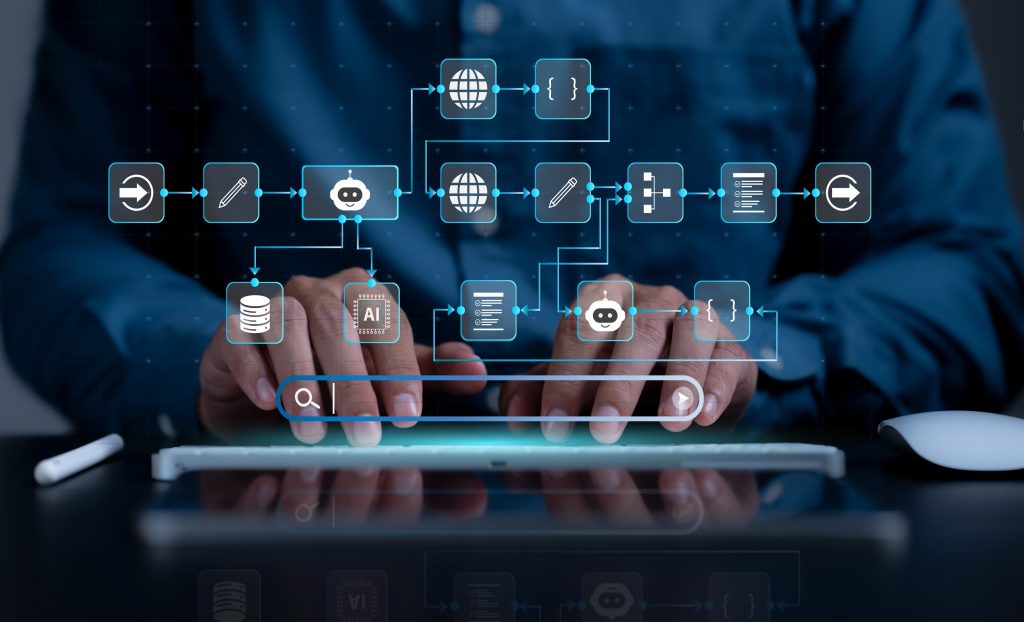
Agentic AI brings a subtle but consequential shift in how software is architected and delivered. Instead of organizing around applications or microservices, IT departments—together with end users—now develop automated workflows.
The agents that implement these workflows may communicate with other agents as part of a more complex, orchestrated group of workflows. But the basic unit of delivery is still the workflow, an end-to-end process with goals that have meaning for the business. CIOs will need to consider how organizing around workflows brings different ways of collaborating with business users, different ways of testing, and different ways of organizing IT initiatives.
Workflows are Different
A workflow is a business process—which cannot be said of a monolithic application or a granular microservice.
Applications are built to stand alone and be invoked as a whole. They are often components in many workflows (sometimes to an extreme, as in the case of an ERP system that extends across the boundaries of business silos). An application is typically built after an extensive requirements elicitation and design process that involves many business stakeholders. Users might give it a name or even imagine it to have a personality.
It made sense historically. An application was an executable, in olden days invoked from a command line. You might buy applications off the shelf—products, marketed by a vendor, with a product’s branding. A new application is similarly budgeted for as a monolithic whole—as if it were a purchased product—even if later enhancements are budgeted separately. But applications need frills to round them out (menus, administrative features, help menus, and suchlike), which add overhead beyond the sought-after functionality. A workflow, on the other hand, is a granular unit of investment with its scope restricted to the task at hand.
Agile initiatives build for user stories, but the features they deliver may be bolted onto an existing application or one in development. They may burn down against a backlog of user stories that add up to a complete application. The orientation around monolithic applications remains. A user story is a unit of functionality, but not necessarily an operational unit. Workflows, however, can be launched individually and even autonomously as agents.
Workflows may seem similar to user stories: Both have a business intent and are valuable to a user. But a workflow captures an entire process, while a user story can be granular, with its implementation spread over different parts of a system. Workflows can be refined continuously through process improvement; user stories are simply delivered and then vanish from the backlog.
It has always been a good practice to break code down into more modular units, a theme in structured programming, object orientation, service-oriented architectures, and microservices. The idea is not just to break the code into smaller pieces, but to align those pieces with business concepts and domains. The objects of object-oriented programs are meant to model bounded business domains; microservices are meant to encapsulate a piece of business logic that can be offered through an API. But microservices are granular and crosscutting. Their alignment with business workflows is rarely neat.
Workflows in Agentic AI
With agentic AI, the picture changes. An agent automates a bounded workflow, perhaps one previously performed by an employee or team. It brings the code closer to the business process—in fact, the two are interchangeable, just different representations and implementations of the same idea.
Kiro takes this idea to its logical conclusion, converting smoothly between the process specification and agentic code. Tools like Amazon Quick Suite allow end users to create agentic workflows. Although we say this “democratizes” access to writing code, we do not expect users to build complete applications like ERP systems. Rather, they will find ways to improve or replace their workflow processes.
By definition an “agent” is something we delegate responsibility to: It acts on our behalf. We give it a particular task to carry out. For example, a supply chain agent might monitor suppliers for price changes and available inventory. Another agent might look for changes in demand patterns, and another might place orders. The agents communicate with each other just as human employees do. Each agent might assist an employee—human-in-the-loop—or be fully autonomous. In either case, the “task” (or workflow) is the unit of specification, the unit of delivery, and the unit of testing, validation, and performance improvement.
Consequences for IT
The consequences are interesting for IT organizations. In the past we pretended that the capabilities IT deployed added business value, while knowing in the back of our minds that the real value came from their use. Value depended on adapting business processes to fit the software (and perhaps on cultural changes that made those adaptations effective). But a workflow encapsulates the process as well as any new features; it is truly an independent unit of value.
Software development initiatives can now begin by breaking business objectives into workflow changes that can be automated (and perhaps made autonomous with the help of AI). Business cases can focus on whether automating a particular workflow is a good investment. The backlog will consist of workflows waiting to be automated. Instead of unit testing a function or regression testing an entire application, you can test a workflow, which is well-defined and implemented as a unit (though some agents might be broken into functions that you should test independently). Security can focus on threat modeling for the particular workflow.
Most interesting is the alignment between business process and technical solution. Much of the “how” can be hidden from business users, while discussions focus on what the current workflow is and what the new workflow must accomplish. The business user can be more involved in the design and creation process, which they can do at a higher level when using AI.
The history of IT is a progression from machine-centric object code to higher-level representations and abstractions, ever closer to the business domain it represents. Agentic is the next step, since agentic workflows are literally business processes. That’s a boon for CIOs seeking to align technology and business.