6 must-have customer experience roles for success | TechT...
Beth Schultz·2026-06-18·via WhatIs
A well-rounded customer experience team helps companies manage customer journeys, feedback, service quality, analytics, AI and cross-functional collaboration.
Customer expectations are ever-changing, so today's strong customer experience (CX) might not measure up tomorrow. Customers increasingly expect fast, consistent and personalized interactions across digital, self-service, contact center, sales and support channels.
Companies that can't keep pace with CX expectations may find themselves in a tough spot. Poor service can hurt retention, loyalty, brand reputation and revenue, especially when customers share negative experiences through reviews, social media and word of mouth.
To reduce that risk, companies must treat CX as a mission-critical goal and build a team that can manage strategy, data, technology, service delivery, automation and continuous improvement.
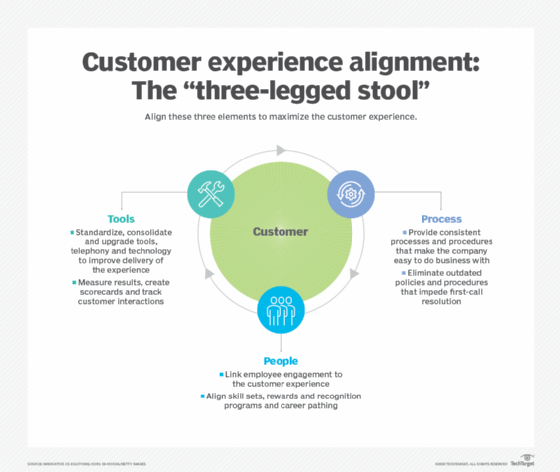
Customer experience teams need alignment across people, processes and tools to improve customer interactions, service delivery and customer satisfaction.
What roles should be on the customer experience team?
A customer experience team comprises a variety of roles, but the following six are standouts.
1. Chief customer officer (CCO) or chief experience officer (CXO)
Ideally, a CX team should have C-level leadership, whether titled as CCO, CXO or a similar designation. Ultimately, this executive leader holds responsibility for all customer-facing activities and the strategy for maximizing key customer-related metrics such as acquisition, retention and satisfaction.
The CCO is also responsible for establishing and nurturing a customer-obsessed mentality throughout the organization. CCOs must be data oriented, relying on analyzing customer ratings, sales and sales through digital channels to identify where to focus for CX improvement across the customer journey. Being able to spot areas for improvement isn't enough, however. Critically important to the CCO role is full empowerment to implement change. That means this position must have a budget, staff and decision-making authority.
2. CX manager
While the C-level leader has strategic ownership of CX, the CX manager's role is more hands-on. In organizations with a CCO, CXO or other executive-level leadership, the CX manager can focus on tactical guidance and overseeing strategic deliverables. At companies without C-level leadership, the CX manager is likely to report to the CEO or top-level marketing or sales, depending on company size and organizational structure.
The CX manager must understand the technology infrastructure supporting CX initiatives and be capable of analyzing the data coming into the contact center to spot trends among customers and assess key customer metrics such as satisfaction and loyalty. The CX manager should also be a people person, often having customer-facing direct reports or liaising with other business areas, such as IT, HR, marketing, sales and security.
3. Skilled CX professionals
Delivering a great customer experience (CX) requires skills beyond an entry-level contact center agent. Skilled agents, or CX professionals, are becoming essential members of a CX team. The agents steeped in product-specific or technology knowledge are vital in guiding customers through complex support issues or pre-purchase questions. They may be the first line of contact for a customer calling the service line or serve as an escalation point of contact when a customer has exhausted self-service or other interaction options. Their responsiveness, empathy and ability to finesse their way through challenging customer engagements are critical to achieving positive customer ratings.
4. Analysts
As indicated with the CCO, CXO and CX manager roles, the ability to gather, analyze and act on customer data is a CX imperative. Analysts with a CX specialization must be able to work with customer feedback data in various forms and across interaction channels to generate real time guidance across the CX team. This isn't just about number crunching, either. Delivering in-the-moment agent assistance based on sentiment analysis can help prevent an experience from souring. Likewise, getting ahead of customer trends using predictive and prescriptive analytics can help improve CX. Analysts also play a growing role in connecting CX data with operational data from CRM, contact center, marketing, sales and e-commerce systems so teams can see where journeys break down.
5. Developers
CX is a constantly changing target. The ability to spin up new CX channels and services, automate workflows, create innovative experiences across different customer touchpoints and keep the UI fresh and exciting are essential to staying ahead of customer expectations. Whether using full-, low- or no-code platforms, developers can work with CX managers and other customer-facing professionals to understand the needs and find the quickest way to deliver. Developers should be well-versed in using AI, APIs, automation and communications PaaS, and be able to present ideas on implementing new offerings programmatically.
6. AI experts
Using AI, generative AI, agent assistance and virtual assistants can be a key success driver for CX. This makes AI expertise a critical role on the modern CX team. This person helps evaluate AI tools, define use cases, support implementation and monitor how AI affects customers, agents and business outcomes. The AI expert should also bring a strong understanding of data privacy, security, governance and responsible AI practices. They need to assess the true cost of large language models (LLMs), understand how automation affects agent work and make sure AI tools include appropriate human oversight, escalation paths and performance measurement.
These roles do not need to sit in one department, but they do need shared ownership. A successful CX team often works across marketing, sales, customer service, IT, data, security, product and operations. The structure matters less than whether the organization has clear accountability for customer journeys, customer data, service quality and technology decisions.
The structure matters less than whether the organization has clear accountability for customer journeys, customer data, service quality and technology decisions.
Common customer experience team responsibilities
Regardless of their title, each member of the CX team is accountable for increasing customer satisfaction and guiding new and returning customers through key touchpoints in the customer journey. To do so, each member of the CX team has key responsibilities, including the following:
Understand the customer journey. A customer journey map showcases every interaction a customer has with a business, from awareness to a loyal repeat customer. Understanding those stages and what a customer needs at each stage is critical to creating an exemplary customer experience.
Gather and implement customer feedback. Using voice of the customer programs, customer surveys and other methods, organizations can gain deeper insight into customers' wants and needs and adjust their offerings accordingly.
Customer service and support. Customer service and support are at the core of the customer experience. By understanding a customer's needs and pain points, the CX team can create tailored experiences to improve customer interaction with the brand.
Measure key metrics. Businesses should measure several customer experience metrics to understand what CX success looks like. Net promoter score, customer satisfaction, customer effort score and customer lifetime value are only a few of the metrics CX teams should be tracking.
Ongoing training and certifications. CX team members must stay current on new technologies, best practices, and key hard and soft skills. One of the best ways to do that is via a customer experience certification.
Eliminate organizational silos. One of the biggest CX challenges is departments keeping separate customer databases and not communicating. By collaborating and sharing a database, the marketing, sales and support departments can fully understand a customer's behavior at key touchpoints.
A well-rounded CX team of various roles is essential for meeting and exceeding customer expectations.
Editor's note: This article was updated to improve clarity and include current customer experience team considerations around AI, analytics and cross-functional collaboration.
Beth Schultz is vice president of research and principal analyst at Metrigy. She focuses her research on unified communications, collaboration and digital customer experience.