
惯性聚合 高效追踪和阅读你感兴趣的博客、新闻、科技资讯
阅读原文 在惯性聚合中打开

推荐订阅源

奇客Solidot–传递最新科技情报
奇客Solidot–传递最新科技情报
L
LINUX DO - 最新话题
Recorded Future
Recorded Future
月光博客
月光博客
博客园 - 【当耐特】
博客园 - 叶小钗
宝玉的分享
宝玉的分享
量子位
雷峰网
雷峰网
博客园 - 三生石上(FineUI控件)
The Cloudflare Blog
Vercel News
Vercel News
L
LangChain Blog
B
Blog
Y
Y Combinator Blog
爱范儿
爱范儿
GbyAI
GbyAI
S
Security @ Cisco Blogs
T
The Blog of Author Tim Ferriss
A
About on SuperTechFans
博客园 - Franky
P
Palo Alto Networks Blog
Threat Intelligence Blog | Flashpoint
云风的 BLOG
云风的 BLOG
C
Cisco Blogs
Scott Helme
Scott Helme
I
Intezer
T
The Exploit Database - CXSecurity.com
MyScale Blog
MyScale Blog
T
Tor Project blog
D
Darknet – Hacking Tools, Hacker News & Cyber Security
T
Troy Hunt's Blog
N
News and Events Feed by Topic
大猫的无限游戏
大猫的无限游戏
F
Fortinet All Blogs
www.infosecurity-magazine.com
Application and Cybersecurity Blog
Cyber Security Advisories - MS-ISAC
S
Security Affairs
Cyberwarzone
Cyberwarzone
PCI Perspectives
PCI Perspectives
小众软件
小众软件
D
DataBreaches.Net
Exploit-DB.com RSS Feed
Know Your Adversary
Know Your Adversary
Forbes - Security
Forbes - Security
S
Securelist
cs.CV updates on arXiv.org
C
Cyber Attacks, Cyber Crime and Cyber Security
The Last Watchdog
The Last Watchdog

WhatIs

Strategic IT outlook: Tech conferences and events calendar | TechTarget 8 AI use cases in manufacturing Enterprises are making an AI native transformation Generative AI ethics: 16 biggest concerns and risks Zero trust in the IT ops stack: Securing hybrid workloads How algorithmic value sets enhance clinical decision-making Top methods for collecting customer feedback Build a data governance team that delivers results How to calculate the total cost of ownership of ERP software Communities call for transparency in AI data center deals Scalable IT infrastructure: Balancing speed with stability How health systems are tackling 'Kill the Clipboard' obstacles Understanding the science behind AI-based hiring assessments Tape's strategic role in modern data protection How to choose an HR software system in 2026: A complete guide The UC stack gets the policy job Top zero-trust use cases in the enterprise 13 top IT infrastructure conferences in 2026 SNMP vs. CMIP: What's the difference? 3 essential network analytics use cases AI Security Risks Force CIOs to Rethink Strategy Red Hat Summit 2026 news and conference guide | TechTarget What is HR technology (human resources tech)? Understand, optimize and track customer journey touchpoints Should IT use Apple Business Manager without MDM? Build and organize an effective machine learning team The storage modernization imperative in a fast-changing IT landscape Procurement automation use cases for CSCOs to consider 3 steps for health system leaders to drive patient safety culture What is DevOps? Meaning, methodology and guide Enterprises Face New Storage Bottlenecks as AI Grows A guide to Intune Suite licensing for endpoint management Epic controls 42% of the US EHR market. Does that help or hurt interoperability? SAP Sapphire 2026 news, trends and analysis | TechTarget How to develop a data governance strategy: 7 key steps 12 generative AI tools for marketing and sales teams Top 9 smart contract platforms to consider in 2026 Top 8 e-signature software providers for 2026 Rise with SAP vs. S/4HANA Cloud: What are the differences? How businesses use KPIs to measure AI's performance 5 clues your network has shadow AI Collaboration security and governance must be proactive Compare SAP greenfield vs. brownfield approach for S/4HANA Merck, Home Depot tap Gemini Enterprise for AI agent development Rural challenges may dampen digital healthcare's potential Build an ethical AI framework: 12 top resources The great workload reshuffle: Choices for AI and analytics How to remove a device from Intune enrollment Cisco unveils quantum network advancements 3 BYOD security risks and how to prevent them 10 of the top carbon accounting software 8 trends powering machine learning's dynamic new roles Network engineers must take the lead to push DDI to the cloud How does Microsoft 365 Copilot pricing and licensing work? ONC highlights behavioral health EHR adoption trends, data exchange barriers LLMs struggle with clinical reasoning, study finds Democratizing AI in business: The good, bad and ugly What can organizations do to address BYOD privacy concerns? Fix the service path before you optimize it with AI How AI reshapes upselling in customer experience platforms When collaboration starts becoming operational drag Balancing health AI management with growing vendor sprawl Career cure for AI phobia: Be a beekeeper, not a worker bee 16 top applicant tracking systems for 2026 How a rural community hospital deploys AI to detect heart disease 8 examples of document version control Guide to 30+ sustainability certifications for professionals AI agents are only as smart as the data that feeds them AI could earn trust in transactional work first How to fix keyboard connection issues on a remote desktop How to add and enroll devices to Microsoft Intune 11 DevSecOps best practices to prioritize in 2026 6 key components of a successful data strategy How to enable Copilot in Microsoft 365: A step-by-step guide What CIOs need to know about Meta's proposed CEO AI agent Top AI recruiting tools and software of 2026 How contact centers detect and prevent fraud 10 essential skills for modern contact center agents Beyond the chatbot: Engineering the agentic enterprise AI in business intelligence: How to manage it effectively Why legacy networks are a growing liability Failure is an option as an IT leadership tool How HR can create a successful change management strategy HR AI is becoming a change management story Digital transformation: Balancing speed and governance RSAC 2026 Conference: Key news and industry analysis | TechTarget 8 best practices for a bulletproof IAM strategy 5 customer journey phases businesses should understand 12 top HR software and tool options to consider in 2025 6 contact center trends shaping the future of customer service Contact center monitoring best practices for CX leaders Cloud vs. local backup: Which is right for your organization? 6 steps for when remote desktop credentials are not working How governance maturity affects M&A integration outcomes Inside the push to turn AI agents into suite functionality How should contact centers use AI today? Accenture global health lead on scaling AI in healthcare with governance and intent 10 best free DevOps certifications and training courses in 2026 What is compensation management? What CIOs must know about bossware strategy
How do digital signatures work?
2026-04-24 · via WhatIs

Organizations use digital signatures when an agreement needs more than convenience. They use them when a workflow requires stronger signer verification, tamper evidence and a better evidentiary trail than a basic electronic signature provides.

That distinction matters because not every document needs the same level of trust. Routine approvals may only need a simple e-signature, while regulated, high-value or dispute-sensitive transactions often benefit from certificate-based digital signatures.

In practice, the goal is to match the signing method to the risk. The right question is not whether a business can sign electronically. It is whether the transaction needs stronger identity assurance, document integrity controls and compliance support.

Digital signatures vs. e-signatures

Organizations must understand the difference between digital signatures and e-signatures so they can implement a level of security that meets their needs.

An e-signature is a broad term that includes any signature a user sends electronically. Some e-signatures, such as those retail stores use for small transactions, don't require identity verification. However, other types, such as digital signatures, involve a strict authentication process.

In the U.S., the E-SIGN Act gives electronic signatures legal standing when key conditions are met, but organizations still use digital signatures when they need stronger identity assurance and tamper evidence. In the EU, trust-service frameworks make those assurance levels even more explicit.

Digital signatures rely on public key cryptography and digital certificates to verify authenticity and detect tampering. In a typical workflow, the system creates a hash of the document and signs that hash with the sender's private key. The recipient then uses the corresponding public key and certificate to verify the signature and confirm that the document has not been altered since it was signed.

To create a digital signature, organizations typically use an e-signature system. E-signature systems offer digital signature capabilities, but they can also streamline workflows. For example, they can send reminder notifications to late signatories and assign roles to specific individuals.

What are digital signatures used for?

Organizations can use digital signatures anywhere a signature is required, but they usually reserve them for transactions where stronger trust, signer verification and document integrity matter most. Common examples include the following:

  • Real estate purchase and sale agreements
  • Sales contracts
  • Insurance agreements
  • Tax documents and forms
  • Construction change orders
  • Clinical trials
  • Loans
  • Mortgages
  • Leases

How digital signatures work

Digital signatures rely on digital certificates that trust service providers issue to signers. These providers are legal entities that use processes and tools in accordance with a national authority, such as the U.S. government or EU, to verify e-signatures' authenticity.

"The trust service provider verifies the identity of the signer prior to the issuance of the digital certificate using various mechanisms, [such as] near-field communication, automated video-based identity documents and biometric verification," Manaila said.

After the trust service provider verifies the signer's identity, it issues the digital certificate in the cloud. It stores the required cryptographic keys on a hardware security module (HSM) and protects it with two-factor authentication (2FA). These security measures let people sign documents and get digital certificates from any type of platform, device or smartphone, Manaila said.

Some countries issue electronic identification cards that store the owner's biometric data, such as their fingerprint or facial structure, on a chip. Citizens and organizations can use these cards to prove their identity online and quickly obtain a digital certificate.
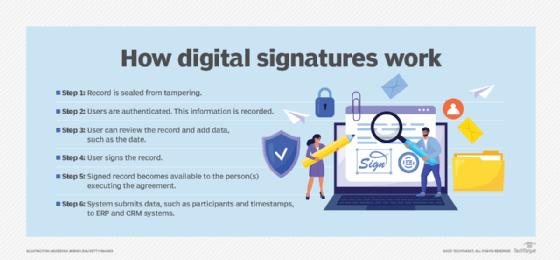
Diagram showing the digital-signature workflow from document hashing and certificate-backed signing to signature verification and downstream processing.
The digital-signature process uses certificates, private/public keys and document hashes to verify signer identity, detect tampering and support downstream workflows.

How cloud affected the digital signature landscape

Before the proliferation of cloud services, organizations relied on physical devices, such as security tokens or smart cards, to protect their digital certificates with an HSM. This traditional approach posed implementation challenges. For example, the approach isn't user-friendly because it requires users to carry a physical device, Manaila said.

Cloud tools, on the other hand, store the cryptographic keys on the cloud provider's HSM so organizations don't need to track physical tokens or replace them over time. Cloud products are also more scalable and require no physical maintenance costs.

The digital signature landscape changed after the CSC standardized remote, cloud-based digital signatures with its open source API. This technology offers the following benefits:

    Security benefits of digital signatures

    Digital signature technology can help organizations prevent bad actors from tampering with important transactions. Security benefits include the following:

    • Links signer's identity to the signature.
    • Makes the signer legally responsible for their actions.
    • Securely stores the digital certificate's cryptographic keys on a certified HSM and protects them with 2FA.
    • Offers access control to strengthen security.
    • Can prove a signature's authenticity in court.

    Digital signatures add assurance, but they also add process and training overhead. That is why organizations should treat them as a fit-for-purpose control: use them where the business needs higher trust, stronger evidence or stricter compliance, and use simpler e-signatures where speed and convenience matter more.

    Editor's note: This article was originally published in 2023 and was updated in 2026 to reflect current digital-signature workflows, legal context and enterprise use cases.