惯性聚合 高效追踪和阅读你感兴趣的博客、新闻、科技资讯
阅读原文 在惯性聚合中打开

推荐订阅源

U
Unit 42
C
Cybersecurity and Infrastructure Security Agency CISA
Exploit-DB.com RSS Feed
Know Your Adversary
Know Your Adversary
S
Securelist
I
Intezer
AWS News Blog
AWS News Blog
L
LINUX DO - 热门话题
P
Privacy International News Feed
Recent Announcements
cs.CL updates on arXiv.org
博客园 - 聂微东
Threat Intelligence Blog | Flashpoint
Attack and Defense Labs
N
News and Events Feed by Topic
The GitHub Blog
The GitHub Blog
C
Cyber Attacks, Cyber Crime and Cyber Security
Schneier on Security
N
Netflix TechBlog - Medium
爱范儿
爱范儿
B
Blog
CTFtime.org: upcoming CTF events
cs.CV updates on arXiv.org
C
CERT Recently Published Vulnerability Notes
Hacker News: Ask HN
Hacker News: Ask HN
Google DeepMind News
Engineering at Meta
Engineering at Meta
Blog — PlanetScale
Blog — PlanetScale
WordPress大学
WordPress大学
S
Secure Thoughts
K
Kaspersky official blog
N
News | PayPal Newsroom
O
OpenAI News
Last Week in AI
Last Week in AI
C
Check Point Blog
D
Darknet – Hacking Tools, Hacker News & Cyber Security
Cyberwarzone
Cyberwarzone
Application and Cybersecurity Blog
T
Tor Project blog
大猫的无限游戏
大猫的无限游戏
Vercel News
Vercel News
D
Docker
Hugging Face - Blog
Hugging Face - Blog
T
Threat Research - Cisco Blogs
Cisco Talos Blog
Cisco Talos Blog
The Register - Security
博客园 - 司徒正美
Martin Fowler
Martin Fowler
人人都是产品经理
人人都是产品经理
P
Palo Alto Networks Blog

WhatIs

Strategic IT outlook: Tech conferences and events calendar | TechTarget 8 AI use cases in manufacturing Enterprises are making an AI native transformation Generative AI ethics: 16 biggest concerns and risks Zero trust in the IT ops stack: Securing hybrid workloads How algorithmic value sets enhance clinical decision-making Top methods for collecting customer feedback Build a data governance team that delivers results How to calculate the total cost of ownership of ERP software Communities call for transparency in AI data center deals Scalable IT infrastructure: Balancing speed with stability How health systems are tackling 'Kill the Clipboard' obstacles Understanding the science behind AI-based hiring assessments Tape's strategic role in modern data protection How to choose an HR software system in 2026: A complete guide The UC stack gets the policy job Top zero-trust use cases in the enterprise 13 top IT infrastructure conferences in 2026 SNMP vs. CMIP: What's the difference? 3 essential network analytics use cases AI Security Risks Force CIOs to Rethink Strategy Red Hat Summit 2026 news and conference guide | TechTarget What is HR technology (human resources tech)? Understand, optimize and track customer journey touchpoints Should IT use Apple Business Manager without MDM? Build and organize an effective machine learning team The storage modernization imperative in a fast-changing IT landscape Procurement automation use cases for CSCOs to consider 3 steps for health system leaders to drive patient safety culture What is DevOps? Meaning, methodology and guide Enterprises Face New Storage Bottlenecks as AI Grows A guide to Intune Suite licensing for endpoint management Epic controls 42% of the US EHR market. Does that help or hurt interoperability? SAP Sapphire 2026 news, trends and analysis | TechTarget How to develop a data governance strategy: 7 key steps 12 generative AI tools for marketing and sales teams Top 9 smart contract platforms to consider in 2026 Top 8 e-signature software providers for 2026 Rise with SAP vs. S/4HANA Cloud: What are the differences? 5 clues your network has shadow AI How do digital signatures work? Collaboration security and governance must be proactive Compare SAP greenfield vs. brownfield approach for S/4HANA Merck, Home Depot tap Gemini Enterprise for AI agent development Rural challenges may dampen digital healthcare's potential Build an ethical AI framework: 12 top resources The great workload reshuffle: Choices for AI and analytics How to remove a device from Intune enrollment Cisco unveils quantum network advancements 3 BYOD security risks and how to prevent them 10 of the top carbon accounting software 8 trends powering machine learning's dynamic new roles Network engineers must take the lead to push DDI to the cloud How does Microsoft 365 Copilot pricing and licensing work? ONC highlights behavioral health EHR adoption trends, data exchange barriers LLMs struggle with clinical reasoning, study finds Democratizing AI in business: The good, bad and ugly What can organizations do to address BYOD privacy concerns? Fix the service path before you optimize it with AI How AI reshapes upselling in customer experience platforms When collaboration starts becoming operational drag Balancing health AI management with growing vendor sprawl Career cure for AI phobia: Be a beekeeper, not a worker bee 16 top applicant tracking systems for 2026 How a rural community hospital deploys AI to detect heart disease 8 examples of document version control Guide to 30+ sustainability certifications for professionals AI agents are only as smart as the data that feeds them AI could earn trust in transactional work first How to fix keyboard connection issues on a remote desktop How to add and enroll devices to Microsoft Intune 11 DevSecOps best practices to prioritize in 2026 6 key components of a successful data strategy How to enable Copilot in Microsoft 365: A step-by-step guide What CIOs need to know about Meta's proposed CEO AI agent Top AI recruiting tools and software of 2026 How contact centers detect and prevent fraud 10 essential skills for modern contact center agents Beyond the chatbot: Engineering the agentic enterprise AI in business intelligence: How to manage it effectively Why legacy networks are a growing liability Failure is an option as an IT leadership tool How HR can create a successful change management strategy HR AI is becoming a change management story Digital transformation: Balancing speed and governance RSAC 2026 Conference: Key news and industry analysis | TechTarget 8 best practices for a bulletproof IAM strategy 5 customer journey phases businesses should understand 12 top HR software and tool options to consider in 2025 6 contact center trends shaping the future of customer service Contact center monitoring best practices for CX leaders Cloud vs. local backup: Which is right for your organization? 6 steps for when remote desktop credentials are not working How governance maturity affects M&A integration outcomes Inside the push to turn AI agents into suite functionality How should contact centers use AI today? Accenture global health lead on scaling AI in healthcare with governance and intent 10 best free DevOps certifications and training courses in 2026 What is compensation management? What CIOs must know about bossware strategy
How businesses use KPIs to measure AI's performance
John Burke · 2026-04-24 · via WhatIs

Business decision-makers under heavy pressure to justify the value of their AI projects look to key performance indicators for salvation. KPIs reveal AI's efficiency and ROI.

By

Published: 24 Apr 2026

Most businesses have AI projects in progress or planned for launch within the next year, with no effective strategy to measure a return on their investment. To justify their AI deployments, demonstrate a positive ROI and determine whether "the juice is worth the squeeze," business leaders must first define the business value they expect AI to deliver and establish key performance indicators to track that value.

KPIs not only measure an AI's ROI, but they can also be used to assess and improve an AI project's efficiency. If a credit card company, for example, uses a traditional AI deployment to develop pattern recognition tools for its fraud-detection department, machine learning (ML) creates foundational models trained on large data sets. In assessing the AI deployment's effectiveness, KPIs can determine the tool's speed, accuracy and efficiency as well as its ROI.

A generative AI (GenAI) deployment follows a similar process -- with one exception: Since GenAI tools generate content, KPIs must measure more than speed, accuracy and efficiency. After training a GenAI model, developers must set benchmarks for creativity, relevance and task-specific factors such as the content's reading grade level. As a result, KPIs might require a more subjective approach, thereby making an assessment more challenging.

Know these AI KPIs

AI KPIs can be divided into two categories: direct and indirect.

Direct metrics

Mean squared error (MSE) is a critical direct metric in ML and GenAI projects. It measures the difference between the output generated and the intended result. MSE helps quantify errors in the training process. The greater the magnitude of the average error, the further the tool is from accomplishing its objective.

Perplexity is also a common metric, particularly for GenAI models that produce text output. It measures how well a language model predicts a sample, measuring how many ways the tool might answer the question "What word comes next?" If, at each evaluation point, the model has a small number of potential "next word" candidates, the results yield a low perplexity score, indicating the model is more confident in its understanding of the text overall and that the generated content is more accurate. Lower perplexity suggests a model is better at producing humanlike text.

For GenAI applications that produce media and images, the Fréchet inception distance (FID) can be a helpful metric. Developed in 2017, FID measures the quality of AI-generated images by comparing them with human-generated ones. To get an FID score, evaluators quantify the characteristics of a reference image by passing it through a separate AI tool that extracts information about the real image features such as shapes, coloration and textures. The tool then extracts information about the generated image and compares the differences between the two images in output. The higher the FID score, the greater the distance between the expected and actual distribution of image features.

Another common image-based metric is the structural similarity index measure (SSIM), developed in 2004 for the motion picture industry, which assesses the perceived quality of generated images compared with original data. While the FID assesses the distribution of macro-level image features, such as shapes, the SSIM examines pixel-level characteristics, such as contrast and luminance. FID is best used across sets of images to determine if the AI tool generates images that generally conform to real images at a high level, while SSIM compares one specific image to another to determine their similarities.

More generic KPIs for businesses and IT also apply to AI projects, including the following:

  • First contact resolution rate. For AI, this KPI can gauge what percentage of prompts submitted to the tool get a satisfactory response the first time, without being modified and resubmitted. It complements content relevance scores.
  • Content relevance score. For text-based models, this KPI quantifies how closely AI-generated content matches business or creative needs.
  • Money saved. It's important to measure both direct and indirect savings that AI can generate. For example, direct savings could be measured by how cost-effectively an AI deployment performs a task along the supply chain compared to a human manager. AI's indirect savings in a public relations firm, for instance, could be measured by how well it reduces the time to generate a press release compared to a human staff member.    
  • Money made. AI's effectiveness can also be measured by the role it plays in building revenue streams, such as enabling new product lines, expanding the customer base or increasing average sales volumes.
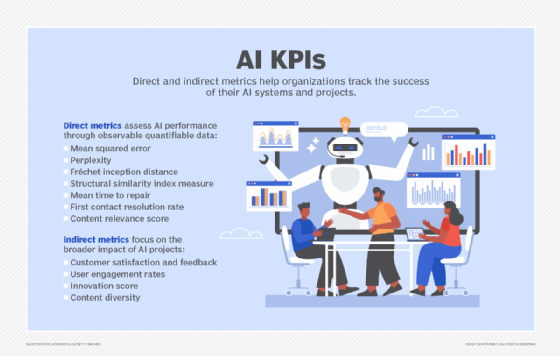
Chart listing direct and indirect KPIs for AI projects and systems.

Indirect metrics

Indirect metrics are just as important as direct ones, especially for GenAI, where subjective measures of creativity and user satisfaction are pivotal. These metrics focus on higher-level business areas, including the following:

  • Customer satisfaction. Direct human feedback-based "rate this answer" scores, coupled with indirect human feedback like the number of times a user restates a question or expresses frustration with the chatbot's responses, can help evaluate how well AI meets its intended purpose.
  • User engagement rates. KPIs such as a user's session length or frequency of return to an application are strong indirect metrics for GenAI tools that generate creative outputs like art or music.
  • Innovation scores. This metric measures how frequently GenAI produces novel, useful ideas or creative outputs that meet specific business goals.
  • Content diversity. This metric evaluates a GenAI system's ability to produce varied, high-quality outputs across different contexts or domains.

How KPIs measure AI's value

AI-related direct and indirect KPIs quantify the effectiveness and efficiency of AI tools, making it easier to calculate ROI. Effective KPIs help track AI's overall business impact. Measuring GenAI ROI accounts for scalability, quantifying how many outputs a tool can generate in a given time period while maintaining quality.  

Consider a business using GenAI to enhance its customer experiences. If one KPI shows a 60% reduction in the time required to generate personalized responses to customers in a real-time chat and another KPI shows a parallel increase in customer satisfaction, the two metrics would likely indicate a successful AI initiative to improve CX. And comparing the cost of the AI initiative to the expense of expanding a human contact center to achieve similar results would likely yield a positive ROI for the AI project.

Editor's note: This article was updated in April 2026 to reflect the latest developments in AI KPI measurement techniques.

 John Burke is CTO and a research analyst at Nemertes Research. Burke joined Nemertes in 2005 with nearly two decades of technology experience. He has worked at all levels of IT, including as an end-user support specialist, programmer, system administrator, database specialist, network administrator, network architect and systems architect.

 Jerald Murphy is senior vice president of research and consulting with Nemertes Research. With more than three decades of technology experience, Murphy has worked on a range of technology topics, including neural networking research, integrated circuit design, computer programming and global data center design. He was also the CEO of a managed services company.


Next Steps

AI deployments gone wrong: The fallout and lessons learned

Business vs. provider: AI software restrictions to know

AI governance can make or break data monetization

Democratizing AI in business: The good, bad and ugly

Does your organization need an AI ethics committee?

Dig Deeper on AI business strategies