





DevOps skills are in high demand, and DevOps engineers command excellent salaries. But before you can land a DevOps job, you need the necessary expertise and skills.
DevOps certifications and training programs can get you on the road to a rewarding DevOps career. These offerings can help you learn and demonstrate DevOps expertise regardless of your background.
There are plenty of opportunities for DevOps certifications and training courses that are easy to access. For this list, the selection methodology is based on search engine placement, the relative popularity of the service or course, and the broad scope of offerings.
What is DevOps?
DevOps is a methodology that changes the traditional development process to emphasize greater collaboration between IT engineers and developers. The goal of DevOps is to accelerate development and eliminate the functional silos that traditionally separated IT and development teams.
A variety of technologies and methodologies enable or enhance DevOps processes. They include techniques such as continuous integration/continuous delivery (CI/CD), which means implementing and pushing out application updates quickly and continuously.
They also extend to the use of tools, such as Git, to perform source control, making heavy use of cloud computing to build software environments that are more flexible and scalable. Automated configuration management tools are also used to speed software deployment and environment provisioning.
DevOps uses a development method known as Agile, which introduces testing from the start. Rather than build a complete application all at once and test it only after development is complete, a small, basic portion of the application that can run is developed and rigorously tested. Once it is tested, new features, functions or portions of the application are added. It is then tested again. The process repeats over and over -- code, then test. This helps find bugs early in the development process, when the codebase is relatively small or newly added, and when developers know where to look.
Why is DevOps important?
By streamlining software delivery processes and removing friction between development and IT teams, DevOps delivers benefits to businesses and their customers. Examples include the following:
- Application updates are faster and less expensive to implement within a CI/CD pipeline. This lets organizations respond more quickly to market changes and deliver cutting-edge features to users regularly.
- Automation tools that DevOps teams frequently use help reduce costs while increasing the reusability and repeatability of configurations and environments, enabling businesses to scale.
- DevOps practices enhance security by standardizing software delivery, reducing the risk of oversights that lead to security vulnerabilities.
Engineers also benefit from DevOps. Because the DevOps concept strongly encourages automation, working as a DevOps engineer means spending less time on tedious work -- such as manually configuring a server or deploying an application release -- and more time performing tasks that are more creative and original, such as planning updates to an application architecture or evaluating a new cloud service.
DevOps can also make engineers' lives easier by accelerating and simplifying problem resolution. If there is a problematic release, engineers can fix it quickly by pushing an update out through their CI/CD pipeline.
Through automation and Agile development processes, the software development lifecycle is shortened, hastening delivery to market and reducing costs. By automating testing and monitoring, DevOps can help identify and fix bugs early in the development process. By breaking down silos between development and operations teams, organizations can respond more quickly to changes in the market or customer needs. By gaining DevOps skills, engineers can increase their value to businesses while also positioning themselves for more enjoyable jobs.
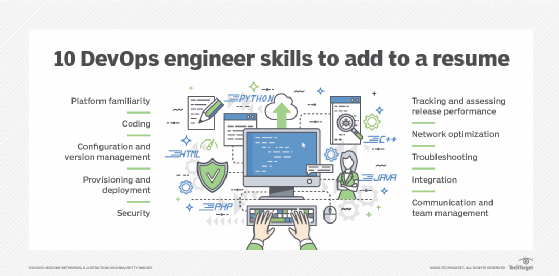
DevOps certifications worth having
When you set out to take a DevOps course or gain a DevOps certification, you'll notice that they fall into these three main categories:
- Introductory courses and certifications. These focus on DevOps basics.
- Advanced courses and certifications. These cater to more sophisticated DevOps skills and tools but do not focus on a single platform or company.
- Courses and certifications tied to practicing DevOps in a specific context. Examples of these types of courses include using a particular public cloud or a specific container orchestration platform.
Your goals will help you decide which type of certification or course to pursue.
If you are new to DevOps and don't know where to start, you'll get the greatest benefit with an introductory course or certification. These will help you demonstrate to management that you can work in a DevOps environment, even if you have not yet acquired expertise with the specific DevOps tools the organization uses.
If you are already familiar with DevOps but want to sharpen your skills, an advanced general-purpose DevOps training course or certification is a good alternative. This approach is useful if you already work in DevOps but want to position yourself for a promotion to a lead DevOps engineer role.
Finally, if your company uses a specific DevOps tool set, consider a DevOps course or certification that is tailored to the platforms or tools within it. A variety of DevOps courses and certifications are available for the major public cloud platforms and for popular DevOps tools, such as Jenkins and Kubernetes.
How to prepare for a DevOps certification
There's no rigid set of prerequisites for gaining a DevOps certification. Although many candidates have academic credentials in application development or IT and may also have practical experience in these fields, most certification programs allow anyone to participate regardless of their background.
The resources you need to prepare for a DevOps certification are also readily available. If it's a certification offered by a cloud provider or tool vendor, read through the company's white papers and technical resources to understand how the company approaches DevOps and which best practices it recommends. For general-purpose certifications, follow the latest news and conversations about DevOps to keep yourself up to date with current trends, tools and methodologies.
10 best free DevOps certifications and training courses
When you're ready to start your certification or training, consider one of the following offerings.
1. DevOps Foundation Exam Study Guide
Course details: The DevOps Foundation course prepares learners for the DevOps Foundation exam. This is a beginner-level certification that focuses on key concepts and terminology.
Who should take this course: Beginners looking for a primer on DevOps.
Prerequisites: Some familiarity with software development is helpful but not required.
Duration: Depends on the specific topics the student chooses to study.
2. DevOps Culture and Mindset
Course details: DevOps Culture and Mindset teaches the underlying principles of DevOps, focusing on culture and mindset. The course consists of four modules: essential DevOps concepts, the DevOps mindset, managing work in a DevOps culture and using DevOps to accelerate time to market. The course is free, but you can purchase a certificate that lets you access all course materials, including graded assignments.
Who should take this course: Engineers who know how to use technical tools but want a primer on the DevOps philosophy.
Prerequisites: None, but the course assumes some familiarity with technical tools and processes.
Duration: Two weeks at 10 hours per week.
3. Introduction to DevOps and Site Reliability Engineering
Course details: This course covers the basics of DevOps, including a focus on rapidly building and deploying software and expanding capacity where needed. The course also discusses writing infrastructure as code, the role of observability systems and the role of continuous integration in software delivery.
Who should take this course: Beginner to intermediate practitioners who understand basic DevOps concepts but want to go a little bit deeper, particularly in a Linux environment.
Prerequisites: No prior experience is required.
Duration: The course is self-paced and takes about 10 weeks, spending one to two hours per week.
4. Kubernetes: Getting Started
Course details: The Kubernetes: Getting Started course introduces Kubernetes at a high level, including what it does and how to administer it. You'll learn why a good container orchestration engine is necessary and why Kubernetes is the one to use. From there, you will learn what Pods are and how to use them. Although this free course doesn't focus specifically on DevOps, it can be useful for DevOps engineers who need a quick way to learn about Kubernetes.
Who should take this course: DevOps engineers, developers, administrators or anyone interested in learning about Kubernetes.
Prerequisites: Basic understanding of YAML syntax, Linux commands, Docker and containers. Google Cloud is a plus, but not mandatory.
Duration: Five sections with 13 lectures running just under four hours.
5. Docker Essentials
Course details: The Docker Essentials course offers an in-depth understanding of containers and Docker. You'll create and run multi-container applications using Docker Compose and learn how to manage Docker Swarm Clusters.
Who should take this course: IT students, professionals and teachers; DevOps engineers and enthusiasts; system administrators, software engineers, computer engineers and software developers.
Prerequisites: Basic knowledge of the Linux OS and Linux Command line.
Duration: Five sections consisting of 13 on-demand video lectures totaling just over three and a half hours.
6. Getting Started with DevOps on AWS
Course details: The Getting Started with DevOps on AWS course explains basic DevOps concepts and how to apply them in the AWS cloud. The training is free, but it can be a first step toward preparing for a paid certification, such as AWS Certified DevOps Engineer.
Who should take this course: Developers, IT operations engineers, IT professionals, IT leaders, cloud practitioners, solutions architects and DevOps engineers interested in learning the basic concepts of DevOps on AWS.
Prerequisites: Basic knowledge of the software development cycle, general IT and cloud computing.
Duration: Self-paced, five modules.
7. Preparing for Google Cloud Certification: Cloud DevOps Engineer Professional Certificate
Course details: The Preparing for Google Cloud Certification: Cloud DevOps Engineer Professional Certificate course teaches you the skills to move forward in your career as a data engineer. It's one of the courses that prepares you for the industry-recognized Google Cloud Professional DevOps Engineer certification. Free to audit; certification requires a fee.
Who should take this course: Data engineers, experienced practitioners who want to learn more about DevOps tools and services on Google Cloud Platform.
Prerequisites: Proficiency with Linux and the command-line environment, as well as a basic understanding of scripting.
Duration: Five hours per week for a month and a half.
8. Microsoft Certified: DevOps Engineer Expert
Course details: This extensive training program covers a variety of DevOps topics, including source control, continuous integration, security and testing. The Microsoft Certified: DevOps Engineer Expert course focuses on Microsoft- and Azure-related technologies, but it also covers core DevOps concepts applicable to any environment. There are both self-paced and instructor-led training options.
Who should take this course: Developers, site reliability engineers and Azure administrators.
Prerequisites: Certification in either the Microsoft Certified: Azure Administrator Associate course or Microsoft Certified: Azure Developer Associate course. An individual must have basic familiarity with both Microsoft Azure development and administration and have strong skills in one of these areas. Candidates should also be familiar with Azure DevOps and GitHub.
Duration: Approximately 60 hours.
9. Developing Cloud-Native Apps with Microservices Architectures
Course details: Delivered as a set of videos, this Red Hat course teaches how to combine different tools and frameworks into a microservices architecture that fits the needs of your organization. The Developing Cloud-Native Apps with Microservices Architectures course covers a variety of DevOps tools, including Docker, Spring Boot, Node.js, .NET, OpenShift, Jenkins, Kubernetes and more.
Who should take this course: Java developers and individuals interested in OpenShift and Kubernetes.
Prerequisites: Understanding of software and IT systems architecture.
Duration: 30 days.
10. Introduction to DevOps
Course details: IBM's Introduction to DevOps course explores the essentials of DevOps, a brief history of DevOps and how to build a business case for DevOps. You'll learn that to adopt DevOps, organizations need to break down silos and combine development and operations teams into one team that works together.
Who should take this course: Individuals new to DevOps and those who want to enhance their knowledge of DevOps.
Prerequisites: None.
Duration: Nine hours.
Editor's note: Andy Patrizio originally wrote this article in May 2021, and it was updated in January 2025 to improve reader experience. Brien Posey updated this article in April 2026.
Andy Patrizio is a technology journalist with almost 30 years' experience covering Silicon Valley who has worked for a variety of publications on staff or as a freelancer, including Network World, InfoWorld, Business Insider, Ars Technica and InformationWeek.
Brien Posey is a former 22-time Microsoft MVP and a commercial astronaut candidate. In his more than 30 years in IT, he has served as a lead network engineer for the U.S. Department of Defense and a network administrator for some of the largest insurance companies in America.