Assembling an ERP project team is challenging because implementations affect many departments. Review the key roles and duties every project should include.
Successfully implementing a new ERP system requires a dedicated team that possesses the necessary skill set to carry out the project. Assembling that group can be a challenging task.
In addition to company employees, the ERP implementation team will likely include individuals from outside the organization, such as an implementation partner, consultants or temporary workers. Company employees who provide input on training or test the new ERP system might come on board later if needed.
What does an ERP implementation team do?
The implementation team has overall responsibility to deliver a functioning ERP system that meets predefined requirements to the company. This entails many steps and constraints that the team must contend with.
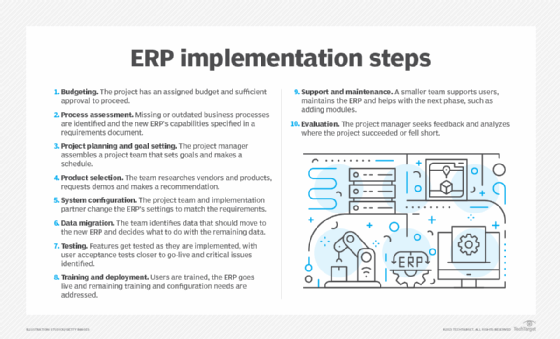
Important steps in the process include the following:
Documenting requirements that outline what the new system must do, setting a budget and building a rough schedule are early steps in the process.
The project team then moves to the ERP vendor selection process, meeting with vendors and attending demos to identify the ERP system that best meets the company's needs.
Once a vendor is selected, the project team finalizes the budget, the contract with the vendor and the implementation schedule.
The implementation team begins configuring the new ERP system.
As the ERP is configured, various members of the team will be responsible for communicating the project's progress to employees, developing documentation and training materials, and testing the ERP as features are implemented.
As the project nears completion, data will be migrated, user acceptance testing will take place, the documentation will be finalized and employees trained.
After the ERP system is finalized and employees begin using the system, the project team will support the transition from the old system to the new one. The team will address questions and issues raised by employees and reconfigure parts of the ERP when required.
The project team will work on shutting down the project by ensuring all documentation is properly stored, all decisions are properly recorded and outstanding issues are either fixed or deferred to a future date.
An ERP implementation includes planning, requirements gathering, configuration, testing, data migration, training, go-live and post-launch support.
The project team is also responsible for working within the following constraints of the project:
Once the budget is set for the project, project leadership is expected to closely track expenses and handle areas of concern within the defined budget. If major issues arise that require more money to be allocated to the project, the project leaders will be expected to follow internal processes to request and justify the need for additional funds.
The implementation schedule is also a constraint that must be managed. Employees and company leadership expect to start using the new ERP system on the go-live date set at the outset of the project.
The number of people who can work on the project is also limited. While there may be some flexibility to grow the team, adding more people impacts costs and the budget.
Project leadership must also consider how the three main constraints listed above impact the overall project and act appropriately when needed. For example, at times more people might be needed to complete a task, which will negatively impact the budget but also help keep the project on schedule. Balancing these competing interests is an important responsibility.
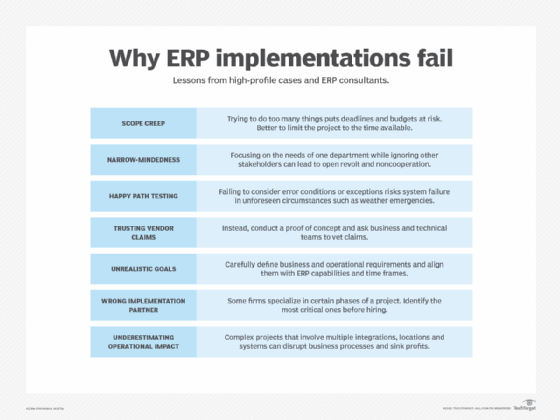
ERP implementations can fail because of poor planning, weak change management, insufficient testing, data problems or unclear ownership.
Key members of an ERP implementation team
While some team members might play more than one role, there are particular jobs that every ERP project team should fill. Here is a list of those key roles and their duties.
Executive sponsor
The project's executive sponsor works on corporate-level items, including securing buy-in from other organizational leaders. The sponsor is a potential escalation point when serious issues arise and can help free up funds if needed. The executive sponsor might also share insight on other company initiatives that could affect ERP planning.
Project leader/owner
The project leader/owner is responsible for the project and will make most of the key decisions with input from other team members. The leader/owner is also typically responsible for building the project team, developing and getting the budget approved, working with the ERP vendor on high-level items and making tough choices when needed. Project leaders are usually senior members of the organization.
Project manager
The project manager is responsible for building a project plan and tracking tasks to ensure they are completed on schedule. Depending on project size and number of implementation partners, multiple project managers might work on an ERP implementation at once. For example, one might take charge of internal resources while another oversees the implementation partner's resources. Very large projects might include a senior project manager who's responsible for the overall project, with more junior project managers managing sub-projects.
Implementation partner
Often, an external party such as the vendor who sold the ERP software license or an implementation specialist assists with the implementation. Typically, the best implementation partner has done multiple ERP implementation projects of the software. Partners usually work with the group to ensure the requirements are clear and then configure the system. The implementation partner might also participate in executive meetings related to the project, document configuration decisions, help with testing and run meetings.
Subject matter experts
These team members often play a key role throughout the project. They help define the requirements, test the new system once the IT team configures it and help develop the training material. Subject matter experts (SMEs) will likely come from multiple business units.
IT
The IT team leads an ERP system implementation. It plays a key role in defining requirements and managing the project and likely appoints the project manager, in addition to ensuring the ERP software integrates with other organizational systems. IT is responsible for security and confirms that the ERP vendor's software is secure, a process that starts before the organization agrees to and signs the contract.
Test team
Throughout the project, the team tests the ERP system to ensure it meets employee needs and that the technology team implements it according to requirements. SMEs are usually part of the test team, but other employees should be included as well. They can help broaden testing coverage because ERP implementation team members might inadvertently skip testing parts of the system that are familiar to them.
Communications
The communications team member is invaluable in supporting successful change management. They help craft company-wide messages to employees that explain the need for the new ERP system, how it will affect employees and why it's important for the organization. Other members of the project team are likely to overlook or skimp on communicating with employees on a regular basis, which can negatively affect the system rollout.
Training
Training employees, and possibly third parties, on the new ERP system is key to ensuring employees use the system properly, people are comfortable with their new processes and productivity does not drop significantly during the transition. The person in charge of training also develops the training material for new employees.
Data migration lead
Every ERP implementation needs a data migration lead because data migration can significantly affect the rollout. If the technology team does not convert important information or does not convert it correctly, employees will have to continue referencing the old ERP system until the data is fixed. Incorrect data in the system can also negatively affect suppliers and customers.
Consultants
Consultants bring project experience that might be missing in-house. They can help develop requirements, evaluate ERP systems and assist with testing the new ERP system, among other tasks.
Change manager
Large ERP projects might have a dedicated change manager. This person is responsible for not only developing a change management strategy and plan, but working with project team members and company leaders to help facilitate a successful change from an old to a new system.
Beyond the technical rollout, the ERP implementation team must also help the organization adopt new processes, trust the data in the new system and sustain the ERP environment after go-live. The goal is not simply to install ERP software, but to make sure the organization can use it effectively.
The goal is not simply to install ERP software. The project team must help the organization adopt new processes, trust the data and sustain the system after go-live.
Best practices for building a successful ERP implementation team
A successful ERP project team is the culmination of many good decisions made when the project team is first formed. Since the project team is often relatively small, everyone must work together to make the project a success. In addition to the project team, others might work on the project to perform certain tasks -- review documentation or training materials -- but they are not involved in the day-to-day running of the project.
The project leader, likely the first person assigned to the project team, should have experience in leading projects of a similar size, be a good communicator, able to make tough decisions and trusted by employees and the executive team.
With the project leader assigned, the next step is to identify the jobs required for the project team. Ideally, the job requirements are drafted without someone already assigned to the position, so that there's no outside influence. Consider the following points when defining the jobs:
How much experience is needed in the given area of responsibility?
How well do team members need to know the system or systems being replaced by the new ERP?
What specific ERP skills are needed? For example, someone might need to know how to program in a certain programming language.
What specific business functions do they need experience in?
Do team members have to be employees, or can they be an external consultant or temporary employee?
Has the candidate been through an implementation before?
Can team members be remote workers, possibly in different time zones?
Is the role employee-facing? This is important since employee-facing team members should be good communicators and listeners.
Does the position require supervising people? If so, is leadership experience required?
Does the position involve confidential information?
With the jobs defined, it's time to identify people to fill the jobs. Ideally, many of the positions will be filled by employees since they know the company's culture, current processes and the systems in use.
Items to consider when selecting people for the project team include the following:
Is the person a top performer?
Do they meet the requirements for the job?
Does the person have time for the project given their other responsibilities?
Is the person trustworthy, especially if the job involves exposure to confidential information?
Are they respected by their peers?
Does the person work well with others?
This same exercise should be undertaken when new people are added to the ERP project team, such as when a team member leaves the company or a new need is identified. Replacing a top performer with a mediocre or unexperienced person partway through the project can have a negative effect not only on the project, but members of the team.
Editor's note: This article was updated to improve clarity and include current ERP implementation team considerations around business ownership, integrations, data migration and change management.
Eric St-Jean is an independent consultant with a particular focus on HR technology, project management and Microsoft Excel training and automation. He writes about numerous business and technology areas.