








Data centers are among the highest consumers of electric power. Studies have shown that data center energy consumption increases annually, with three identifiable trends.
The first trend is that mainstream legacy corporate data centers remain major power consumers, despite many organizations migrating systems and hardware to cloud environments. However, while average use is increasing steadily, it's doing so at a lower rate than 25 years ago, when cloud data centers emerged as a major alternative to legacy facilities.
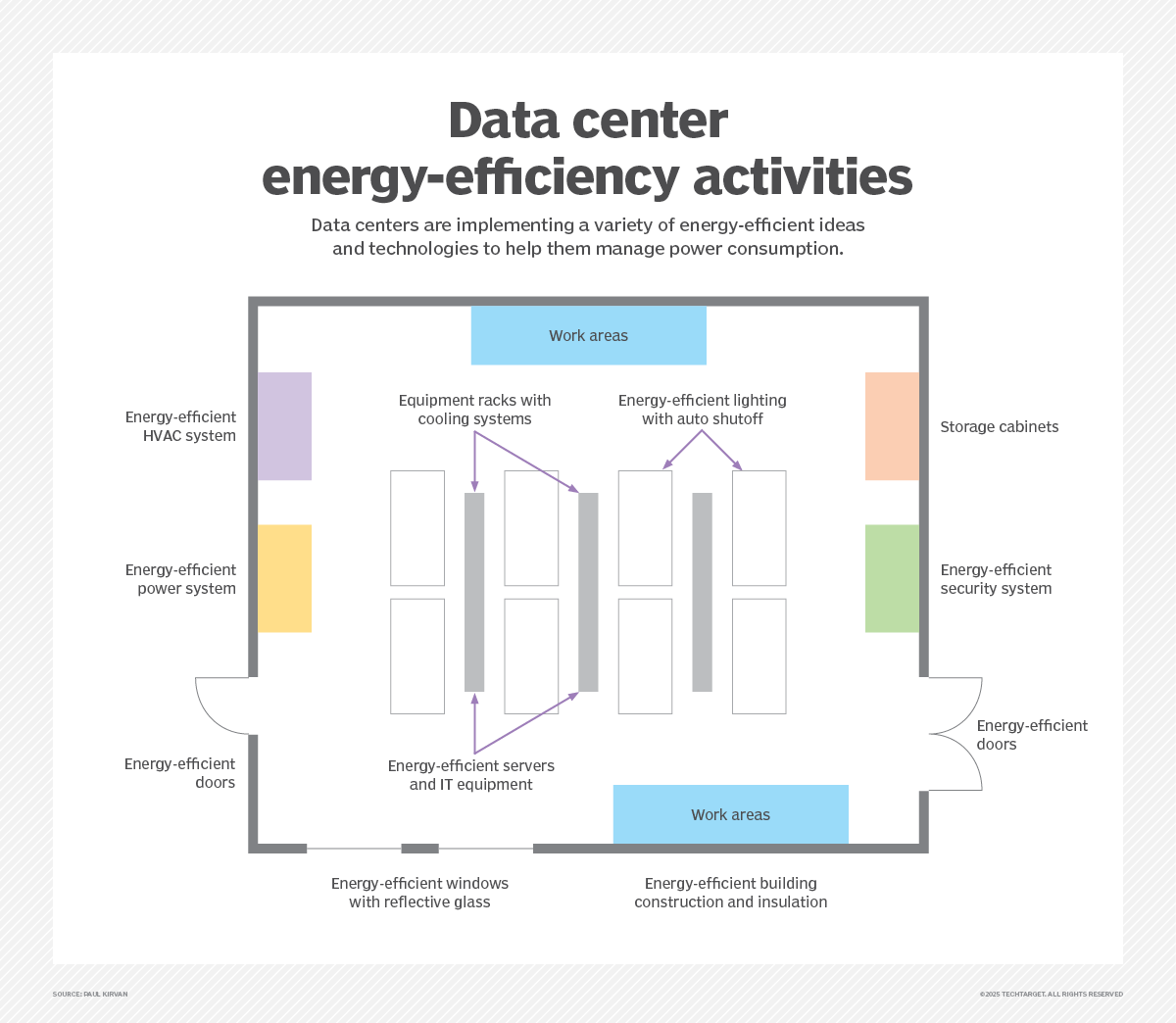
The second trend is that while large cloud data centers, often called hyperscale data centers, are steadily increasing their power usage, they balance that consumption by investing in green initiatives, such as energy-efficient equipment. They're also revamping supporting systems, such as HVAC, security and lighting equipment.
That said, the proliferation of energy-intensive AI applications is a recent trend with major implications for future data center energy consumption.
Estimates on global data center energy usage
The following paragraphs provide estimates and forecasts of data center energy consumption in the U.S. The data reinforces the importance of using energy-efficient equipment in data centers.
The DOE's "2024 United States Data Center Energy Usage Report" was produced by Lawrence Berkeley National Laboratory's Center of Expertise for Energy Efficiency in Data Centers and funded by the DOE's Industrial Efficiency and Decarbonization Office. The report outlines data center energy use from 2014 to 2028.
According to the report, from 2014 to 2016, the annual energy consumption of data centers in the U.S. remained stable at approximately 60 TWh. By 2018, this figure had increased to around 76 TWh, accounting for 1.9% of the country's total electricity consumption. As of 2023, energy use by U.S. data centers reached 176 TWh, accounting for 4.4% of the U.S. electricity consumption.
Total data center energy demand more than doubled between 2017 and 2023, according to Berkeley Lab's report. This increase is primarily due to the use of accelerated servers for AI services. The report also projects that total data center power demand will be between 74 and 132 GW (gigawatts) in 2028. This data center power demand would account for about 6.7% to 12.0% of total U.S. electricity consumption in 2028.
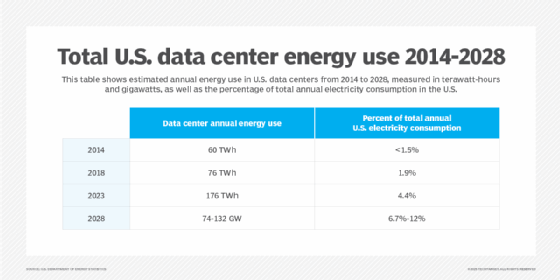
Based on historical data, the electricity consumption of U.S. data centers grew at an accelerating compound annual growth rate (CAGR) of about 7% from 2014 to 2018 and 18% from 2018 to 2023. The report predicts this growth rate to increase further -- ranging from 13% to 27% between 2023 and 2028 -- based on an analysis of new trends and the most recent available data.
The U.S. Energy Information Administration's (EIA) Annual Energy Outlook 2026 report projects that electricity consumption will continue to grow by 0.9% to 1.6% through 2050, citing data center server energy as a main driver. As the stock of AI servers grows exponentially through 2040, the report estimates that data center energy use will reach 818 billion kWh by 2050, implying that server energy consumption in 2050 would be 16 times that in 2020, despite increasing server computational efficiency over time. These projections are part of the EIA's high electricity demand case.
The integration of new energy-efficiency strategies is necessary to reduce the negative effects of current and future energy surges in the data center industry. However, broader strategies are also needed to manage server energy consumption and curb rapidly increasing data center energy demand on a global scale.
A closer look at data center types and energy use
Traditional data center operators are typically concerned with maximizing output and performance, often overlooking the power implications. For large organizations, the need for increased computing power often led to the construction of additional data centers, significantly increasing energy consumption. However, the availability of significant computing resources without requiring floor space fueled the trend toward shutting down legacy data centers and moving operations to the cloud.
Non-hyperscale cloud data centers demonstrate their use of energy-efficient equipment and environmental systems by maintaining steady energy consumption. Hyperscale cloud data centers have steadily increased their energy usage and effectively managed it for similar reasons.
Hyperscale data centers have aggressively invested in sustainability strategies for two primary reasons. According to Uptime Institute's research, larger facilities are more efficient and more likely to yield an ROI from energy savings. This is partly due to newer hyperscale data centers using leading-edge equipment that provides more efficient cooling designs and optimized controls.
There's also something to be said for operating at larger scales. Large data centers are more likely to have blind spots and less granular control over their equipment because there are so many machines operating. When automated tools are applied across the board, the gains are greater than in smaller data centers that might already have deeper insight and control over operations.
Another reason for this investment in green technologies is the growing customer demand that's spotlighting hyperscalers' energy consumption, pressuring them to find eco-conscious resources. This pressure has led to positive change.
According to Data Centre Magazine, for example, AWS has set ambitious sustainability goals, including reaching net-zero emissions by 2040 and using 100% renewable energy by 2025 -- five years ahead of their original target of 2030. They managed to achieve the latter goal: By the end of 2024, Amazon had matched 100% of the electricity consumed by 24 AWS data center regions with renewable, carbon-free energy sources. Amazon's data centers also reported an average power usage effectiveness (PUE) of 1.14 in 2025, an improvement from the year prior. This PUE is better than both the public cloud industry average of 1.25 and the on-premises enterprise data center average of 1.63, according to IDC estimates.
AWS is just one example of how hyperscalers are incorporating green initiatives. When investments are made on such a large scale, they lower the barrier to adoption for others in the industry. This can have a cascading effect, helping other data centers deploy green technologies to save energy.
The future of data center energy consumption
Energy-efficient equipment and green data center operations can help keep energy costs under control. However, the boom in energy demand may be significantly more challenging to balance out in the years ahead.
An analysis of U.S. data center energy demand in McKinsey & Company's Global Energy Perspective 2025 report estimates an average annual growth rate of nearly 25% through 2030. If current trends continue, data centers could account for more than 14% of total U.S. power demand by the end of the decade. The report states that data centers are a growth driver of global electricity demand, and, partly because of this, total electricity demand could double the 2023 level by 2050.
McKinsey also points to the scaling of new technologies, such as AI, as a primary driver of data center energy demand. The report notes that the effect AI could have on future energy demand could vary depending on the growth trajectories of its applications.
The benefits of energy efficiency and green data center operations are just part of the efforts to manage energy costs and demand, especially given the rapid growth of power-hungry technologies like AI.
Why do data centers consume so much energy?
There are many types of equipment in a data center, virtually all of which need electricity. The following figure depicts the various kinds of energy-consuming devices, not to mention overhead lighting, found in a typical data center.
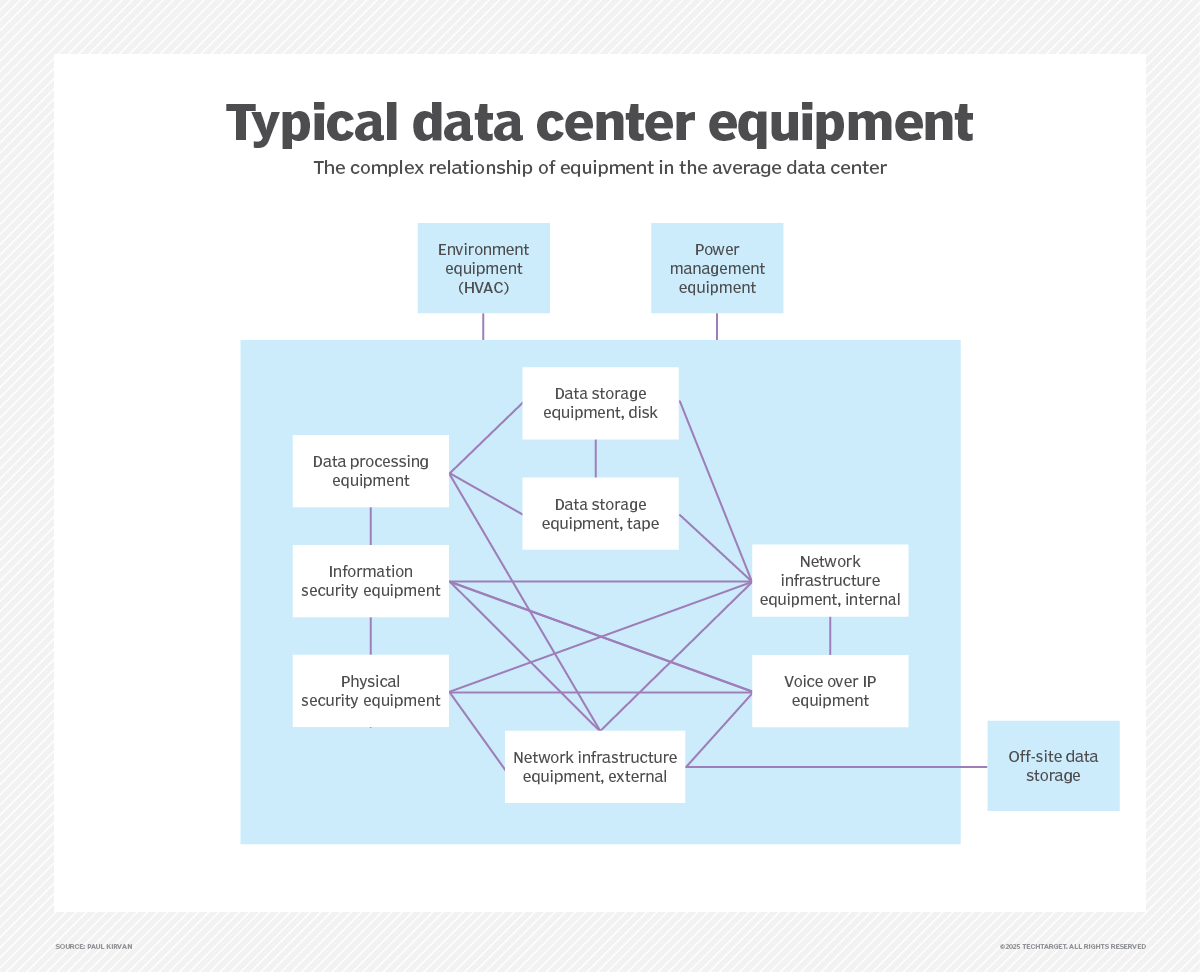
Older servers and network communications equipment consume more power than newer, more energy-efficient systems. The above elements can be updated with newer systems that reduce electricity demand.
The rapidly accelerating AI trend is pushing systems to their limits in many ways. To develop, train, deploy and use in real-world applications, AI models require vast volumes of data and intensive computations. Conducting those complex data processes and computational workloads requires significant energy. One Google search, for example, uses about 0.3 watt-hours, whereas an AI-powered ChatGPT request consumes around 2.9 watt-hours. That's almost 10 times the amount of power consumed.
According to the IEA, the speed and manner in which AI use will grow is unclear. Current data suggests that household and business adoption of AI is rapid, but overall energy demand could vary greatly depending on which types of AI services remain popular.
Generative AI that creates videos is more energy-intensive than AI that creates text. From a business standpoint, the financial returns on AI have yet to be fully seen or measured. If the ROI is not what organizations expect, spending and energy use could dramatically decrease in the future.
Another point to consider is that the efficiency of AI-related computer chips, such as GPUs, has doubled about every two and a half to three years between 2008 and 2023. Modern AI chips use nearly 99% less power to perform the same computations as a model from 2008. If these advancements continue at the same relative pace, it could reduce the expected steep rise of AI energy demand.
But the components of those chips are getting more expensive. According to Reuters, memory chip prices doubled in the first quarter of 2026 and could increase by up to 63% in the second quarter. Consumer goods are suffering as a result, with Xbox CEO Asha Sharma stating that storage components for Xbox consoles were twice as expensive in the spring of 2026 as they were in fall 2025. The chip shortage is expected to worsen and last at least through 2027, with Sharma expecting prices to be over five times what they were two years ago. These price increases are largely driven by demand for AI data centers.
According to the IEA, total data center electricity consumption today is around 415 TWh, which is about 1.5% of global electricity consumption. It has grown about 12% year-over-year for the last five years. The surging demand for AI workloads and the deployment of high-performance accelerated servers are largely driving this growth: Accelerated servers account for nearly half of the increase in global data center energy consumption. The IEA's Base Case projects that total data center electricity consumption will double by 2030, rising to about 945 TWh (around 3% of global electricity consumption). It is projected to grow at an even higher rate of 15% year over year.
However, the impact of rising energy costs and use is uncertain. Potential options to reduce energy consumption include rethinking data center design for better efficiency, updating power distribution models, investing in energy-efficient technologies -- such as new AI chips and more effective liquid cooling processes -- and adopting renewable resources. If such solutions are adopted on a global scale, they might help balance -- but not necessarily eliminate -- the financial and environmental costs of AI energy demand.
While the future of AI energy demand in data centers remains uncertain, its short-term impact is undeniable. To avoid ballooning operational costs and environmental impacts, data center admins can implement a few strategies to keep pace with current energy demand and prepare for future spikes.
How is data center energy consumption being addressed?
Organizations can pursue numerous strategies to improve data center energy efficiency and reduce energy demand. These initiatives are generally grouped under the term "green data centers."
The following are green data center strategies, with a focus on cloud data centers.
Energy efficiency
To become carbon-negative and reduce carbon emissions, cloud vendors use eco-friendly power sources, contract with power-generation utilities to supply green energy, regularly measure PUE, and document plans and time frames for their green goals.
Use of renewable energy
Wind and solar energy are among the most frequently used renewable energy sources by cloud vendors. Nuclear energy and hydropower are also promising alternatives to fossil fuels. Renewable energy sources can be wholly owned and managed by the cloud vendor or obtained through contracts with renewable energy providers.
Efficient data storage and server power measures
According to Energy Star, data centers can identify, consolidate and remove hardware that isn't running at capacity to save on energy and maintenance costs. Specific tools and technologies enhance data storage efficiency, and built-in server power management features can help servers reduce power consumption during low utilization.
Eco-friendly data center buildings
Design and construction of current and future cloud data center buildings typically conform to energy-efficient design specifications. This includes using materials with less embodied carbon, such as limestone instead of concrete, and locally sourced materials.
Data center site selection
Professionals who choose data center site locations should consider places with minimized risk from factors such as floods, earthquakes, hurricanes and other natural disasters. Cloud vendors access low-cost energy and reliable telecommunications infrastructure sources to maximize energy efficiency. Naturally, cold areas can help keep equipment cool without consuming as much energy. Using systems that reuse heat or recirculate water can also reduce power consumption.
Infrastructure energy efficiency
Cloud data centers typically use commercial power and telecommunication resources from utility companies. Cloud vendors often have policies and procedures to assess utility providers' eco-friendliness. Eco-friendly providers typically focus on improving the efficiency of their conductors and transformers, investing in grid-enhancing technologies and automating distribution systems at scale for superior performance.
HVAC management
Energy-efficient cooling systems are part of a typical HVAC suite and are carefully managed for energy consumption. Operators monitor and manage temperature, humidity and heat load to optimize operational conditions. Additional issues to consider include the climate and compliance with local, state and federal regulations.
Protection from fire and water damage
Water detection devices notify data center operators of water leaks or floods. Fire and smoke detection devices and their associated suppression assets -- such as FM-200 discharge, and wet-pipe and dry-pipe water systems -- are located throughout the data center and its adjoining work areas, conference rooms, food service areas and utility rooms.
New economic practices
Data centers can collaborate with electric companies to create a shared economy model that cultivates better balanced energy grids. Circular economy practices also help data centers reduce energy use by making the production process more efficient, sustainable and environmentally friendly.
Microgrids and grid sharing
When data centers are connected to central or regional power grids, it can strain the energy supply and increase costs for the communities that rely on them. It can also worsen the resiliency of energy infrastructure. To combat this, some data centers are building microgrids, localized, self-contained energy systems that can operate independently of central or regional power grids. Microgrids can combine distributed energy sources, such as solar panels and wind turbines, and disconnect from the main grid in the event of a failure to maintain uptime and continue providing power to the data center.
Microgrids are one form of grid sharing, which can help balance energy supply and demand within an electrical network. Grid sharing is key to building a more energy-efficient economy and more reliable and resilient energy infrastructure. However, microgrids are expensive and still new and untested, requiring specialized expertise to deploy and operate.
Monitoring tools and lifecycle assessments
Data centers have IT monitoring tools that measure hardware energy consumption. They use the resulting analytics and insights to reallocate resources and reconfigure assets to improve efficiency. This data also feeds into lifecycle assessments to proactively identify when inefficient equipment needs to be replaced.
Flexible operational strategies
New operational strategies are being developed to meet rising and potentially fluctuating energy demands. These strategies often involve investing in more energy-efficient processors, using virtualization to improve resource flexibility and employing continuous monitoring and analytics to ensure optimal efficiency.
Regulatory intervention
Due to pushback from local communities, certain regions and states are introducing legislation to ban or limit the construction of new data centers to protect against potential impacts on local economies, power grids and the environment. This is challenging data centers to explore and embrace more sustainable strategies in data center construction and operation, which may help standardize data center energy usage and curtail the effects of rising demand on local energy supply.
Green goals for energy consumption
Data center admins are refocusing their strategies on sustainability. While deploying energy-efficient technologies can be a step in the right direction, truly green data centers must incorporate sustainable practices from the top down.
Data centers that aim to significantly reduce energy consumption and commit to sustainability focus on the following goals:
- Track PUE, renewable energy usage, effectiveness and material efficiency.
- Implement efficient airflow management techniques to reduce energy use associated with equipment cooling.
- Deploy energy-efficient hardware to gain more control over use and ensure consumption is minimal.
- Use virtualization to reduce reliance on physical equipment and resources.
- Use power distribution systems that prioritize energy efficiency to reduce power losses and enhance monitoring capabilities.
- Integrate energy efficiency and renewable resources into data center infrastructure. This includes on-site or off-site renewable energy generation or procurement.
By setting green goals, data center admins can ensure energy consumption is always top of mind and as under control as possible. At scale, this can help prevent energy consumption from rising to dangerous levels, even in the face of rising demand and more power-intensive technologies.
Data center power consumption going forward
Data center power consumption will continue to increase in the coming years. This trend is partly fueled by the continued popularity of cloud data centers, which are among the largest energy consumers today, and the rapid proliferation of AI.
The U.S. data center industry isn't the only advocate of green data centers. One example of a major initiative is the Climate Neutral Data Centre Pact, which aims to have climate-neutral data centers in Europe by 2030. The pact also supports the European Green Deal, which aims to make all of Europe climate-neutral by 2050.
In addition, the IEA published its "Net Zero by 2050: A Roadmap for the Global Energy Sector" report in 2021. The report sets out a pathway for the global energy sector to reach net zero emissions by 2050 while maintaining global energy security. This roadmap is consistently updated to keep global warming below 1.5 degrees Celsius. It is part of the United Nations Sustainable Development Goals, which brings together policymakers worldwide to align with a shared mission.
With energy demand set to increase in the years ahead, it's key for data centers to work with these sustainability goals in mind to keep costs low, maintain energy security and protect the environment at large.
Editor's note: This article was updated by Jacob Roundy in June 2026. The update reflects the latest statistics on data center energy consumption, accounts for AI workloads and is formatted to improve the reader's experience.
Jacob Roundy is a freelance writer and editor with more than a decade of experience with specializing in a variety of technology topics, such as data centers, business intelligence, AI/ML, climate change and sustainability. His writing focuses on demystifying tech, tracking trends in the industry, and providing practical guidance to IT leaders and administrators.
Paul Kirvan, FBCI, CISA, is an independent consultant and technical writer with more than 35 years of experience in business continuity, disaster recovery, resilience, cybersecurity, GRC, telecom and technical writing.