








While the labor market is in flux, companies must still use any advantage they can to find and hire the best candidates, and applicant tracking systems can help them succeed. Capabilities such as AI can potentially save recruiters time, and tools for text messaging candidates and asking current employees for referrals can help companies improve their recruiting efforts.
Some vendors offer standalone ATSes, while some HR software vendors include an ATS module as part of a larger offering. CHROs should learn as much as possible about each product so they can make an informed decision about which ATS is right for their company.
What are applicant tracking systems?
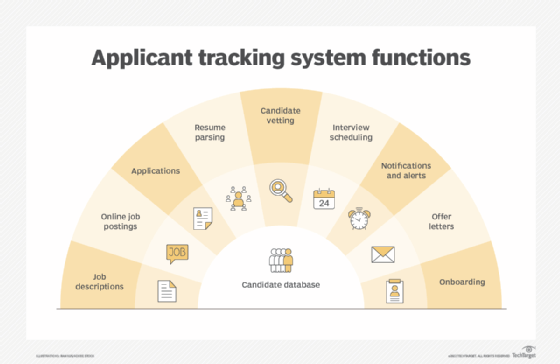
An applicant tracking system is software for managing the recruiting and hiring process. ATS users have different functions available to them based on their role in the recruitment process. For example, a recruiter can use the ATS to post a job, review applications, communicate with candidates and offer the job to the top candidate. Candidates can use the ATS to review an organization's job openings and apply for the ones that match their education, skills and experience. Candidates might also use the ATS to communicate with hiring teams and sign offers of employment. Managers will typically review resumes and add notes based on their interactions with candidates.
The market for applicant tracking systems is large, with some vendors focused on providing standalone ATSes and others including the ATS as part of a talent management suite. Standalone systems often have greater depth of functionality, while suites provide a consistent look and feel across the ATS and other modules and keep all HR data in one system, which can reduce the need for rekeying data.
Applicant tracking systems were originally developed to automate the many steps in the recruitment process. Modern ATSes provide additional features, such as advanced branding options, diversity and inclusion tools, and integration with complementary systems, such as background check services and human resource information system (HRIS) applications. They may also offer CRM (candidate relationship management) functionality to help companies engage past and passive candidates.
Vendors increasingly offer AI and machine learning capabilities for tasks such as reviewing resumes, writing job descriptions, identifying top candidates for open positions and communicating with candidates. Reporting and dashboards have also become increasingly sophisticated.
16 of the top applicant tracking systems
The list below consists primarily of companies that focus on the ATS market, so vendors of HRISes and human capital management suites that include an ATS module do not appear on this list, which is presented in alphabetical order. Vendors were chosen based on information from sources such as Capterra, G2 and Gartner, as well as vendor websites and the author's personal experience working with ATSes.
1. Avature
Avature was founded in 2005 by the co-founder of HotJobs.com, and the software first focused on engaging candidates and sourcing passive ones. Now Avature users can automate the hiring process and customize the system to meet their companies' unique needs.
The software also includes functions for contingent workforce management, onboarding, performance management and succession planning, as well as a recruiting events management feature for planning, promoting and tracking the outcomes of recruiting events.
2. Breezy
Breezy has more than 17,000 clients in over 80 countries. The software enables users to communicate with candidates by text and email, and it offers templates for various HR and talent acquisition interactions.
The system also integrates with diversity, equity and inclusion (DEI) job sites and offers features to help attract a diverse candidate base, including deleting information such as gender from job applications to help prevent bias. The vendor also offers an onboarding module to welcome new hires to the company.
3. ClearCompany
ClearCompany was founded in 2004 as HRM Direct, and its talent management suite includes an ATS, onboarding, background checks, performance management, learning management, employee engagement and compensation.
The system supports video interviews and text messaging with candidates, and offers English, French and Spanish candidate communication. ClearCompany makes it easy to brand offer letters, even if a company has multiple locations.
The software also includes AI capabilities for processes such as writing job descriptions and composing emails.
4. Greenhouse
Greenhouse offers a mobile app , over 500 prebuilt integrations and an open API so the software can connect to a company's HRIS and other applications such as Slack and DocuSign.
The software also includes reporting and dashboards to help track the recruitment process, scorecards to attempt to avoid bias in interviews, access to more than 1,000 job boards and an onboarding module.
5. ICIMS
ICIMS' talent acquisition system includes AI capabilities for identifying potential candidates already in the database, interacting with candidates through a chatbot and providing insights across the platform. The system also includes other features that can help companies maintain a connection with internal and external talent, as well as onboarding capabilities.
ICIMS also has a large number of partners that offer specialized services.
6. JazzHR
JazzHR is aimed at small businesses and has won awards for its offerings. It is owned by Employ Inc., which also offers other applicant tracking systems.
The company's evaluation system can compare candidates and attempt to reduce bias in the hiring process using scorecards. The software also integrates with popular calendar applications for interview scheduling and supports an unlimited number of job listings and users, avoiding the need to pay additional fees if a company hires more recruiters.
JazzHR also lets users request and receive referrals from employees' and recruiters' personal networks, track candidate progress and receive applications by text.
7. Jobvite
Jobvite's ATS lets users add extra functionality, including onboarding features for new hires, chatbots, CRM and video screening, among other additions. AI capabilities include searching the candidate database to identify and rank previous candidates, sending candidate messages and scheduling interviews with applicants.
Recruiters can receive training and certification using the vendor's Jobvite Academy. Like JazzHR, Jobvite is owned by Employ Inc.
8. Lever
Lever is easy to use and maintain and includes built-in integrations with popular HR systems. Users can pull data from multiple Lever sources, such as a candidate profile or job offer, and push it to the company HRIS.
The software also includes integrated candidate relationship management capabilities to help build long-term relationships with candidates who may be a fit for future positions as well as features that support DEI programs, such as evaluating whether the company is meeting its DEI goals. The software enables users to create multiple postings for one job, which could be helpful for companies that operate and hire in various locations.
9. Manatal
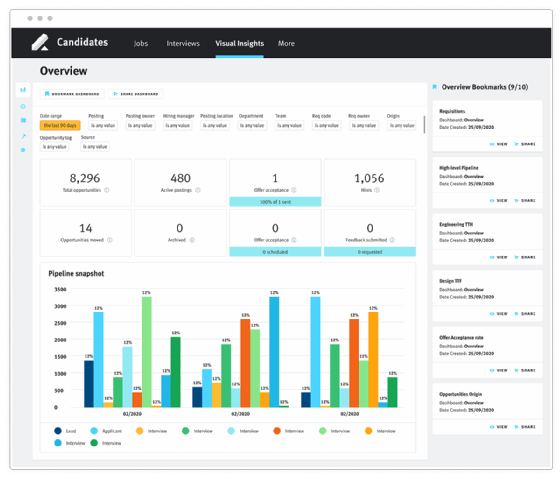
Manatal uses AI to develop candidate profiles by mining data from social media and other sites and to offer recommendations about which candidates are the best fit for open jobs.
The progressive web app design lets users access the software on any device, and Manatal is transparent about the system's performance uptime, providing a link on its homepage to a log of software issues, resolutions and improvements.
10. Pinpoint
Pinpoint offers multilingual applicant tracking software that includes a built-in onboarding feature to help simplify the process of completing new-hire forms and processes. The system also includes preconfigured integrations with job boards and an employee referral feature.
Users can add any agencies to the system that the company uses to help fill vacancies and can customize the system's requisition approval process.
11. Recruitee
Recruitee offers an ATS as well as onboarding tools, e-signature functionality and AI capabilities that can help automate manual recruiting processes. Recruitee supports WhatsApp as a communication tool for the hiring process, which is unusual. Candidates can apply using WhatsApp and use it to chat with recruiters.
Recruitee was formed by combining the companies KiwiHR, Javelo and Recruitee.
12. SeekOut
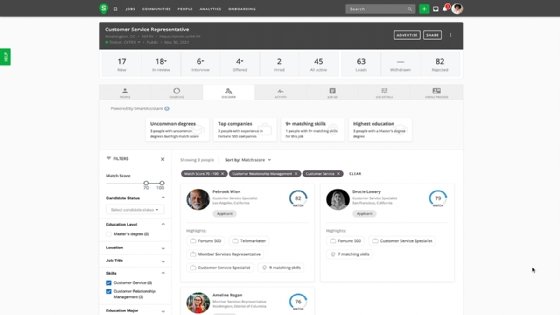
SeekOut was founded in 2016 by former Microsoft executives and engineers. The software uses AI to mine publicly available content on social media and other sources to help recruiters find passive candidates and build internal and external candidate profiles. The AI engine also matches internal and external candidates to open positions.
SeekOut also includes tools to help companies meet their diversity recruiting goals, including the ability to analyze representation among candidates. The system's detailed employee profiles can foster employee development and support internal mobility programs.
13. SmartRecruiters
SmartRecruiters was acquired by SAP SE in 2025, and SAP says the software will be integrated into SAP SuccessFactors but remain available as a standalone ATS as well. The ATS can automate the full talent acquisition process, including recruitment marketing, offer management, onboarding and compliance. The software also offers interview scheduling capabilities and interview scorecards to attempt to avoid bias.
SmartRecruiters' AI can carry out resume screening, and a chatbot can communicate through text and WhatsApp. A central inbox captures all candidate communication, regardless of the communication method.
14. Taleo
Founded in 1996 and acquired by Oracle in 2012, Taleo possesses one of the largest client bases in the talent acquisition industry.
Taleo's ATS offers a wide range of configuration options and integrations with third-party vendors. The software uses AI to parse resumes and award points based on keywords. The software can also assign more points to certain words if necessary.
15. Trakstar
Trakstar is owned by Mitratech, and the vendor's website claims Trakstar has over 3,000 customers. Its talent management suite includes an ATS as well as performance management, learning and workforce analytics modules.
The ATS, Trakstar Hire, can post open positions in multiple locations simultaneously, and the software can parse a candidate's email and accompanying resume to automatically create a candidate profile. Users can add a talent sourcing partner to the ATS, so all recruiting takes place in one system.
16. VidCruiter
VidCruiter's end-to-end interview platform makes it easy to incorporate video into the hiring process, including videos of candidates answering prescreening questions.
Candidates can also use the platform to take online skill tests, with or without a proctor. If candidates complete skills assessments without a live proctor, the software can limit and track candidates' actions. For example, VidCruiter can prevent candidates from pasting in answers and track instances of a candidate switching tabs or applications. It also has a tool for checking whether a candidate is a deepfake.
The platform can help plan virtual events and automate the reference-checking process.
Eric St-Jean is an independent consultant with a particular focus on HR technology, project management and Microsoft Excel training and automation. He writes about numerous business and technology areas.