





Executives across all business sectors have been making substantial investments in machine learning, saying it is a critical technology for competing in today's fast-paced digital economy.
"Machine learning is the backbone of today's business, turning data into insights and insights into action and predictability. That's why machine learning is highly useful," said Adnan Masood, chief AI architect at UST, a digital transformation solutions company.
The proof? Masood pointed to the fact that machine learning (ML) supports a large swath of business processes -- from decision-making to maintenance to service delivery.
That, in turn, is driving the ongoing adoption of machine learning, with technology and business leaders implementing ML capabilities throughout their operations.
Machine learning, a subset of AI, features software systems capable of analyzing data and offering actionable insights based on that analysis. Moreover, it continuously learns from that work to produce more refined and accurate insights over time.
It is a powerful, prolific technology that powers many of the services people encounter every day, from online product recommendations to customer service chatbots.
In fact, experts said that many of the AI capabilities used by companies today are specifically associated with machine learning.
The benefits of machine learning can be grouped into the following four major categories, said Vishal Gupta, partner at research firm Everest Group.
- Efficiency. This is achieved primarily through increased productivity or optimized processes.
- Effectiveness. Machine learning can improve the quality of work done.
- Experience. Workers, customers and other stakeholders have an overall better interaction using machine learning.
- Evolution of the business itself. Machine learning enables new products, services and market opportunities.
The "2024 IT Outlook Report" -- commissioned by Rackspace Technology in partnership with Dell Technologies and VMware -- found that 34% of the 1,420 IT professionals surveyed said machine learning will be a priority at their organizations in 2024.
"There are many use cases across most businesses where machine learning is in place today and can still be put in place tomorrow, even in a world where generative AI exists," said Ryan Gross, partner in the data practice at consulting firm Credera. "In fact, machine learning is often the right solution. It is still the more effective technology, and the most cost-effective technology, for most use cases."
Common machine learning use cases
Although there are myriad use cases for machine learning, experts highlighted the following 12 as the top applications of machine learning in business today.
1. Chatbots
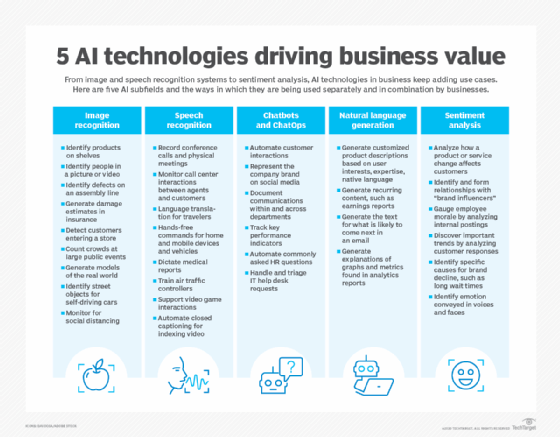
The majority of people have had direct interactions with machine learning at work in the form of chatbots.
Aptly named, these software programs use machine learning and natural language processing (NLP) to mimic human conversation. They work off preprogrammed scripts to engage individuals and respond to their questions by accessing company databases to provide answers to those queries.
Early generations of chatbots followed scripted rules that told the bots what actions to take based on keywords. However, ML enables chatbots to be more interactive and productive, and thereby more responsive to a user's needs, more accurate with its responses and ultimately more humanlike in its conversation.
Digital assistants such as Apple's Siri and Amazon's Alexa are everyday examples of chatbots, as are the chatbots that provide the first point of contact for most customer call centers today.
2. Recommendation engines
Machine learning also powers recommendation engines, which are most commonly used in online retail and streaming services.
Here, algorithms process data -- such as a customer's past purchases along with data about a company's current inventory and other customers' buying history -- to determine what products or services to recommend to customers.
Recommendation engines let companies personalize a customer's experience, which helps with customer retention, and enables companies to increase sales by offering products and services that more accurately match what each customer likes and wants.
"That recommendation engine is profiling you and saying, 'People like you bought these other things,' and so then you end up buying them, too," explained Rod Fontecilla, who served as partner and chief innovation officer at consultancy Guidehouse until March 2024.
3. Dynamic pricing
Machine learning also enables companies to adjust the prices they charge for products and services in near real time based on changing market conditions, a practice known as dynamic pricing.
"You look at consumer behavior and buying patterns to move your pricing up and down; it's a very valuable use of machine learning for companies," said Vikas Agarwal, a financial services risk and regulatory leader at professional services firm PwC.
Machine learning systems typically use numerous data sets, such as macro-economic and social media data, to set and reset prices. This is commonly done for airline tickets, hotel room rates and ride-sharing fares. Uber's surge pricing, where prices increase when demand goes up, is a prominent example of how companies use ML algorithms to adjust prices as circumstances change.
4. Customer churn modeling, customer segmentation, targeted marketing and sales forecasting
In many organizations, sales and marketing teams are the most prolific users of machine learning, as the technology supports much of their everyday activities. The ML capabilities are typically built into the enterprise software that supports those departments, such as customer relationship management systems.
So much so, that "these have become table stakes," Gross said. "And if you're not using these, you're probably behind the competition."
Machine learning supports multiple marketing activities.
First, there's customer churn modeling, where machine learning is used to identify which customers might be souring on the company, when that might happen and how that situation could be turned around. To do that, algorithms pinpoint patterns in huge volumes of historical, demographic and sales data to identify and understand why a company loses customers. The company can then use machine learning capabilities to analyze behaviors among existing customers to alert it to which ones are at risk of taking their business elsewhere, identify the reasons why they're leaving and then determine what steps to take to retain them. "Think of it as a recommendation engine built for retail," Masood said.
Companies also use machine learning for customer segmentation, a business practice in which companies categorize customers into specific segments based on common characteristics such as similar ages, incomes or education levels. This lets marketing and sales tune their services, products, advertisements and messaging to each segment.
Additionally, machine learning supports sales by helping customers set the optimal prices for their products and ensures they deliver the right products and services to the right areas at the right time through predictive inventory planning and customer segmentation. Retailers, for example, use machine learning to predict what inventory will sell best in which of its stores based on seasonal factors affecting a particular store, the demographics of that region, what's trending on social media and other data points, Masood explained.
5. Fraud detection
Another prominent use of machine learning in business is in fraud detection, particularly in banking and financial services, where institutions use it to alert customers of potentially fraudulent use of their credit and debit cards.
Machine learning's capacity to understand patterns, and instantly see anomalies that fall outside those patterns, makes this technology a valuable tool for detecting fraudulent activity.
This is how it works: Data scientists use machine learning to understand an individual customer's typical behavior, such as when and where the customer uses a credit card. Machine learning takes that information along with other data to accurately determine in mere milliseconds which transactions fall within the normal range and are therefore legitimate versus which transactions are outside expected norms and therefore are likely fraudulent.
Although this application of machine learning is most common in the financial services sector, travel institutions, gaming companies and retailers are also big users of machine learning for fraud detection.
6. Cyberthreat detection
Machine learning's capacity to analyze complex patterns within high volumes of activities to both determine normal behaviors and identify anomalies also makes it a powerful tool for detecting cyberthreats.
Moreover, its capacity to learn lets it continually refine its understanding of an organization's IT environment, network traffic and usage patterns. So even as the IT environment expands and cyberattacks grow in number and complexity, ML algorithms can continually improve its ability to detect unusual activity that could indicate an intrusion or threat.
7. Optimization
Another use case that cuts across industries and business functions is the use of specific machine learning algorithms to optimize processes. Companies can have the algorithms analyze data and run simulations to determine optimal or near-optimal solutions, or they can use algorithms to offer next best actions -- predictions and recommendations the technology has determined will lead to the best result.
Management advisers said they see ML for optimization used across all areas of enterprise operations, from finance to software development, with the technology speeding up work and reducing human error.
They further noted that its use in logistics, manufacturing and supply chain has delivered particularly significant benefits.
"Machine learning and graph machine learning techniques specifically have been shown to dramatically improve those networks as a whole. They optimize operations while also increasing resiliency," Gross said.
8. Decision support
Organizations also use machine learning to help them make better decisions.
For its survey, Rackspace asked respondents what benefits they expect to see from their AI and ML initiatives. Improved decision-making ranked fourth after improved innovation, reduced costs and enhanced performance.
Experts noted that a decision support system (DSS) can also help cut costs and enhance performance by ensuring workers make the best decisions.
To support decision-making, ML algorithms are trained on historical and other relevant data sets, enabling them to then analyze new information and run through multiple possible scenarios at a scale and speed impossible for humans to match. The algorithms then offer up recommendations on the best course of action to take.
In the healthcare sector, a DSS can assist clinicians in diagnosing patients, reading and interpreting medical imaging and diagnostic scans, and developing treatment options.
In agriculture, machine learning-enabled decision support tools incorporate data on climate, energy, water, resources and other elements to guide farmers on their crop management decisions.
In business operations, a DSS can help management teams anticipate trends, identify problems and speed up decisions.
9. Predictive maintenance
Powering predictive maintenance is another longstanding use of machine learning, Gross said.
Company machine learning systems take data from numerous disparate sources -- historical operational data, performance data coming from IoT devices, supply chain data and market prediction information -- to predict the optimal time to perform maintenance on equipment.
Predictive maintenance differs from preventive maintenance in that predictive maintenance can precisely identify what maintenance should be done at what time based on multiple factors. It can, for example, incorporate market conditions and worker availability to determine the optimal time to perform maintenance.
This minimizes the effect of any equipment downtime while maximizing investments in the equipment by not scheduling unnecessary maintenance or scheduling work unnecessarily early in the equipment lifecycle.
Airliners, farmers, mining companies and transportation firms all use ML for predictive maintenance, Gross said.
Meanwhile, some companies are using predictive maintenance to create new services, for example, by offering predictive maintenance scheduling services to customers who buy their equipment.
10. Monitoring and quality assurance
Machine learning's capacity to understand and distinguish patterns in data at a scale, speed and level unmatched by humans makes the technology particularly useful for monitoring needs and quality assurance, said Nicolas Avila, CTO for North America at IT services firm Globant.
As an example, he pointed to the use of machine learning to monitor supply chain operations, with the technology continually analyzing patterns to identify anything that diverts from normal parameters and, thus, could indicate an issue that needs attention.
"It's able to highlight anything that doesn't seem right," Avila said.
Meanwhile, ML technology types such as deep learning, neural networks and computer vision can be used to more effectively and efficiently monitor production lines and other workplace outputs to ensure products meet established quality standards.
11. Sentiment analysis
With sentiment analysis, machine learning models scan and analyze human language to determine whether the emotional tone exhibited is positive, negative or neutral. ML models can also be programmed to rate sentiment on a scale, for example, from 1 to 5.
Companies often use sentiment analysis tools to analyze the text of customer reviews and to evaluate the emotions exhibited by customers in their interactions with the company.
Sentiment analysis also lets companies react more appropriately to customers' needs, Fontecilla said.
For example, the use of sentiment analysis in a call center can help identify a customer's tone and share that analysis with other systems -- such as a chatbot or a human agent's DSS -- to adjust responses or recommended scripts based on those emotions.
12. Information extraction
Information retrieval and information extraction systems -- built using ML technologies such as NLP, optical character recognition and intelligent character recognition -- automatically identify key pieces of structured data from documents even if the information is held in unstructured or semistructured formats.
The technology can also be used with voice-to-text processes, Fontecilla said.
This use of machine learning brings increased efficiency and improved accuracy to documentation processing. It also frees human talent from what can often be mundane and repetitive work.
Editor's note: This article was updated in June 2024 to provide updated research figures and to improve the reader experience.
Mary K. Pratt is an award-winning freelance journalist with a focus on covering enterprise IT, cybersecurity management and strategy.