How leaders can spot AI drift before it hurts the busines...
Rahul Awati·2026-06-24·via WhatIs
The companies that win with AI aren't those with the best models at launch; they're the ones who notice when things start to slip and respond before their customers do.
When it comes to enterprise AI, most organizations focus on how it can enhance the productivity and creativity of their human workforce, boost operational efficiency and lower costs. Such optimism regarding the power and potential of AI is both understandable and often even defensible. At the same time, many business executives and leaders make a common mistake: They fail to account for AI drift.
The term AI drift -- often discussed as model drift -- refers to the degradation of an AI model's performance over time, leading it to produce increasingly inaccurate, irrelevant or biased predictions. It can be problematic because even a small performance drop can compound into major business problems: process inconsistency, operational errors, higher costs, workforce burnout, eroded trust in AI-driven decision-making, and lost customer trust and revenue.
According to a 2025 AI governance survey by Pacific.ai, only 48% of organizations reported monitoring their production AI systems for accuracy, drift and misuse. Another more recent report by Deloitte revealed that only 21% of organizations have mature governance capabilities to manage the risks of autonomous AI, even though AI use is escalating and its risks -- including drift -- are not unknown. As enterprises move to large-scale AI deployment, managing AI drift has become a critical business and leadership imperative. This article suggests some practical ways that can help organizations manage AI drift before it undermines business outcomes and, in doing so, protects the value of AI investments.
What AI drift looks like in practice
Two of the most common types of AI drift are data drift and concept drift.
Data drift
This type of drift occurs when the incoming data has characteristics different from those of the training data.
An example of data drift is an AI-enabled chatbot that can no longer answer customers' product-related queries. If the chatbot could independently handle up to 70% of queries in the past but now escalates almost 50% to human agents, that might be because it cannot keep up with changing product lines. Since the input data has changed, the chatbot produces irrelevant responses that annoy customers and increase friction during their purchase journey.
Concept drift
This type of drift occurs when the relationship between the input variables and the output, or target, variables changes. If what the organization is trying to predict changes, the original definitions might no longer remain valid, so the AI algorithm could start generating incorrect outcomes.
AI-enabled fraud detection is a good example of concept drift. These systems establish a behavioral baseline for legitimate customers and then use this baseline to identify anomalous and potentially fraudulent behaviors, such as fabricated identities and money laundering attempts. But a drifting system also flags and blocks legitimate customers because it cannot account for their shifting buying patterns, which might result from factors like travel, inflation or changes in personal circumstances. Consequently, it flags any deviation from historical behavior as fraudulent, even if it's not.
Another example of concept drift is an email spam filter that, over time, cannot identify phishing emails. As spammers' tactics evolve to polished, grammatically correct text, personalized greetings and legitimate-looking domains, the spam filter's ability to classify emails as spam might deteriorate. This would allow more spam emails to land in users' inboxes rather than go to the spam folder.
Signs of AI drift that should be concerning
AI drift often happens quietly, but it can still produce early warning signals. If organizations watch for these indicators, they can take early, proactive action to mitigate drift and maintain the AI system's performance.
Here are some common signals to look for:
Customers are increasingly abandoning AI features or ignoring AI suggestions, resulting in drops in usage metrics, click-through rates or conversion rates.
Customer complaints about inaccurate chatbot responses, poor personalization or inconsistent service are rising.
More customer support tickets complain about below-par AI functionality (e.g., hallucinations) or mention that "the system used to work better."
Support agents must frequently override AI outputs or create "clean-up tickets."
Sales reps report that the AI system often fails to precisely identify high-intent prospects.
Experienced staff point to a growing gap between AI-generated recommendations and what they themselves would suggest to -- for example -- increase sales, strengthen customer relationships or enhance long-term brand value.
The finance team complains that AI-driven forecasts are consistently wrong, confusing or overly optimistic.
AI-driven cybersecurity tools flag too many non-risks as risks (false positives) or fail to flag real threats (false negatives).
Business users express declining confidence in AI-generated predictions.
Leadership has noticed a measurable decline in business KPIs, such as lower customer conversion or retention rates, higher customer churn, declining customer satisfaction scores or higher support costs.
Any of these signals, whether they appear in isolation or in conjunction with other indicators, might indicate that the AI system is no longer aligned with its real-world operating environment. Such misalignment could create numerous operational, financial, strategic, regulatory and reputational hazards for the organization.
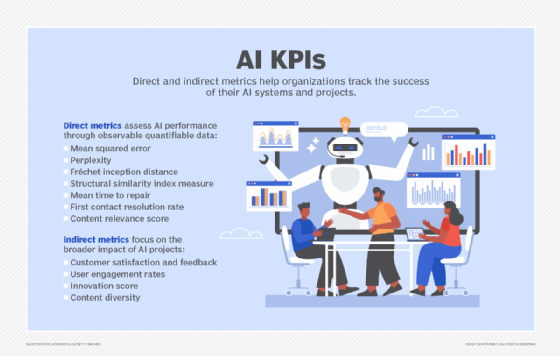
Companies can use both direct and indirect KPIs to measure the success of AI systems.
Building a practical early-warning system
The best way to prevent widespread AI drift is to build an early-warning system to catch it early. Real-time monitoring can help organizations easily identify the common signs of AI drift. It provides continuous visibility into how models perform after deployment and if they are drifting toward faulty decision-making and poor predictions.
Beyond implementing the right technology, it's important to establish a team of employees dedicated specifically to AI drift detection. This group should include more than just data scientists or machine learning teams. For example, product managers have specialized insight into customer experience metrics, while customer success teams are the first to hear complaints from consumers when something is amiss. Business analysts can focus on outcomes, such as forecast accuracy, while an executive sponsor can ensure resources are allocated where they are most needed.
One of the most critical questions enterprise leaders should ask is whether the AI is still solving the business problem it was designed to address. Does it reduce customer wait times? Reduce the need for manual processing? Reduce costs through automation? If not, there might be a problem that requires immediate attention and remediation.
One of the most critical questions enterprise leaders should ask is whether the AI is still solving the business problem it was designed for.
The monitoring system should also highlight trust issues among users and whether trust is increasing or decreasing over time. Additionally, it should highlight failure patterns that might not be obvious at first glance. For example, are predictions more inaccurate for certain customer segments? Or at specific times of day? Or for certain product categories? After these analyses, organizations can assign resources to diagnose the root cause of the drift and take actionable steps to fix it, such as redesigning AI workflows or auditing and cleaning training data.
Along with monitoring, it's also important to set statistical thresholds so that, when drift exceeds acceptable limits, teams receive immediate alerts -- e.g., "If customer complaints increase X%, we take Y action." With real-time alerts, they can take prompt action before performance degradation affects production operations or customers.
Proactive strategies to stay ahead of AI drift
Continuous monitoring and oversight are essential to preventing -- or, at least, mitigating -- AI drift. Since drift usually builds up gradually, enterprise leaders should ensure AI systems are designed for observability from the start. This means undertaking the following:
Building systems with "inspection points" where business users can see why decisions were made.
Making it possible to view comparison views of "here's what the AI recommended" vs. "here's what actually happened."
Another useful "anti-drift" strategy is to reduce the organization's vulnerability to drift. For example, organizations can deploy an AI observability platform to automate drift detection. They can help automate drift detection, monitor model behavior, evaluate outputs and alert teams when performance changes.
Additionally, organizations can take the following steps:
Schedule regular retraining of AI models.
Add human-in-the-loop for high-stakes scenarios.
Build escape hatches to dial back AI influence if problems emerge.
A cultural shift can also help organizations avoid and manage AI drift. Normalize the discussion of AI failures and provide users with a safe space to say, honestly, "This isn't working." Also, celebrate early detection, rewarding teams that flag AI drift before it becomes a crisis.
Finally, invest in AI literacy at every level of the organization. Business leaders and frontline workers should be able to understand what's realistic to expect from the AI system and which signals matter when it comes to drift discussions.
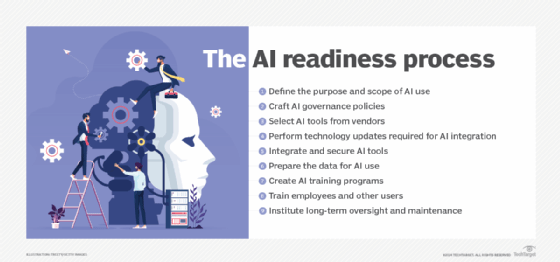
Determining the readiness of an AI project involves several steps, including the creation of AI training programs and the establishment of long-term oversight and maintenance.
Why preemptive action is key
Companies that ignore AI drift or fail to plan for it could experience the erosion of customer trust and face a competitive disadvantage. They also risk wasting their AI investment. To ensure that AI systems maintain value over time and seamlessly adapt to changing conditions, proactive AI drift management is critical.
Ultimately, the companies that win with AI aren't those with the best models at launch; they are often the first to notice when things start to slip and, more importantly, to respond before small errors morph into huge crises.
Rahul Awati is a PMP-certified project manager with IT infrastructure experience spanning storage, compute and enterprise networking.