





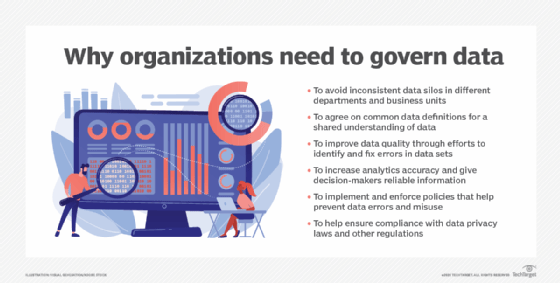
Without effective data governance, growing volumes of data in IT systems are likely to become a disorganized morass, limiting their potential use. The risk of data misuse also increases due to lax controls.
Conversely, well-governed data is consistent and accessible across the enterprise, enabling better-informed business decisions and more accurate analytics and AI applications. Companies are also less likely to experience serious data breaches or data privacy issues, reducing their exposure to regulatory compliance problems, legal liabilities and reputational damage.
As a result, developing a data governance strategy is a high-priority item on the C-suite agenda in well-run companies. The chief data officer and other data leaders play central roles in that process, typically managing it and working closely with their business counterparts to create and then implement the governance strategy.
Getting started with data governance is a big undertaking that commonly requires a substantial budget and significant resource commitments. It might be tempting to buy a strategy from a consultancy or a data governance software vendor that promises a packaged set of policies and tools. But for optimal alignment with your organization's business operations and processes, it's best to develop a tailored one in-house, using these seven steps.
1. Document existing data governance processes
Your company likely already has some data governance processes that should be incorporated into a formal strategy or replaced with new ones. Various people manage and oversee corporate data -- database administrators, backup admins, data architects and data quality analysts, for example. Document this by creating a directory of data assets and a corresponding list of managers and staff who are responsible or accountable for data.
Don't be surprised if this exercise reveals some sobering, even shocking, oversights and gaps. The existing informal approach might reflect a messy reality, but getting a picture of current processes sets the stage for establishing a more strategic data governance program.
2. Secure executive sponsorship for the data governance program
Enlist senior business executives to sponsor, fund and promote the governance program. Their buy-in and top-down influence are critical because effective data governance requires participation and cooperation by departments and business units across the enterprise. But how can you win executive support for an initiative that might not show clear bottom-line benefits, at least not right away?
Invoking fear, uncertainty and doubt is the usual default method. Horror stories of inaccurate data leading to bad business decisions, or of fines for failing to comply with data privacy and protection laws, might be enough to convince business leaders to back a governance initiative. By itself, however, this defensive approach isn't the optimal way to secure long-term data governance commitments.
Instead, combine it with a more forward-looking approach. Explain that data governance is largely informal now and that the company needs a framework with more defined processes. Emphasize that implementing one will not only help improve data quality and meet regulatory requirements but also make the organization more functional and resilient.
Also, address upfront an issue that often causes resentment among business stakeholders and users: the perception that data governance stifles creative uses of data. Data governance policies don't restrict innovation. It's quite the opposite: By creating a more reliable data foundation, effective governance enables new ideas to flourish while reducing the risk of improper data use.
3. Improve data literacy and skills across the organization
End users who understand the potential value of data and how to use it effectively are more likely to recognize the need to protect data assets and prevent misuse. To foster that understanding across the enterprise, develop training to improve data literacy and skills as part of the governance strategy.
Enhanced data literacy also helps raise up data governance efforts in another way. End users often create duplicate reports, dashboards, spreadsheets and even entire databases because they don't know how to find existing ones. A data-literate culture is better equipped to discover and reuse such assets, increasing efficiency and consistency and reducing the risk of data errors. This, in turn, helps streamline governance tasks.
4. Create a virtual governance team at first, then formalize roles
It's too much to ask a company to reorganize upfront to improve data governance. Instead, start by constructing some organizational scaffolding around the existing ad hoc data structures. Identify the key roles currently involved in governance processes and create a virtual team to improve coordination and collaboration.
As governance becomes more formalized, new roles will emerge. A data governance manager or vice president commonly leads a team of data governance specialists who coordinate the program. Some business or IT workers will become data stewards, with direct responsibility for implementing governance policies in particular data sets. That can be a full-time or part-time role, depending on the organization's size and the complexity of its governance needs.
Establishing a data governance council or committee is also a must. It typically includes the following members:
- Representatives from all departments and business units.
- IT, legal and compliance executives.
- Data stewards or others with data ownership responsibilities.
The council sets data governance policies, creates common data standards, prioritizes governance projects and resolves data-related disputes, among other responsibilities. Having one ensures there's broad input on data governance controls and helps pave the way for enterprise-wide adoption of the governance strategy.
5. Decide how to measure the governance program's effectiveness
For a data governance program to gain and maintain support in an organization, it's crucial to measure its effectiveness -- and show how it benefits the company. But effective data governance might not tangibly affect business performance. It also isn't easy to calculate KPIs for reduced business risks, such as avoiding regulatory fines or reputational damage.
Instead, identify key data governance metrics to track and tie them to business benefits such as improved decision-making, optimized business processes and stronger privacy protections. For example, use metrics on data accuracy, completeness, consistency, timeliness and duplication to monitor data quality levels and document improvements that make data more reliable for analytics and AI applications.
Metrics also help identify governance issues. Tracking how often users access data provides insight into whether it's being used effectively. Low usage might indicate a lack of awareness or accessibility. An increase in the overall number of analytics users is a marker of the governance program's success, but further training might be required if metrics also show new users are creating reports and dashboards that duplicate existing ones.
6. Prioritize data governance for new AI applications
Governing data for AI applications is now a key consideration for data leaders and governance teams. Data readiness is critical to successful deployments of machine learning, generative AI and agentic AI tools. Effective data governance ensures that AI models are built on a solid foundation of high-quality data and don't use it in ways that violate privacy and ethics policies.
For example, retrieval-augmented generation (RAG) frameworks pose specific data governance challenges in enterprise AI applications. RAG enables large language models (LLMs) to directly draw from enterprise data -- it retrieves relevant documents or records from internal knowledge bases and uses them to generate responses to user queries.
From a governance perspective, successful RAG use requires not only accurate, up-to-date data but also data lineage documentation that traces an LLM's output back to the original data sources for explainability and performance auditing. Well-managed access control is also necessary. Define and enforce user permissions in the RAG framework to prevent end users from inadvertently seeing data they can't access in conventional analytics applications.
In addition to incorporating AI-related governance processes into your data governance strategy, align them with an AI governance program that monitors and controls AI deployments more broadly. Data governance and AI governance are separate functions, but they go hand in hand and should be tightly integrated.
7. Select technologies that fit the data governance strategy
Various technologies can be used in data governance initiatives. Data governance software automates program management tasks, such as policy development, process documentation, data classification and workflow management. Data catalogs provide a unified inventory of data assets, with built-in governance, data lineage and data curation features. Analytics catalogs help users find relevant dashboards, reports and data visualizations and provide guidance on how to use them appropriately.
For data processing, newer data lakehouse architectures combine the raw data storage of a data lake with the structured, governed repository of a data warehouse. Collapsing the separation between those two platforms streamlines data management and governance work and provides a single system that supports BI, advanced analytics and AI applications.
But don't build a data governance strategy around specific technologies. Selecting tools that align with the strategy and support its goals will put the governance program on track to deliver the expected benefits, rather than running into a technology dead end that undermines the program.
Editor's note: This article was updated in April 2026 for timeliness and to add new information.
Donald Farmer is a data strategist with 30-plus years of experience, including as a product team leader at Microsoft and Qlik. He advises global clients on data, analytics, AI and innovation strategy, with expertise spanning from tech giants to startups.