AI agents can speed up work without simplifying it
James Alan Miller·2026-05-27·via WhatIs
AI agents might simplify work for users, but enterprises still need workflow mapping, process visibility and human oversight to manage hidden complexity.
AI agents might simplify work for users, but that does not mean the work itself got simpler.
That matters as agents move out of pilots and into real enterprise workflows. To the employee, the improvement might be obvious: fewer clicks, fewer screens, faster handoffs and less manual routing from one system to another.
But the work does not disappear. It gets handed off, checked, routed, approved, escalated or stitched back together somewhere underneath the cleaner experience.
An agent might make a workflow more efficient by breaking it into more steps, more checkpoints and more automated actions. What looked like a 10-step process for a person might become a 50-step agent-supported process underneath.
That is not necessarily a flaw.
Agents have the speed, compute and independence to handle a level of granularity that would be impractical for a person or a traditional manual workflow. More steps can still mean more efficiency if those steps happen quickly, consistently and in the right order.
But it also means agentic AI can add hidden complexity even as it removes manual effort.
Agentic AI can add hidden complexity even as it removes manual effort.
Orchestration is not just automation
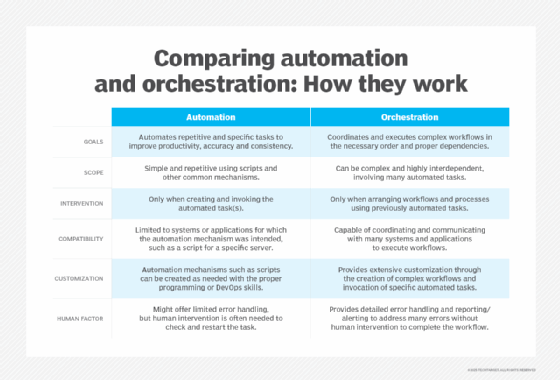
That is where the difference between automation and orchestration matters. Automation usually describes a specific task or set of tasks. A system takes an input, follows a rule and produces an output. That can be powerful, but the scope is often narrow.
Orchestration is different. It coordinates work across tasks, systems, data sources, approvals, dependencies and exception paths. It is not just "do this one thing faster." It is "move this work through the right sequence, using the right systems, with the right controls, until the process reaches the right outcome."
That is the part that can get lost in the AI pitch. The person using the tool might see one cleaner button or one faster answer. The company behind that button still needs to know which systems were touched, which steps were skipped, which ones were added and who owns the result if something goes wrong.
Which systems did the agent touch? Which data did it use? Which steps did it execute? Which decision did it make? Where did it wait for approval? What happened when the process hit an exception?
Those questions matter because agents are not just completing isolated tasks. Increasingly, they are being positioned to help coordinate workflows across applications, teams and business processes.
Agentic AI can make work more efficient by orchestrating more steps, dependencies and automated actions behind the scenes.
Hidden complexity still has to be managed
The user might experience a faster result, while the organization has to manage more dependencies, more exception paths, more checkpoints and more automated decisions behind the scenes.
This is where the unglamorous work matters.
Before an agent can take on more of a process, someone still has to map the work. Where does it start? Which system does it touch first? What data is safe to use? What happens when information is missing or the answer is uncertain? When does the agent keep going, and when does a person need to step back in?
Without that, the agent is not really improving the workflow. It is just moving faster through a process the business might not fully understand.
This is also where vendor tooling can create a false sense of readiness. Dashboards, testing environments, governance controls, observability features and human checkpoints can help organizations manage agents once they go live. They can make agents easier to watch, test and restrict.
An agent needs more than a dashboard watching it; it needs a process that is clear enough to follow. The business has to know where the work starts, which systems matter, what counts as an exception and when the agent should hand the work back to a person.
Vendor tools can help. But they do not replace that work.
A dashboard can show what the agent did. It cannot decide whether the agent should have done it. A checkpoint can stop the process for review, but the reviewer still has to know what they are approving. Governance controls can keep an agent inside a fence, but they cannot make a messy workflow clean.
AI agent effectiveness comes down to two things working together: platform controls from vendors and process clarity from the enterprise using the agents. Vendors can provide more granular control, observability, orchestration and governance. But the enterprise still has to map the work, define the scale path and decide what the agent is supposed to change.
The best version of agent management is not vendor tooling instead of workflow design. It is vendor tooling built on top of workflow design.
Human oversight changes shape
The same logic applies to human oversight.
Human in the loop means people are directly involved in the automated process. They approve, reject or redirect work before it moves forward.
Human on the loop gives AI more independence. The system gets more room to act autonomously, while people monitor the work and intervene when needed. That shift sounds like humans are stepping further away from the process. In reality, it only works if the process underneath the AI is more clearly defined.
For a person to safely move from in the loop to on the loop, the organization has to trust that the agent can perform its function accurately within the boundaries of the business process. That requires rules, workflow clarity, data context, access controls, governance and systems that define what the agent can and cannot do.
The more structure there is beneath the agent, the more room the agent can have to act. The more common and trustworthy the foundation is across the enterprise software stack, the more realistic it becomes for people to monitor AI-supported work instead of approving every move.
A human cannot stay on the loop if the loop itself is unclear.
Map the work before the agent scales
The point is not that AI agents make workflows simple; it is that they can make complicated workflows move faster -- but only if the organization understands the work well enough to manage the added complexity.
That means understanding the workflow before automating it, not after.
Organizations need to know which steps agents should handle, which steps humans should approve, where bottlenecks might appear and what happens when the process runs into an exception. They need to know who owns the output, what systems are involved, which data the agent can use and how success will be measured.
That work can feel slower than launching another pilot or turning on another embedded agent. But it is what gives the organization a better chance of making agentic AI useful in production.
AI agents might eventually reshape enterprise work. But they will not do that well if they are dropped into workflows that no one has clearly defined.
The simplest version of the workflow might be what the user sees. The real work is making sure the hidden complexity underneath is visible enough to manage.
James Alan Miller is a veteran technology editor and writer who leads Informa TechTarget's Enterprise Software group. He oversees coverage of ERP & Supply Chain, HR Software, Customer Experience, Communications & Collaboration and End-User Computing topics.