10 machine learning benefits for businesses | TechTarget
John Moore·2026-06-23·via WhatIs
CIOs and other IT leaders can gain an edge with machine learning, from customer retention to patient care. Blending ML with other AI elements opens new possibilities.
Machine learning (ML) aims to predict outcomes with greater accuracy and discern trends humans would likely miss when relying solely on conventional statistical methods.
A machine learning algorithm aims to make better use of data. It examines data for patterns, and as it receives more data, it improves over time. This leads to better predictions, customer demand forecasts, recommendations and decision-making capabilities.
For businesses with data-driven aspirations, those capabilities spell competitive advantage. That's why machine learning is seeing expanded enterprise adoption and being used in vertical niches, such as patient care and cross-industry operational systems. The latest iterations of generative AI and agentic AI, combined with ML, offer more functionality than was previously available.
For instance, CIOs and other IT leaders can tap agentic AI to automate data preparation, load the data into an ML model, and then use GenAI to create reports and add context. As such, machine learning continues to play an important role in delivering AI's business benefits.
Beneficial ways to use machine learning for business
With that backdrop in mind, here are 10 key benefits of machine learning for business.
1. Analyze data to retain customers, reduce costs
The ability to cultivate customers ranks among the top reasons to deploy ML. Customer churn is a huge headache for enterprises. Finding new customers is more expensive than maintaining existing ones. ML can help businesses identify which customers are likely to leave; that's insight organizations can use to reach out and foster customer retention.
However, AI and ML have moved beyond mining historical customer data. They're now able to take action at scale and specify those actions with high fidelity.
"Things have progressed over the last two years where AI can take additional steps," said David Frigeri, chief AI officer at EisnerAmper, a business advisory firm. "So, if it's retention, [the technology] can actually do research on that particular buyer or client and come up with a very tailored, evidence-based email to reach out to them."
The benefits apply to both the cost side and revenue centers. For example, a pharmacy can automate customized actions, such as reaching out to patients to ensure they're taking their medicines properly, Frigeri said. Poor medication compliance contributes to hospital admissions and high healthcare costs. Research has estimated nonadherence costs the U.S. $100 billion to $300 billion annually.
2. Improve patient care
ML's role in healthcare is becoming increasingly important. Researchers at Cedars-Sinai used ML to analyze electronic health records and identify which medications affect patients' blood sugar levels. Jesse Meyer, assistant professor of computational biomedicine at Cedars-Sinai, said a large percentage of people admitted to hospitals have diabetes and, therefore, have issues with blood sugar regulation. Certain medicines are known to influence those levels, but the Cedars-Sinai study uncovered new interactions.
It's unbelievable the way the world has changed and how much data analysis one person can do.
Jesse MeyerAssistant professor of computational biomedicine at Cedars-Sinai
"We showed we could use ML to discover unexpected associations between the drugs that patients are taking and their blood sugar," said Meyer, the study's corresponding author. The findings will help improve patient care and prevent adverse health outcomes, he noted.
Meyer, who has been working with ML for several years, said developments in LLMs, GenAI and AI-assisted coding have made ML more accessible. Those tools let people describe what they want in natural language to generate code and build models.
"It's unbelievable the way the world has changed and how much data analysis one person can do," Meyer said.
3. Deploy agent-based automation for administrative tasks
The set of use cases for the expanded version of ML includes automating back-office manual processes.
EisnerAmper has unlocked huge productivity gains in automating billing, Frigeri said. The firm built an AI agent that scans colleagues' calendars and Microsoft Teams to identify missed billing opportunities. A recent pilot found that the firm's business advisors recovered at least one hour of billable time per person, per day that would otherwise have been overlooked.
"It's really meaningful just having that mechanism to help you jog your memory that you actually did this work for a particular client that you wouldn't normally have captured," Frigeri said. This use case is an example of what modern AI has brought to bear versus traditional ML, he added.
4. Boost the efficiency of operational systems
Operational systems, which exist between back-office and customer-facing systems, can also benefit from ML. Deployments targeting in-between systems help manufacturing, retail, logistics and other industries boost efficiency and cut costs and margins.
Operational systems that run a business are where we are seeing the biggest gains.
Derek PerryCTO of Sparq
Derek Perry, CTO at Sparq, an engineering consulting company, said that operational systems in this middle-office tier are ripe for ML and AI. Industries that benefit most from that combination are those that have made substantial investments in the middle office and need technical innovation to improve margins and deliver results to shareholders.
"Operational systems that run a business are where we're seeing the biggest gains," Perry said.
Sparq worked with a conveyor systems manufacturer whose middle office included complex customer order management, scheduling systems and master data on how the company manufactures conveyors. The manufacturer had backlogs because of the time engineers spent on manual tasks, such as order checking. ML modeling and GenAI reduced the time devoted to manual data analysis by 95%, Perry said.
5. Cut unplanned downtime through predictive maintenance
Another in-demand ML application is predictive maintenance. Here, ML uses pattern recognition and anomaly detection to predict equipment failure before it happens. That's a considerable advantage for businesses operating expensive assets in industries such as manufacturing and transportation.
The National Center for Manufacturing Sciences (NCMS), a cross-industry technology development consortium, cited ML benefits in a technology brief on predictive maintenance published in October 2025.
"The use of ML algorithms in predictive maintenance software helps organizations resolve maintenance issues quickly, improve asset availability, increase production output, reduce unscheduled downtime, and lower operating and maintenance costs," the brief stated.
Technology adopters must keep change management in mind when applying ML in this use case. "It's important to provide training and support to help maintenance professionals understand and trust AI-driven systems, according to NCMS.
6. Launch recommender systems to grow revenue
E-commerce, media and other businesses have been using ML to build recommender systems, which suggest new products or services based on a customer's purchasing history. The business benefits include upselling and cross-selling opportunities -- and increasing revenue.
Those systems, which have been around for years, are entering a new phase. Emerging generative recommendation models integrate other types of AI, such as transformers and LLMs, into traditional algorithms. They go beyond historical data to provide richer context, yielding greater insight into customer intent and potentially better recommendations.
Uber Eats is moving in the generative direction. In an April 2026 blog post, the company said it has modernized its recommendation system, tapping transformer architectures among other components. The company said its overhaul will lead to a fully generative recommendation approach.
7. Improve planning and forecasting
ML is all about making predictions. The technology provides a natural platform for planning and forecasting.
ML can help organizations forecast demand, manage inventory, predict prices and make financial projections. The Defense Logistics Agency, which manages the defense supply chain, is tapping ML and AI to improve its forecasting. DLA's forecasting is 60% accurate, but the agency aims to hit 85% accuracy in its demand forecasting.
"Transitioning to ML-based material planning that's informed by new data represents a necessary evolution for the organization to improve accuracy, resilience, and strategic responsiveness," a DLA article noted.
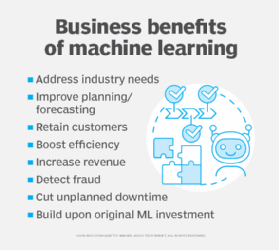
The business benefits of machine learning include customer retention, revenue generation and cost cutting.
8. Assess patterns to detect fraud
ML's ability to identify patterns is useful for fraud detection, which is important for businesses that have shifted more of their operations online in recent years. Verified Market projected the global online fraud detection market will climb to $254.93 billion by the end of 2031 from $45.6 billion in 2024, expanding at a 24.2% annual average growth rate.
AI and ML "are transforming the landscape of fraud prevention and detection," according to the market research firm. "These intelligent systems help organizations analyze vast amounts of transaction data to detect anomalies that traditional rule-based systems often miss."
9. Build upon the original investment
Another benefit is the ability to generate multiple returns from an initial ML investment. For example, a retailer that creates a data set to forecast product demand has an opportunity to build upon that investment, Frigeri said. Some organizations have made foundational investments in data sets with reusability in mind.
Everyone is so familiar with AI that they're all coming up with their own use cases. But you still have to deal with the governance.
David FrigeriChief AI officer at EisnerAmper
"The idea of reuse is you only have to tailor the last 20% for a particular use case, across the board," he said.
That ability to accelerate use case delivery has become increasingly valuable with the rise of AI tools such as ChatGPT. "Everyone is so familiar with AI that they're all coming up with their own use cases," Frigeri said. "But you still have to deal with the governance."
Companies that have built a data foundation with appropriate guardrails can address use cases much faster than they otherwise would, he added.
10. Take advantage of complementary technologies
As the benefits listed above suggest, IT leaders will increasingly find ML acting in concert with other aspects of AI, especially GenAI and agentic AI. IT projects across a range of use cases stand to benefit from a cohesive suite of technologies, each with strengths for specific roles.
"These technologies are settling into distinct layers, and they need each other more than people realize," said Avitesh Kesharwani, senior principal consultant at Genpact, a professional and technology services company.
Agentic AI is "eating the upstream work," such as data preparation, feature engineering and pipeline orchestration, which was once the biggest ML bottleneck, Kesharwani said. Those tasks used to require months of manual effort that had to be handled before the modeling stage. ML still owns prediction work in fields such as risk scoring, demand forecasting and anomaly detection, he noted. GenAI, for its part, covers the output side, synthesizing model results into something a business leader can read and act upon, he added.
Sparq's Perry described the interaction between ML and GenAI, saying "You can take the outcome of a machine learning analysis, maybe you can make eight recommendations based upon historical understanding, and then you can feed that into a generative engine to get that contextualized a little bit more. For us, it's the right tool for the job."
John Moore is a writer for Informa TechTarget covering the CIO role, economic trends and the IT services industry.