
惯性聚合 高效追踪和阅读你感兴趣的博客、新闻、科技资讯
阅读原文 在惯性聚合中打开

推荐订阅源

Hacker News: Ask HN
Hacker News: Ask HN
C
Cisco Blogs
The Hacker News
The Hacker News
T
Tor Project blog
Cyber Security Advisories - MS-ISAC
The GitHub Blog
The GitHub Blog
A
Arctic Wolf
CTFtime.org: upcoming CTF events
The Register - Security
云风的 BLOG
云风的 BLOG
Simon Willison's Weblog
P
Palo Alto Networks Blog
Vercel News
Vercel News
C
CERT Recently Published Vulnerability Notes
I
InfoQ
freeCodeCamp Programming Tutorials: Python, JavaScript, Git & More
M
MIT News - Artificial intelligence
I
Intezer
aimingoo的专栏
aimingoo的专栏
U
Unit 42
C
Cyber Attacks, Cyber Crime and Cyber Security
L
LINUX DO - 热门话题
Microsoft Security Blog
酷 壳 – CoolShell
酷 壳 – CoolShell
Cyberwarzone
Cyberwarzone
P
Proofpoint News Feed
P
Proofpoint News Feed
B
Blog
T
Threat Research - Cisco Blogs
博客园 - 叶小钗
Recorded Future
Recorded Future
Last Week in AI
Last Week in AI
N
News and Events Feed by Topic
cs.AI updates on arXiv.org
Know Your Adversary
Know Your Adversary
Engineering at Meta
Engineering at Meta
G
Google Developers Blog
PCI Perspectives
PCI Perspectives
Google DeepMind News
WordPress大学
WordPress大学
Application and Cybersecurity Blog
MyScale Blog
MyScale Blog
Security Archives - TechRepublic
Schneier on Security
N
News | PayPal Newsroom
C
Cybersecurity and Infrastructure Security Agency CISA
H
Help Net Security
博客园 - 聂微东
H
Hackread – Cybersecurity News, Data Breaches, AI and More
G
GRAHAM CLULEY

WhatIs

Strategic IT outlook: Tech conferences and events calendar | TechTarget 8 AI use cases in manufacturing Enterprises are making an AI native transformation Generative AI ethics: 16 biggest concerns and risks Zero trust in the IT ops stack: Securing hybrid workloads How algorithmic value sets enhance clinical decision-making Top methods for collecting customer feedback Build a data governance team that delivers results How to calculate the total cost of ownership of ERP software Communities call for transparency in AI data center deals Scalable IT infrastructure: Balancing speed with stability How health systems are tackling 'Kill the Clipboard' obstacles Understanding the science behind AI-based hiring assessments Tape's strategic role in modern data protection How to choose an HR software system in 2026: A complete guide The UC stack gets the policy job Top zero-trust use cases in the enterprise 13 top IT infrastructure conferences in 2026 SNMP vs. CMIP: What's the difference? 3 essential network analytics use cases AI Security Risks Force CIOs to Rethink Strategy Red Hat Summit 2026 news and conference guide | TechTarget What is HR technology (human resources tech)? Understand, optimize and track customer journey touchpoints Should IT use Apple Business Manager without MDM? Build and organize an effective machine learning team The storage modernization imperative in a fast-changing IT landscape Procurement automation use cases for CSCOs to consider 3 steps for health system leaders to drive patient safety culture What is DevOps? Meaning, methodology and guide Enterprises Face New Storage Bottlenecks as AI Grows A guide to Intune Suite licensing for endpoint management Epic controls 42% of the US EHR market. Does that help or hurt interoperability? SAP Sapphire 2026 news, trends and analysis | TechTarget How to develop a data governance strategy: 7 key steps 12 generative AI tools for marketing and sales teams Top 9 smart contract platforms to consider in 2026 Top 8 e-signature software providers for 2026 Rise with SAP vs. S/4HANA Cloud: What are the differences? How businesses use KPIs to measure AI's performance 5 clues your network has shadow AI How do digital signatures work? Collaboration security and governance must be proactive Compare SAP greenfield vs. brownfield approach for S/4HANA Merck, Home Depot tap Gemini Enterprise for AI agent development Rural challenges may dampen digital healthcare's potential Build an ethical AI framework: 12 top resources The great workload reshuffle: Choices for AI and analytics How to remove a device from Intune enrollment Cisco unveils quantum network advancements 10 of the top carbon accounting software 8 trends powering machine learning's dynamic new roles Network engineers must take the lead to push DDI to the cloud How does Microsoft 365 Copilot pricing and licensing work? ONC highlights behavioral health EHR adoption trends, data exchange barriers LLMs struggle with clinical reasoning, study finds Democratizing AI in business: The good, bad and ugly What can organizations do to address BYOD privacy concerns? Fix the service path before you optimize it with AI How AI reshapes upselling in customer experience platforms When collaboration starts becoming operational drag Balancing health AI management with growing vendor sprawl Career cure for AI phobia: Be a beekeeper, not a worker bee 16 top applicant tracking systems for 2026 How a rural community hospital deploys AI to detect heart disease 8 examples of document version control Guide to 30+ sustainability certifications for professionals AI agents are only as smart as the data that feeds them AI could earn trust in transactional work first How to fix keyboard connection issues on a remote desktop How to add and enroll devices to Microsoft Intune 11 DevSecOps best practices to prioritize in 2026 6 key components of a successful data strategy How to enable Copilot in Microsoft 365: A step-by-step guide What CIOs need to know about Meta's proposed CEO AI agent Top AI recruiting tools and software of 2026 How contact centers detect and prevent fraud 10 essential skills for modern contact center agents Beyond the chatbot: Engineering the agentic enterprise AI in business intelligence: How to manage it effectively Why legacy networks are a growing liability Failure is an option as an IT leadership tool How HR can create a successful change management strategy HR AI is becoming a change management story Digital transformation: Balancing speed and governance RSAC 2026 Conference: Key news and industry analysis | TechTarget 8 best practices for a bulletproof IAM strategy 5 customer journey phases businesses should understand 12 top HR software and tool options to consider in 2025 6 contact center trends shaping the future of customer service Contact center monitoring best practices for CX leaders Cloud vs. local backup: Which is right for your organization? 6 steps for when remote desktop credentials are not working How governance maturity affects M&A integration outcomes Inside the push to turn AI agents into suite functionality How should contact centers use AI today? Accenture global health lead on scaling AI in healthcare with governance and intent 10 best free DevOps certifications and training courses in 2026 What is compensation management? What CIOs must know about bossware strategy
3 BYOD security risks and how to prevent them
2026-04-23 · via WhatIs

Dan Jones

By

Published: 23 Apr 2026

BYOD can lower hardware costs and give workers more flexibility, but it also pushes corporate data onto endpoints the business does not fully own.

The modern BYOD security question is not simply whether a personal phone can reach work resources. It is how the organization will protect identities, apps and data on a device that also contains personal accounts, personal apps and personal cloud services.

That requires a more layered control model than older BYOD programs used. Organizations can now combine app protection, Conditional Access, privacy-preserving enrollment methods, minimum OS requirements and selective wipe rather than relying only on full-device control.

Why BYOD presents unique risks

BYOD creates unique risk because work data, personal apps and personal accounts all sit on the same endpoint. The threat model is not limited to malware. It also includes oversharing through personal cloud services, unauthorized apps, weak identity controls and inconsistent patch levels across personal devices.

The three biggest BYOD risks usually show up in these areas: unclear security protocols and shadow IT, data leakage through unmanaged or malicious apps, and device loss, theft or compromise.

Unclear security protocols

Many BYOD breaches start with behavior, not malware. Employees use unapproved apps because they are convenient, reuse personal identities and sign in from devices that may not meet corporate security or patch standards. That makes shadow IT, oversharing and credential theft just as important as classic device compromise.

Organizations should not rely on policy documents alone. They should pair user training with enforcement, including strong authentication, approved-app guidance and access controls that block unsupported clients or require app protection before users reach corporate resources. 

In Microsoft environments, Conditional Access can require app protection before access is granted, and Intune app protection policies can keep work data protected even when the device itself is not fully managed. That lets organizations reduce risk without assuming every personal device must be treated like a company-owned endpoint.

Mobile malware

Malware targeting mobile devices remains a risk, but unmanaged apps and personal cloud sync are just as dangerous in BYOD environments. The problem is not only whether an app is malicious. It is also whether work data can move into personal storage, personal messaging or consumer apps that the organization does not control.

Modern BYOD controls should focus on containment as much as detection. App protection policies can restrict copy and paste, data sharing and save-as behavior inside managed apps. Apple User Enrollment and Android work profiles can also separate work from personal data so organizations manage the work side without exposing personal apps and usage.
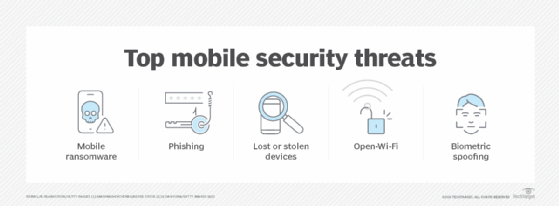
Graphic showing common mobile security threats such as ransomware, phishing, lost or stolen devices, open Wi-Fi and biometric spoofing.
Common mobile security threats in BYOD environments include phishing, device loss, insecure connections and malware.

Device hacking, loss or theft

Lost, stolen or compromised devices still demand a clear response plan.

BYOD devices are easy to lose and hard to recover, and the risk is worse when work and personal data are mixed together. Security teams need a response plan for lost devices, employee departure and devices that fall out of compliance.

That plan should cover encryption, screen-lock requirements, minimum OS or patch levels, selective wipe rights and the point at which stronger device action becomes justified. Employees should know in advance what the business can remove, how quickly IT may act and what steps they must take when a device disappears.

How to manage BYOD security risks

BYOD security is no longer just a device-management problem. Organizations need controls at three layers: identity and access, app and data protection, and device compliance and response.

For some organizations, app protection, Conditional Access and selective wipe will be enough. Others will still need deeper MDM or UEM enrollment to meet compliance and reporting expectations. The key is to make that control model explicit in policy, communicate it clearly to employees and use the least invasive approach that still protects corporate data.

Editor's note: This article was originally published in 2022 and was updated in 2026 to reflect current BYOD security controls, app-protection practices and privacy-preserving enrollment models.


Next Steps

5 steps to approach BYOD compliance policies

7 key benefits of implementing a BYOD policy

What BYOD trends will take hold in the business world?

Does Apple offer work profiles for iPhones?

6 steps to increase Android security in the enterprise

Dig Deeper on Mobile security