
惯性聚合 高效追踪和阅读你感兴趣的博客、新闻、科技资讯
阅读原文 在惯性聚合中打开

推荐订阅源

Apple Machine Learning Research
AWS News Blog
AWS News Blog
Google DeepMind News
U
Unit 42
博客园 - 叶小钗
博客园 - 聂微东
GbyAI
GbyAI
Stack Overflow Blog
Stack Overflow Blog
有赞技术团队
有赞技术团队
aimingoo的专栏
aimingoo的专栏
D
DataBreaches.Net
CTFtime.org: upcoming CTF events
Jina AI
Jina AI
美团技术团队
The Cloudflare Blog
M
MIT News - Artificial intelligence
Microsoft Azure Blog
I
InfoQ
S
Schneier on Security
C
Check Point Blog
Project Zero
Project Zero
The Hacker News
The Hacker News
Scott Helme
Scott Helme
K
KPMG report finds enterprise disconnect between AI and its ROI | CIO
Cisco Talos Blog
Cisco Talos Blog
P
Privacy International News Feed
SecWiki News
SecWiki News
Latest news
Latest news
MongoDB | Blog
MongoDB | Blog
S
Secure Thoughts
Google Online Security Blog
F
Fortinet All Blogs
博客园 - 三生石上(FineUI控件)
H
Help Net Security
TaoSecurity Blog
TaoSecurity Blog
cs.CL updates on arXiv.org
Last Week in AI
Last Week in AI
P
Privacy & Cybersecurity Law Blog
Forbes - Security
Forbes - Security
G
GRAHAM CLULEY
N
Netflix TechBlog - Medium
L
Lohrmann on Cybersecurity
A
About on SuperTechFans
T
The Exploit Database - CXSecurity.com
C
Cisco Blogs
PCI Perspectives
PCI Perspectives
大猫的无限游戏
大猫的无限游戏
T
Troy Hunt's Blog
H
Hacker News: Front Page
Vercel News
Vercel News

WhatIs

Strategic IT outlook: Tech conferences and events calendar | TechTarget 8 AI use cases in manufacturing Enterprises are making an AI native transformation Generative AI ethics: 16 biggest concerns and risks Zero trust in the IT ops stack: Securing hybrid workloads How algorithmic value sets enhance clinical decision-making Top methods for collecting customer feedback Build a data governance team that delivers results How to calculate the total cost of ownership of ERP software Communities call for transparency in AI data center deals Scalable IT infrastructure: Balancing speed with stability How health systems are tackling 'Kill the Clipboard' obstacles Understanding the science behind AI-based hiring assessments Tape's strategic role in modern data protection How to choose an HR software system in 2026: A complete guide The UC stack gets the policy job Top zero-trust use cases in the enterprise 13 top IT infrastructure conferences in 2026 SNMP vs. CMIP: What's the difference? 3 essential network analytics use cases AI Security Risks Force CIOs to Rethink Strategy Red Hat Summit 2026 news and conference guide | TechTarget What is HR technology (human resources tech)? Understand, optimize and track customer journey touchpoints Should IT use Apple Business Manager without MDM? Build and organize an effective machine learning team The storage modernization imperative in a fast-changing IT landscape Procurement automation use cases for CSCOs to consider 3 steps for health system leaders to drive patient safety culture What is DevOps? Meaning, methodology and guide Enterprises Face New Storage Bottlenecks as AI Grows A guide to Intune Suite licensing for endpoint management Epic controls 42% of the US EHR market. Does that help or hurt interoperability? SAP Sapphire 2026 news, trends and analysis | TechTarget How to develop a data governance strategy: 7 key steps 12 generative AI tools for marketing and sales teams Top 9 smart contract platforms to consider in 2026 Top 8 e-signature software providers for 2026 Rise with SAP vs. S/4HANA Cloud: What are the differences? How businesses use KPIs to measure AI's performance 5 clues your network has shadow AI How do digital signatures work? Collaboration security and governance must be proactive Compare SAP greenfield vs. brownfield approach for S/4HANA Merck, Home Depot tap Gemini Enterprise for AI agent development Rural challenges may dampen digital healthcare's potential Build an ethical AI framework: 12 top resources The great workload reshuffle: Choices for AI and analytics How to remove a device from Intune enrollment Cisco unveils quantum network advancements 3 BYOD security risks and how to prevent them 10 of the top carbon accounting software 8 trends powering machine learning's dynamic new roles Network engineers must take the lead to push DDI to the cloud How does Microsoft 365 Copilot pricing and licensing work? ONC highlights behavioral health EHR adoption trends, data exchange barriers LLMs struggle with clinical reasoning, study finds Democratizing AI in business: The good, bad and ugly What can organizations do to address BYOD privacy concerns? Fix the service path before you optimize it with AI How AI reshapes upselling in customer experience platforms When collaboration starts becoming operational drag Balancing health AI management with growing vendor sprawl Career cure for AI phobia: Be a beekeeper, not a worker bee 16 top applicant tracking systems for 2026 How a rural community hospital deploys AI to detect heart disease 8 examples of document version control Guide to 30+ sustainability certifications for professionals AI agents are only as smart as the data that feeds them AI could earn trust in transactional work first How to fix keyboard connection issues on a remote desktop How to add and enroll devices to Microsoft Intune 11 DevSecOps best practices to prioritize in 2026 6 key components of a successful data strategy How to enable Copilot in Microsoft 365: A step-by-step guide What CIOs need to know about Meta's proposed CEO AI agent Top AI recruiting tools and software of 2026 How contact centers detect and prevent fraud 10 essential skills for modern contact center agents Beyond the chatbot: Engineering the agentic enterprise AI in business intelligence: How to manage it effectively Why legacy networks are a growing liability Failure is an option as an IT leadership tool How HR can create a successful change management strategy HR AI is becoming a change management story Digital transformation: Balancing speed and governance RSAC 2026 Conference: Key news and industry analysis | TechTarget 8 best practices for a bulletproof IAM strategy 12 top HR software and tool options to consider in 2025 6 contact center trends shaping the future of customer service Contact center monitoring best practices for CX leaders Cloud vs. local backup: Which is right for your organization? 6 steps for when remote desktop credentials are not working How governance maturity affects M&A integration outcomes Inside the push to turn AI agents into suite functionality How should contact centers use AI today? Accenture global health lead on scaling AI in healthcare with governance and intent 10 best free DevOps certifications and training courses in 2026 What is compensation management? What CIOs must know about bossware strategy
5 customer journey phases businesses should understand
2026-04-09 · via WhatIs

Article 1 of 4

Part of: Begin your customer journey mapping process

The customer journey does not end at the sale. Businesses need to understand how awareness, consideration, purchase, retention and advocacy shape the full customer experience.

Griffin LaFleur

By

Published: 09 Apr 2026

Understanding the customer journey still matters, but the conversation has moved beyond simple funnel thinking. Businesses now need to understand not only how customers move from awareness to purchase, but also what happens after the sale and how those later stages affect loyalty, retention and advocacy. 

The core customer journey phases still provide a useful framework: awareness, consideration, purchase, retention and advocacy. Different organizations may label them differently, and customers may enter at different points, but the broader pattern remains the same. 

The journey is not always linear, though. Customers may move backward, skip stages or revisit earlier questions as new stakeholders, new information or new priorities emerge.

Explore the five main customer journey phases and what consumers need to know in each one. 

Retention is also typically more cost-effective than acquisition. If organizations can reduce churn, improve support and help customers see ongoing value, they are more likely to keep that business and build the foundation for advocacy later. 
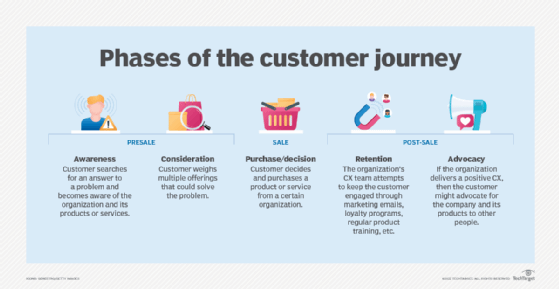
Infographic showing five customer journey phases: awareness, consideration, purchase or decision, retention and advocacy, grouped across presale, sale and post-sale stages.
The customer journey spans awareness, consideration, purchase, retention and advocacy, showing how the experience continues well beyond the sale.

1. Awareness phase 

Most prospective customers start at the awareness phase, where a user has a problem or need and looks for an answer. At this stage, customers are usually trying to understand a problem and what kinds of solutions might address it. 

These customers prefer educational thought leadership over promotional or product-oriented insights, so organizations shouldn't aggressively push products on customers. Instead, marketing teams can show how their offerings can address customer needs, like listing benefits.  

Common approaches in this phase include educational content, search visibility, thought leadership and other materials that help customers make sense of their problem before they are ready to evaluate vendors. 

2. Consideration phase 

During the consideration phase, customers compare one organization's offerings to competing options. Blog content, case studies, email nurturing and webinars can all help organizations continue engaging with prospects. 

At this stage, the tone usually shifts from broad education to more detailed explanations of fitvalue and differentiation. As CX teams engage with customers, they can also reinforce how products and services work in practice and where they solve real problems. 

Ultimately, if marketing teams can address major issues that prospects have, they can help move those consumers into the next customer journey phase. Marketing teams must change content tone and messaging in this phase from high-level and educational to a more detailed approach. 

3. Purchase/decision phase 

The first three phases usually involve the closest coordination between marketing, sales and presales teams. By the purchase or decision phase, customers often have a short list of options and are looking for proof, confidence and clarity. 

Sometimes, people enter the customer journey in this phase if they initially request demos, ask for quotes or want to speak to a sales representative. These individuals may fill out a business's contact form or other conversion points lower in the sales funnel, including a paid campaign that targets the bottom end of the funnel. 

People at this stage commonly have a short list of companies they would buy from, so a good sales process and successful case studies give an organization an edge over its competition. An introduction to an existing customer as a reference also enables discussions between peers outside of the sales process. And, within the sales process, good relationships and rapport can set brands apart. 

4. Retention phase

In many cases, the first few weeks after the sale do a lot to determine whether the customer moves toward retention or starts drifting toward frustration. 

The last two phases of the customer journey happen after the sale, which is where many organizations still fall short. A purchase does not end the journey. In many cases, it is where the harder work begins. 

Retention depends on whether customers can adopt the product, get value from it and resolve problems without unnecessary effort. That means onboarding, support, knowledge, training and regular communication all play a bigger role than many companies assume. 

In this phase, organizations may offer training, FAQs, product updates, customer success programs, loyalty initiatives oproactive check-ins. The goal is not just to stay visible. It is to help customers succeed and reduce the chances that confusion, poor support or low adoption undermine the relationship later.

5Advocacy phase 

Advocacy comes after strong customer experience, not before it. Customers who consistently get value from a product or service, and who feel that the company understands their needs, are more likely to recommend that brand to others. 

This is one reason expectations set during onboarding and early product use matter so much. If customers can recognize progress, measure success and feel supported over time, they are more likely to become references, case-study participants or informal promoters through word of mouth. 

Organizations can also gauge advocacy through reference participation, feedback conversations and tools such as Net Promoter Score. These signals can help teams understand not only whether customers are satisfied, but why they are willing -- or unwilling -- to speak positively about the brand. 

Key takeaways 

The five journey phases still offer a useful framework, but businesses should not treat them as a simple funnel that ends at purchase. Retention and advocacy are just as important to the overall customer experience (CX), especially in subscription, service and long-term account relationships. 

Teams that understand how customer needs change at each stage can align content, support, communication and service more effectively. They can also see where expectations break down across the full lifecycle, not just before the sale. 

The customer journey is not static. As products, channels and customer expectations change, businesses need to revisit these phases and adjust how they support customers from first touch through ongoing use and follow-up. 

Editor's note: This article was originally published in 2022 and updated in April 2026 to reflect current thinking on customer journey phases across presale and post-sale experience. 

Griffin LaFleur is a MarketingOps and RevOps professional working for Swing Education. Throughout his career, LaFleur has also worked at agencies and independently as a B2B sales and marketing consultant. 

Next Steps

Dig Deeper on Customer experience management

Part of: Begin your customer journey mapping process

Article 1 of 4

Up Next