







When businesses want to boost revenue, they naturally turn to their existing customers. From the racks of hair ties and lighters at grocery store checkouts to sales representatives offering cable TV customers an extra channel package at a discounted rate, companies look for new ways to entice their customers into unplanned purchases to increase their bottom line.
And it's no wonder. Companies have a 60% to 70% chance of selling products and services to existing customers, compared to a 5% to 20% chance with new customers, according to Marketing Metrics co-author Paul Farris.
Tapping into this rich source of revenue requires ever-increasing sophistication, however. From applying artificial intelligence to predict likely customer interest to relying on psychological cues, companies are testing the waters with upselling tactics and technologies that use existing customer data to better understand their customers' emotions and encourage them to buy.
Finding holes in the funnel
The idea of gathering and using customer information to upsell products and services is not new. That's what allows sales representatives to offer an enhanced sports channel package to a caller or to ask whether a customer wants to upgrade to the latest iPhone. Data gathered and analyzed on customer buying habits can help shore up gaps in the sales funnel and increase the likelihood that existing and even new customers will hit the purchase button, said Will Ward, founder of audio equipment services provider Translation Equipment HQ, based in Washington, D.C.
"For example," Ward explained, "if too many people leave items in the cart and never end up buying, this could mean a UX problem there. Companies can try to figure out this problem and find UX solutions. Without data, such problems in the funnel never get discovered."
Data correlation techniques provide businesses with insights into a customer's next purchase by aggregating past purchases, customer preferences and product popularity, said Matt Bertram, CEO of marketing agency EWR Digital in Houston. These techniques have become more widespread due to advanced technologies embedded in customer experience management systems.
"By using predictive analytics to identify patterns in purchase behavior, we can identify complementary products at the critical moment that can trigger an impulse purchase," Bertram said. "This allows us to suggest an upsell that enhances the customer experience due to its relevance and timeliness."
Segmenting and engaging customers
Organizations have a much greater abundance of customer data than ever before. Segmentation can help provide the right offer at the right time. But companies need to properly segment that data into specific audiences, advised Max Whiteside, sponsored content lead at strength training and fitness resource BarBend, based in Columbus, Ohio.
BarBend customers read reviews, information on equipment or fitness-related news. To target customers with the right offers, Whiteside said, the company's upselling tactics include capturing whatever content its customers view as well as their email addresses and sending them lead magnets and automated email campaigns.
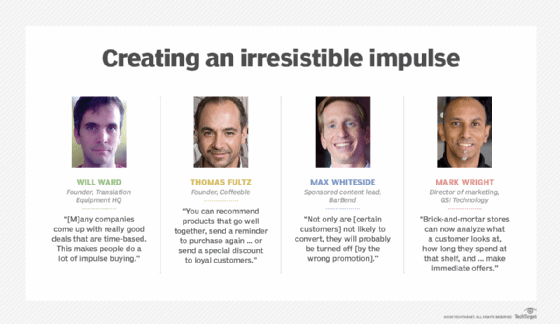
If BarBend is pushing a promotion on kettlebells, for example, the company wouldn't send an email to customers that only engage with nutrition content. "Not only are they not likely to convert," Whiteside added, "they will probably be turned off, which is worst case scenario for me."
Integrating e-commerce stores with email marketing programs can be a powerful way to upsell and cross-sell customers, noted Thomas Fultz, founder of Coffeeble, a site dedicated to coffee enthusiasts and based in Oklahoma City. "You can recommend products that go well together, send a reminder to purchase again if your product is something that needs to be replaced or refilled, or send a special discount to loyal customers who have made a certain amount of purchases in the past," he explained.
Tapping into emotions
An impulse buy requires some understanding of psychology. Fear of missing out, for example, is a powerful emotion that B2C companies can use online and in stores. "With the holiday season coming up," Translation Equipment's Ward said, "many companies come up with really good deals that are time-based. This makes people do a lot of impulse buying."
Until recently, businesses struggled to introduce upselling tactics and tools into their brick-and-mortar locations. Facial recognition technology, however, can help businesses identify what customers are interested in while they're browsing and connect that data to loyalty programs, said Mark Wright, director of marketing, AI processors at GSI Technology.
"Brick-and-mortar stores can now analyze what a customer looks at, how long they spend at that shelf, and they can then infer items of interest and make immediate offers," Wright said. With the integration of loyalty programs and online customer data, he added, companies can make online offers based on in-store behavior.
By combining time-tested upselling tactics, advanced technologies and psychological techniques, companies can create innovative methods to entice existing customers into impulse purchases. So long as they're collecting the right data, segmenting it properly and providing relevant offers to targeted customers, businesses can realize increased sales and add to their bottom line.