惯性聚合 高效追踪和阅读你感兴趣的博客、新闻、科技资讯
阅读原文 在惯性聚合中打开

推荐订阅源

cs.CV updates on arXiv.org
小众软件
小众软件
博客园_首页
博客园 - 聂微东
V
V2EX
WordPress大学
WordPress大学
freeCodeCamp Programming Tutorials: Python, JavaScript, Git & More
OSCHINA 社区最新新闻
OSCHINA 社区最新新闻
罗磊的独立博客
酷 壳 – CoolShell
酷 壳 – CoolShell
博客园 - 司徒正美
博客园 - 三生石上(FineUI控件)
奇客Solidot–传递最新科技情报
奇客Solidot–传递最新科技情报
S
SegmentFault 最新的问题
J
Java Code Geeks
Last Week in AI
Last Week in AI
The Cloudflare Blog
月光博客
月光博客
雷峰网
雷峰网
宝玉的分享
宝玉的分享
钛媒体:引领未来商业与生活新知
钛媒体:引领未来商业与生活新知
Hugging Face - Blog
Hugging Face - Blog
让小产品的独立变现更简单 - ezindie.com
有赞技术团队
有赞技术团队
人人都是产品经理
人人都是产品经理
博客园 - Franky
腾讯CDC
Jina AI
Jina AI
博客园 - 叶小钗
大猫的无限游戏
大猫的无限游戏
阮一峰的网络日志
阮一峰的网络日志
量子位
爱范儿
爱范儿
美团技术团队
T
Tailwind CSS Blog
博客园 - 【当耐特】
D
Docker
IT之家
IT之家
V
Visual Studio Blog
P
Proofpoint News Feed
L
LangChain Blog
Engineering at Meta
Engineering at Meta
C
Check Point Blog
G
Google Developers Blog
Google DeepMind News
云风的 BLOG
云风的 BLOG
Cyber Security Advisories - MS-ISAC
Microsoft Azure Blog
B
Blog RSS Feed
Recorded Future
Recorded Future

WhatIs

Strategic IT outlook: Tech conferences and events calendar | TechTarget 8 AI use cases in manufacturing Enterprises are making an AI native transformation Generative AI ethics: 16 biggest concerns and risks Zero trust in the IT ops stack: Securing hybrid workloads How algorithmic value sets enhance clinical decision-making Top methods for collecting customer feedback Build a data governance team that delivers results How to calculate the total cost of ownership of ERP software Communities call for transparency in AI data center deals Scalable IT infrastructure: Balancing speed with stability How health systems are tackling 'Kill the Clipboard' obstacles Understanding the science behind AI-based hiring assessments Tape's strategic role in modern data protection How to choose an HR software system in 2026: A complete guide The UC stack gets the policy job Top zero-trust use cases in the enterprise 13 top IT infrastructure conferences in 2026 SNMP vs. CMIP: What's the difference? 3 essential network analytics use cases AI Security Risks Force CIOs to Rethink Strategy Red Hat Summit 2026 news and conference guide | TechTarget What is HR technology (human resources tech)? Understand, optimize and track customer journey touchpoints Should IT use Apple Business Manager without MDM? Build and organize an effective machine learning team The storage modernization imperative in a fast-changing IT landscape Procurement automation use cases for CSCOs to consider 3 steps for health system leaders to drive patient safety culture What is DevOps? Meaning, methodology and guide Enterprises Face New Storage Bottlenecks as AI Grows A guide to Intune Suite licensing for endpoint management Epic controls 42% of the US EHR market. Does that help or hurt interoperability? SAP Sapphire 2026 news, trends and analysis | TechTarget How to develop a data governance strategy: 7 key steps 12 generative AI tools for marketing and sales teams Top 9 smart contract platforms to consider in 2026 Top 8 e-signature software providers for 2026 Rise with SAP vs. S/4HANA Cloud: What are the differences? How businesses use KPIs to measure AI's performance 5 clues your network has shadow AI How do digital signatures work? Collaboration security and governance must be proactive Compare SAP greenfield vs. brownfield approach for S/4HANA Merck, Home Depot tap Gemini Enterprise for AI agent development Rural challenges may dampen digital healthcare's potential Build an ethical AI framework: 12 top resources The great workload reshuffle: Choices for AI and analytics How to remove a device from Intune enrollment Cisco unveils quantum network advancements 3 BYOD security risks and how to prevent them 10 of the top carbon accounting software 8 trends powering machine learning's dynamic new roles Network engineers must take the lead to push DDI to the cloud How does Microsoft 365 Copilot pricing and licensing work? ONC highlights behavioral health EHR adoption trends, data exchange barriers LLMs struggle with clinical reasoning, study finds Democratizing AI in business: The good, bad and ugly What can organizations do to address BYOD privacy concerns? Fix the service path before you optimize it with AI How AI reshapes upselling in customer experience platforms When collaboration starts becoming operational drag Balancing health AI management with growing vendor sprawl Career cure for AI phobia: Be a beekeeper, not a worker bee 16 top applicant tracking systems for 2026 How a rural community hospital deploys AI to detect heart disease 8 examples of document version control Guide to 30+ sustainability certifications for professionals AI agents are only as smart as the data that feeds them How to fix keyboard connection issues on a remote desktop How to add and enroll devices to Microsoft Intune 11 DevSecOps best practices to prioritize in 2026 6 key components of a successful data strategy How to enable Copilot in Microsoft 365: A step-by-step guide What CIOs need to know about Meta's proposed CEO AI agent Top AI recruiting tools and software of 2026 How contact centers detect and prevent fraud 10 essential skills for modern contact center agents Beyond the chatbot: Engineering the agentic enterprise AI in business intelligence: How to manage it effectively Why legacy networks are a growing liability Failure is an option as an IT leadership tool How HR can create a successful change management strategy HR AI is becoming a change management story Digital transformation: Balancing speed and governance RSAC 2026 Conference: Key news and industry analysis | TechTarget 8 best practices for a bulletproof IAM strategy 5 customer journey phases businesses should understand 12 top HR software and tool options to consider in 2025 6 contact center trends shaping the future of customer service Contact center monitoring best practices for CX leaders Cloud vs. local backup: Which is right for your organization? 6 steps for when remote desktop credentials are not working How governance maturity affects M&A integration outcomes Inside the push to turn AI agents into suite functionality How should contact centers use AI today? Accenture global health lead on scaling AI in healthcare with governance and intent 10 best free DevOps certifications and training courses in 2026 What is compensation management? What CIOs must know about bossware strategy
AI could earn trust in transactional work first
James Alan Miller · 2026-04-15 · via WhatIs

AI might initially earn trust in transactional work, where narrower tasks, cleaner data and clearer oversight make procurement and manufacturing stronger proving grounds.

James Alan Miller

By

Published: 15 Apr 2026

AI might earn trust first not in the flashiest corners of enterprise software, but in some of the most structured ones. Transactional work gives AI something a lot of other enterprise tasks do not: narrower use cases, repeatable steps, clearer rules and outcomes that are easier to measure.

If companies are looking for places where AI can start to earn trust, procurement, sourcing, manufacturing and other structured workflows look like some of the strongest candidates.

Transactional work gives AI clearer boundaries

Oracle's latest push helps explain why. Its new agentic applications are being positioned not around one giant agent trying to do everything, but around teams of agents working together toward business objectives.

Big outcomes are made up of smaller outcomes. That helps explain why transactional work matters here.

Procurement, sourcing and manufacturing are all large ERP domains made up of smaller, more repeatable tasks. They are the kinds of workflows where it is easier to imagine AI taking on narrow responsibilities without immediately asking organizations to trust it with the whole process.

Oracle's human-in-the-loop and human-in-the-lead model also feels more grounded in this context. In transactional work, the path from full oversight to partial autonomy is easier to picture because the rules are clearer and success is easier to define. In that setting, AI in ERP feels less like a moonshot and more like a controlled attempt to expand trust over time.

What still feels unresolved is how vendors or customers actually decide when the system has performed well enough to deserve more independence.

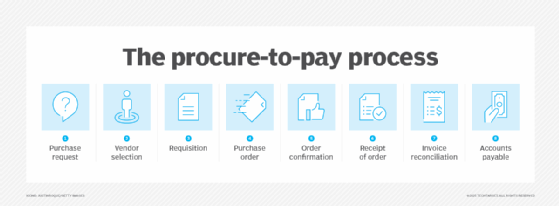
Graphic showing the steps in the procure-to-pay process, including purchase request, vendor selection, requisition, purchase order, order confirmation, receipt of order, invoice reconciliation and accounts payable.
Procure-to-pay is the kind of structured, repeatable workflow where enterprise AI might be able to prove value early because the steps, handoffs and outcomes are easier to define and measure.

Procurement makes AI case more concrete

Procurement makes the case more concrete because it is one of the clearest places where AI can prove its value right now. Spend visibility, continuous risk monitoring, accounts payable and supply-chain resilience are all narrow enough to be believable and important enough to matter.

The value is also easier for executives to see. Better visibility into spend, fewer payment errors, faster responses to disruption and more proactive risk monitoring all translate into outcomes that are operationally and financially legible. In that sense, procurement feels like one of the clearest places where AI can show what it is good at without requiring companies to buy into a much broader transformation story all at once.

Procurement is also a reminder not to oversell the technology. Automation works best when the underlying data is clean and when the workflows make sense. That gets at the real limit of the transactional proving-ground idea.

AI does not rescue a bad process simply by being layered on top of it.

AI does not rescue a bad process simply by being layered on top of it. If the workflow is dysfunctional or the data is weak, automation can just scale the dysfunction.

Organizational readiness matters especially here.

Manufacturing strengthens the AI use case

Manufacturing pushes the same argument from a different angle. The strongest use cases are not broad claims that AI is reinventing the factory. Instead, they are practical uses tied to forecasting, documentation, computer-aided design, inventory and purchasing decisions, predictive maintenance, and coding assistance in more digitally mature environments.

The strongest projects share a few traits: clear operational or financial outcomes, high-quality and structured data, defined human oversight, and realistic deployment inside existing workflows. Those are the conditions that make AI in manufacturing feel practical rather than speculative.

The caution is part of why the manufacturing case feels more grounded. Generative AI is still not suitable for many mission-critical use cases, and many of the most realistic applications are still in the back office or in tightly bounded operational settings with human oversight. That limitation also keeps the use case from being oversold.

If AI is going to earn wider trust in manufacturing, it will likely do so first through pragmatic, time-saving applications that fit into existing processes rather than through sweeping promises of autonomy.

Sourcing points in the same direction

Direct materials sourcing has long been slowed by fragmented bills of materials, disconnected supplier workflows and manual coordination gaps between engineering, procurement, suppliers, finance and manufacturing. That kind of friction is exactly the sort of environment where narrower AI and automation use cases can start to prove value -- not by replacing the whole process at once, but by making a stubborn, expensive, highly transactional part of it move faster and with less waste.

Taken together, transactional work looks like one of the strongest early tests for enterprise AI. It is not that these areas are simple; it is that they are well-defined enough to let AI work within clearer boundaries. That gives companies a better shot at measuring results, defining oversight and deciding where more autonomy is justified.

James Alan Miller is a veteran technology editor and writer who leads Informa TechTarget's Enterprise Software group. He oversees coverage of ERP & Supply Chain, HR Software, Customer Experience, Communications & Collaboration and End-User Computing topics.

Next Steps

Cloud ERP vs. on-premises ERP: Key differences

Top generative AI use cases in procurement

Challenges of using AI in procurement

AI and ERP: The digital labor evolution in manufacturing

ERP trends that leaders should plan for in 2026

Dig Deeper on ERP administration and management