惯性聚合 高效追踪和阅读你感兴趣的博客、新闻、科技资讯
阅读原文 在惯性聚合中打开

推荐订阅源

Security Archives - TechRepublic
罗磊的独立博客
T
The Blog of Author Tim Ferriss
The GitHub Blog
The GitHub Blog
Apple Machine Learning Research
The Register - Security
J
Java Code Geeks
V2EX - 技术
V2EX - 技术
Vercel News
Vercel News
N
News and Events Feed by Topic
腾讯CDC
P
Proofpoint News Feed
N
News | PayPal Newsroom
www.infosecurity-magazine.com
爱范儿
爱范儿
O
OpenAI News
酷 壳 – CoolShell
酷 壳 – CoolShell
月光博客
月光博客
Martin Fowler
Martin Fowler
Engineering at Meta
Engineering at Meta
D
Docker
Y
Y Combinator Blog
博客园 - 聂微东
G
Google Developers Blog
S
Security @ Cisco Blogs
Simon Willison's Weblog
S
Schneier on Security
H
Hackread – Cybersecurity News, Data Breaches, AI and More
S
SegmentFault 最新的问题
云风的 BLOG
云风的 BLOG
阮一峰的网络日志
阮一峰的网络日志
C
CXSECURITY Database RSS Feed - CXSecurity.com
CTFtime.org: upcoming CTF events
C
CERT Recently Published Vulnerability Notes
I
Intezer
G
GRAHAM CLULEY
有赞技术团队
有赞技术团队
Attack and Defense Labs
V
Visual Studio Blog
博客园 - Franky
博客园 - 三生石上(FineUI控件)
W
WeLiveSecurity
钛媒体:引领未来商业与生活新知
钛媒体:引领未来商业与生活新知
让小产品的独立变现更简单 - ezindie.com
Hugging Face - Blog
Hugging Face - Blog
Scott Helme
Scott Helme
T
Troy Hunt's Blog
Hacker News - Newest:
Hacker News - Newest: "LLM"
L
LINUX DO - 最新话题
C
Cybersecurity and Infrastructure Security Agency CISA

WhatIs

Strategic IT outlook: Tech conferences and events calendar | TechTarget 8 AI use cases in manufacturing Enterprises are making an AI native transformation Zero trust in the IT ops stack: Securing hybrid workloads How algorithmic value sets enhance clinical decision-making Top methods for collecting customer feedback Build a data governance team that delivers results How to calculate the total cost of ownership of ERP software Communities call for transparency in AI data center deals Scalable IT infrastructure: Balancing speed with stability How health systems are tackling 'Kill the Clipboard' obstacles Understanding the science behind AI-based hiring assessments Tape's strategic role in modern data protection How to choose an HR software system in 2026: A complete guide The UC stack gets the policy job Top zero-trust use cases in the enterprise 13 top IT infrastructure conferences in 2026 SNMP vs. CMIP: What's the difference? 3 essential network analytics use cases AI Security Risks Force CIOs to Rethink Strategy Red Hat Summit 2026 news and conference guide | TechTarget What is HR technology (human resources tech)? Understand, optimize and track customer journey touchpoints Should IT use Apple Business Manager without MDM? Build and organize an effective machine learning team The storage modernization imperative in a fast-changing IT landscape Procurement automation use cases for CSCOs to consider 3 steps for health system leaders to drive patient safety culture What is DevOps? Meaning, methodology and guide Enterprises Face New Storage Bottlenecks as AI Grows A guide to Intune Suite licensing for endpoint management Epic controls 42% of the US EHR market. Does that help or hurt interoperability? SAP Sapphire 2026 news, trends and analysis | TechTarget How to develop a data governance strategy: 7 key steps 12 generative AI tools for marketing and sales teams Top 9 smart contract platforms to consider in 2026 Top 8 e-signature software providers for 2026 Rise with SAP vs. S/4HANA Cloud: What are the differences? How businesses use KPIs to measure AI's performance 5 clues your network has shadow AI How do digital signatures work? Collaboration security and governance must be proactive Compare SAP greenfield vs. brownfield approach for S/4HANA Merck, Home Depot tap Gemini Enterprise for AI agent development Rural challenges may dampen digital healthcare's potential Build an ethical AI framework: 12 top resources The great workload reshuffle: Choices for AI and analytics How to remove a device from Intune enrollment Cisco unveils quantum network advancements 3 BYOD security risks and how to prevent them 10 of the top carbon accounting software 8 trends powering machine learning's dynamic new roles Network engineers must take the lead to push DDI to the cloud How does Microsoft 365 Copilot pricing and licensing work? ONC highlights behavioral health EHR adoption trends, data exchange barriers LLMs struggle with clinical reasoning, study finds Democratizing AI in business: The good, bad and ugly What can organizations do to address BYOD privacy concerns? Fix the service path before you optimize it with AI How AI reshapes upselling in customer experience platforms When collaboration starts becoming operational drag Balancing health AI management with growing vendor sprawl Career cure for AI phobia: Be a beekeeper, not a worker bee 16 top applicant tracking systems for 2026 How a rural community hospital deploys AI to detect heart disease 8 examples of document version control Guide to 30+ sustainability certifications for professionals AI agents are only as smart as the data that feeds them AI could earn trust in transactional work first How to fix keyboard connection issues on a remote desktop How to add and enroll devices to Microsoft Intune 11 DevSecOps best practices to prioritize in 2026 6 key components of a successful data strategy How to enable Copilot in Microsoft 365: A step-by-step guide What CIOs need to know about Meta's proposed CEO AI agent Top AI recruiting tools and software of 2026 How contact centers detect and prevent fraud 10 essential skills for modern contact center agents Beyond the chatbot: Engineering the agentic enterprise AI in business intelligence: How to manage it effectively Why legacy networks are a growing liability Failure is an option as an IT leadership tool How HR can create a successful change management strategy HR AI is becoming a change management story Digital transformation: Balancing speed and governance RSAC 2026 Conference: Key news and industry analysis | TechTarget 8 best practices for a bulletproof IAM strategy 5 customer journey phases businesses should understand 12 top HR software and tool options to consider in 2025 6 contact center trends shaping the future of customer service Contact center monitoring best practices for CX leaders Cloud vs. local backup: Which is right for your organization? 6 steps for when remote desktop credentials are not working How governance maturity affects M&A integration outcomes Inside the push to turn AI agents into suite functionality How should contact centers use AI today? Accenture global health lead on scaling AI in healthcare with governance and intent 10 best free DevOps certifications and training courses in 2026 What is compensation management? What CIOs must know about bossware strategy
7 ways to collect customer data that keep you compliant | TechTarget
Andrew Froehlich · 2026-06-18 · via WhatIs

Customer data can improve CX, marketing and sales decisions, but organizations must collect it transparently, protect it and follow applicable privacy laws.

Making decisions based on customer feedback can help CX teams efficiently understand market trends and pain points to alleviate that can improve customers' experiences.

One challenge in customer data collection, however, is ensuring the methods and types of data collected don't go against government mandated compliance and regulatory requirements. The most widely known is the European Union's GDPR, yet the U.S. has several state-level regulations, including CCPA in California, Virginia's Consumer Data Protection Act and the Colorado Privacy Act.

While these regulations can hinder customer data collection, organizations can still glean thoughtful insights if they are transparent with users. Learn about seven ways to collect customer data that keep both businesses and customers safe and within compliance laws.

1. Customer surveys

Perhaps the best way to stay compliant is to conduct no-obligation surveys throughout the customer journey. Plenty of customers are willing to share their opinions on purchase decisions, product and service fulfillment procedures and other feedback that CX teams can combine with other surveys. Then, teams can analyze the data to better plan their marketing strategies and sales tactics, and to streamline problematic processes.

2. Transactional data

Data collected from sales at the point of sale is known as transactional data, which can include transaction dates, times, locations, products or services purchased, purchase history and payment methods.

Then, CX teams can use this data to determine the following:

  • Success or failure of a particular marketing campaign.
  • Shopping trends.
  • Potential campaigns that might be successful in the future.
  • The likelihood of a customer returning.

To remain compliant when collecting transactional data, CX teams should only collect information that doesn't contain personal details about the customer. Instead, brands should focus on the transactions themselves, which provide sufficient information for business decision-making without risking data theft or loss.

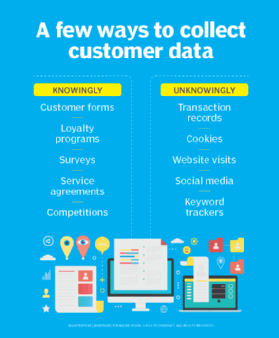
A chart listing various ways to collect customer data.
Many forms of data collection previously unknown to customers -- such as cookies and website visits -- now require brands to disclose the practice to remain compliant.

3. Web tracking

Organizations that conduct business over websites can collect and analyze data using a number of tracking tools. Understanding how customers interact with a website can highlight what customers want, so CX teams can refine the website layout, content and purchasing methods to better attract prospects and cut down on cart abandonment rates.

Businesses should be careful about what data they collect from global websites and ensure they adhere to various regulations, like GDPR and CCPA. In many cases, websites that track information must disclose this fact to customers before they can collect data. Most commonly, brands disclose a cookie tracking policy on their website that requires customers to accept the terms in advance.

4. Opt-in digital newsletters and blogs

Many organizations stay in the minds of customers because they offer digital newsletters and walled blog content that use an opt-in, opt-out process. These methods benefit both businesses and customers, as they offer useful information, discounts and other incentives to customers while providing a wealth of user data for the business.

In many cases, customers are willing to provide their information if the content or discounts entice them. From a business perspective, the newsletters, blogs and other related incentives are worth the time and money spent to engage a loyal customer base.

5. Social media

Social media can help brands engage and interact with existing and prospective customers. Popular platforms such as LinkedIn, Facebook, Twitter and Instagram offer businesses built-in analytics tools and often provide a near-real-time view of customer sentiment and an audience's continuously evolving interests.

Alternatively, CX teams can extract the data, place it into third-party tools and combine it with other forms of collected information for deeper inspection. When teams extract data from social media platforms, they must understand the business is responsible for keeping it safe and removing personal information that may lead to noncompliance.

6. CRM data

Most organizations rely on CRM tools to help track interactions with current or future customers. CX teams must take great care to protect CRM databases, as they contain customers' personal information, including names, email addresses and phone numbers. These systems also store descriptive, qualitative and quantitative data, which helps visualize and quantify customer behavior and lifetime value estimates.

The key to compliance is to require customers' consent prior to data collection.

7. Chatbots

As long as users grant consent and an organization's reasons for collecting the data are transparent, chatbots can help businesses focus on the types of questions, concerns and problems that customers may experience.

Whether a user requests specific information about a product or has questions or complaints regarding a pre- and post-sale experience, CX teams can use these data points to get either a high-level or granular view of what the customer wants.

Consent, transparency are key

The key to compliance is to require customers' consent prior to data collection. Once they give their consent, organizations must let them know about the uses of the data in accordance with various government regulations.

Digital tools and AI-backed services can help in this regard, as they can organize, deduplicate and remove personal information that could potentially be lost or stolen.

Dig Deeper on Customer data management