



What is the tech jobs market like for job seekers and hiring managers today? It’s a broad question for which one answer is that it’s a land of contrasts and confusion, and also some crossed wires. Experienced engineers and managers feel ghosted by employers and recruiters, who in turn have given up on inbound applications because their inboxes are full of AI slop, sometimes from bogus candidates. It’s rosier for those with specific skillsets, who are in strong demand – and personal networks help more than ever to land the right job.
For this final part of our series on the tech hiring market during the first half of 2026, I spoke with more than 50 hiring managers, software engineers, and engineering leaders. Thank you to everyone who contributed!
For more on this topic, check out our analysis of what the data says about the market in Part 1 and Part 2 of this mini-series.
Overall, an appropriate description of the employment market as many folks experience it right now would be “weird”. This is a characteristic that’s not easy to see in the data, but is clear from talking to people and hearing their anecdotal, personal accounts of job hunting this year. I think the data in the first two articles of this series failed to capture just how unusual things are. So, in today’s issue, we attempt to shed some light on the weirdness, covering:
“Catch-22:” nobody finds each other. Hiring managers struggle to find experienced folks, who barely get any replies when applying for jobs. How’s that work?
No trust. Is AI to blame? AI-enhanced resumes read as incredible, but hiring managers often face disappointment. Some places don’t bother reading inbound applications as a result.
Hot market for some, but tough for most. For those in AI Engineering, ML, or FDE, the market is incredible. For everyone else, it’s much less great.
Higher hiring bar & lower compensation – but not for everyone. Many candidates are unhappy with offers that are the lowest in years. This doesn’t apply to AI Engineering positions or at AI businesses, however.
Engineering leader recruitment: also weird for senior ICs. Senior engineering leaders are struggling to find opportunities, or may turn them down in favor of fractional roles or to work on their own startup.
US market trends. Folks experiencing the “best market ever” are likely in the US, where a talent shortage is a bigger complaint than it is elsewhere.
Trends in the UK, EU, and rest of the world. “Ghosting” is more commonplace than in the US, “fake applicants” a bigger issue, remote roles are going extinct, and more.
For more details on the hiring market, see also:
Software engineering recruitment: trending up, mostly
Big Tech and publicly-traded companies
Who’s hiring the most software engineers?
AI engineering: explosive demand
Who’s hiring the most AI engineers?
Is AI engineering replacing software engineering hiring?
Part 2, what the data says, continuied:
Top AI labs are now more attractive than Big Tech
Harder for new grads & interns to get hired
Mobile and frontend demand drops, AI & FDE surges
AI engineering comp > software engineering comp
Management’s “great flattening” continues
Big Tech seniority & tenure keep rising
Interview preparation signups: what do they indicate?
Where engineers go after Big Tech
The phrase “Catch 22” refers to a paradoxical problem, whose solution is blocked by the problem itself. The term originated in a famous World War II novel of the same name, and it also describes pretty accurately what I see in today’s tech job market. Hiring managers are saying that highly-skilled talent (typically senior+ engineers) is not available to be recruited, at the same time as experienced, proven professionals find their applications ignored by employers.
What seems paradoxical here is how both can be true. It’s as if recruiters and potential candidates aren’t hearing each other. Of course, there’s some nuance:
Mike Julian, CEO of DuckBill Group, which is hiring software engineers, replied to my post with this observation:
“We get about 1,000 applications a day on inbound and maybe two of them are even relevant to the posting.
I mostly no longer look at inbound seriously because it’s so c***. I’d almost certainly miss a great inbound submission if it came in.
All of our recent hires have been via network and us reaching out to folk on LinkedIn. Biggest hurdle we have to outreach is thin LinkedIn profiles and little other online presence.”
From the other hiring managers we talked with, more themes emerged:
“I’ve never seen so many inbounds and strong resumes. I’m hiring for lots of roles; for one software engineering position in Seattle, we have had 800 resumes inbound over a three-month period. I’ve never seen anything like this! These resumes are not low-quality either: they are people who have worked at MSFT, AWS, other large tech companies, and have solid skills.” – Head of Engineering, Series B startup, Seattle, US
“It’s difficult to find good candidates among all the noise. Have had two open senior engineer positions for months, and the only good interviews or offers we’ve extended were in network.” – Engineering Manager, late-stage startup, US
“A glut of vastly underqualified people completely drowning your hiring pipeline. This is what I’m seeing, and it’s making inbound a useless channel.” – Engineering Director, Big Tech, US
“From what I hear from recruiters, every job posted has 1,000+ applicants, and 98% of them are considered unqualified.” – fullstack engineer, Middle East
“We are a small company and gave up on inbound hiring. We got too many AI applications. Much lower signal-to-noise compared to past experience.” – Director of Engineering, Canada
“Even when you’re good, it feels like there’s a LOT of noise to cut through to get noticed. I’m quietly looking for a new role in devtools, and fit that ‘product engineer’ profile perfectly. I feel like the demand for great people is higher than ever, but I can’t figure out where on that bar I fall.” – Tech lead, seed-stage startup, US
“As an experienced engineer & successful-ish founder I have yet to get to a phone screening in this job market. There is clearly something amiss, just a wall of noise preventing any signal from getting through.” – Software engineer + founder, 8 years experience, US
A staff engineer at a late-stage startup in the US summed things up:
“It feels like everyone who has a good job is holding onto it for dear life, and THOSE are the people we want to hire.”
A director of engineering at a Big Tech in the US, identifies two distinct groups in the market:
“If you are at the top of your game, have AI experience, and are senior enough, you can write your own ticket. If not, then the job market is tough! This job market is like the tale of these two very different cities.”
Observations from some job seekers echo this: demand feels strong for “AI-adjacent” engineers (those building AI systems), especially in the US. Standout engineers with a strong network are still in demand, and we covered the story of one such person in “How to be a 10x engineer” – interview with a standout dev. For everyone else, it’s a struggle to get an interview!
Several experienced engineers currently on the job market say they only get interviews when they personally know someone at a company:
“Larger companies have to have some serious AI going on to sift through resumes because they are being bombarded. It really is the case that you don’t get your resume seen unless you know people who can vouch for you.” – Technical Program Manager, Big Tech, US
“Referrals are a lifeline. It’s impossible to get interviews for Staff or Principal Eng positions by cold applying. The only interviews I am getting from a cold-apply are Senior-level roles.” – Principal Engineer, 10 YOE, US
From a couple of hiring managers:
“The only interviews or offers we’ve extended were to devs already in our network.” – Software architect at a mid-sized company, US
“I filled an engineering manager position in record time thanks to a person in my network looking for this job. If it would not have been for my network I would probably have been looking for someone for a couple of months.” – VP of Engineering, private equity-funded company, Germany
Hiring managers repeatedly tell us they no longer trust what they read in resumes, and that some candidates even turn out to be fake.
A common gripe among hiring managers is that resumes are highly optimized by AI, but candidates turn out not to have the experience they claim:
“CVs are high-quality, but the people behind them are not. Almost every resume looks impressive. However, the quality of the conversations does not match it at all.
One recent example: I interviewed a senior candidate who had spent five years at a US-based cloud consulting company, most recently as an architect. I asked which architectural principles or patterns he had used in his projects. His answer was: “Daily standup, sprint planning, and retrospective.” I clarified that I meant from a tech perspective, not process perspective. He confidently replied: “Yes, daily standup, sprint planning, and retrospective.” – Engineering manager, large company, Berlin, Germany
“Ten years ago, we would have appreciated resumes tailored to a role that was posted, now it’s just lazily thrown together with AI.” – Engineering Manager, mid-sized company, Canada
AI-keyword stuffing is rampant, according to one head of engineering in the UK:
“Lots of people are rebranding themselves as senior AI Engineers and demanding much higher salaries. Their resumes now have lots of AI-related keywords mentioned, like RAG, evals, inference… but when digging deeper there is little substance. Many of them are seeking a senior level salary (£90k–£140k) when they are barely showcasing mid-level skills.”
Cover letters are as good as dead, several hiring managers tell us. The reason is that they’re always AI-generated, boring to read, and pointless. More than 18 months ago, we reported on how cover letters were being made redundant by AI in How GenAI is reshaping tech hiring.
An engineering manager at a UK e-commerce agency summarizes what’s happening:
“’Claude; write me a CV that matches this job spec, then auto send’. This seems like the name of the game for most applicants.”
Does anything encapsulate the challenges of today’s job market for recruiters more succinctly than candidates who do not exist, even when they appear to be sitting in an interview? A year ago, we covered an “AI faker” applicant caught by a security startup, who was potentially a state agent from North Korea.
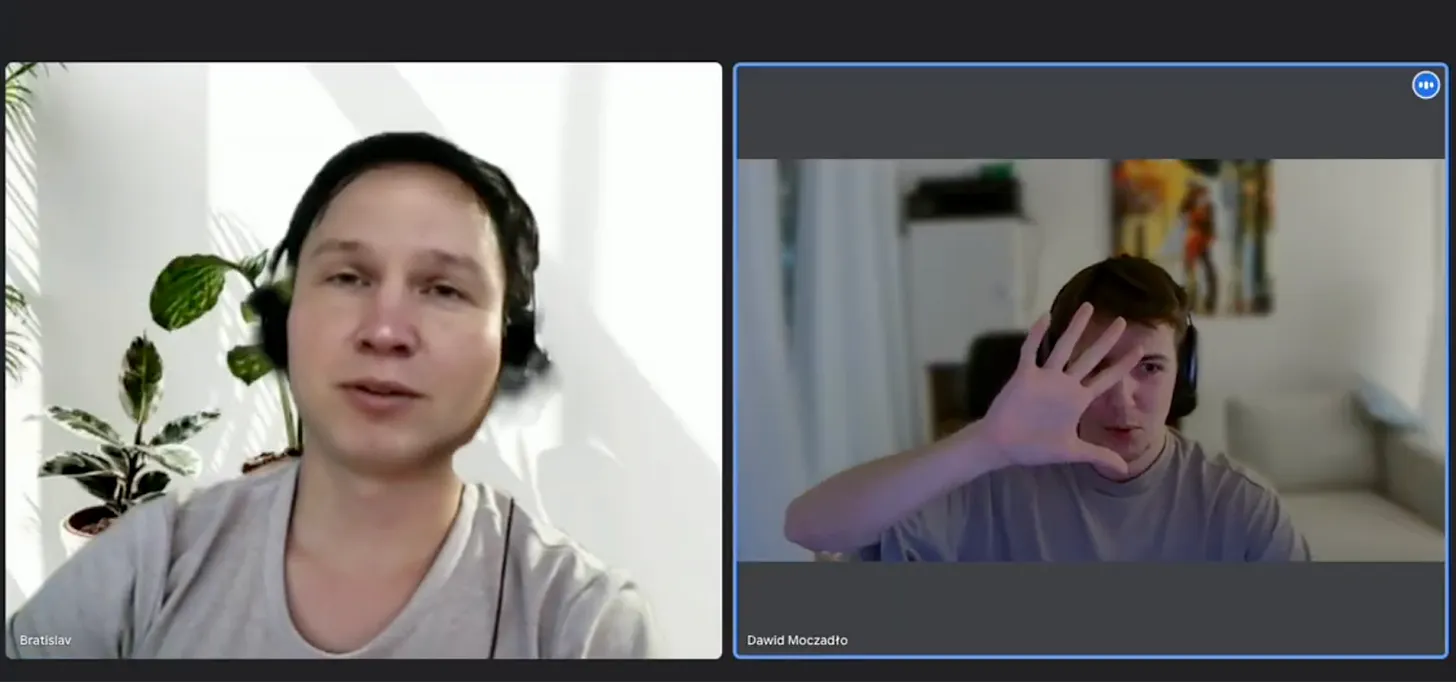
Such incidents are becoming more common at US, UK and EU companies which hire for remote roles:
“There are a lot more fake candidates applying, leveraging AI for not just resumes, but also interviews. In extreme cases, the interviews are being outsourced so that a different person shows up for the interview. It feels a bit like playing captcha with them during interviews.” – Senior EM, private-equity backed company, Bay Area, US
“The second person we interviewed was clearly a North Korean scammer, writing questions into an LLM, reading the response, easily tripped up, and other interviews were background noise in the room.” – Staff Engineer, UK
“Many applicants that looked a good fit turned out to be someone else in the Asia Pacific region doing interviews with an AI in the background. It’s easy to spot because of the ‘lag’ in a naturally flowing conversation.” – head of engineering, mid-sized company, Germany
Cheating in remote interviews by using AI is also commonplace. A software engineer based in Finland told us:
“A couple of times we saw an applicant who was using AI to answer the questions, and this was sooo weird. I honestly didn’t know how to react, so we decided to cut the interview short. We then shared a note with the recruiters on how to spot this.”
The market appears sharply bifurcated: amazing for AI and a few specialist roles, and a major struggle for everyone else. Some accounts from folks benefitting in the current conditions:
“The market is really good as an (AI) engineer with the right experience. I’m not actively looking but get 2–3 messages a day. When I was hiring for AI engineers at my last AI startup, the market for these folks was terrible. It’s very hard to find good talent, and people that were great on paper did poorly in interviews.” – AI Engineer, 5 YOE, New York, US
“It seems like demand for senior positions is still there, but only if your profile really matches what the company needs. For example, I’ve been working on different data pipelines for a while, and finding such a position is relatively simple. However, breaking into anything else is not! Every startup wants to hire only people experienced in that particular thing they need.” – Software Engineer, 13 YOE, Big Tech, UK
Here’s what two job seekers who are struggling at present say:
“I sent my handcrafted resume to 30–40 positions, and heard back from zero. Eventually, I got an interview after a recruiter reached out via LinkedIn; I don’t know how I would’ve found anything, if it was not for this!” – Software engineer, 5 YOE, Amsterdam, Netherlands
“As a developer without a specific “specialization,” I’m struggling to get any interviews. I’ve spent a few years as frontend, then another few as backend, and most recently working on DevEx. In this market, I just don’t get any callbacks for interviews, not even a first round interview.” – Software engineer, 6 YOE, London, UK
We see in the data that AI engineering is seeing explosive demand, and that forward deployed engineers (FDEs) are also seeing a massive spike in demand. For more detail on this, check our deepdive on what FDEs are, and why they’re hot right now.
Anecdotal evidence from job seekers suggests that being in these fields means the market is as good as it gets, right now:
“It’s the greatest job market I’ve ever seen. I’m an L5 former FDE, now SWE, who has worked on LLM apps for ~2 years. The inbound top of the funnel is bonkers, and I find myself saying “no” to places that I would have once killed to work at.” – AI Engineer at an AI decacorn, San Francisco, US
“I have seen huge interest in FDEs and AI Engineers as an engineer who’s been interviewing.” – Software Engineer, 5 YOE, New York, US
“It’s not hard to get interviews as an ML/AI engineer. The technical bar is about the same as late 2022. If anything, onsites seem to be of fewer rounds for the same level. Companies seem to move fast to get candidates onsite.” – ML engineer, ex-Meta, Bay Area, US
An engineer at Apple is surprised by the demand for their skills from AI companies:
“Got a lot of responses from cold applications for AI roles, and ended up with two offers at AI infra companies. I ended up getting a significant pay bump beyond what Apple offers for the same level!”
A software engineer at well-known company in the Bay Area, also finds the job market is good:
“I got offers for Senior SWE with Stripe and Rippling, was rejected from Snowflake… Anecdotally, the job market is better compared to 2025 for regular SWE positions in the Valley.”
A repeat complaint from hiring managers in the US is how challenging it is to recruit solid engineering managers and Staff+ engineers:
“It’s extremely difficult to hire EMs and Staff+ engineers. It’s much easier to hire folks with less than 10 years of experience. This is despite us offering 90th percentile comp via Pave, and having a hybrid and good culture.” – Fractional VP of Engineering, Series B, New York, US
“My team has been looking for a new engineering manager for three months and we barely had any good applicants. It’s a super weird dynamic right now.” – Senior Infrastructure Engineer, Series D Fintech, company with offices in the US and EU
“The most desirable candidates right now are EM or staff-level folks who can keep up with uncertainty in the business. We are having trouble hiring folks who roll with the constant change that is now very typical at startups.” – CTO at a San Francisco-based startup
A few examples:
Distributed systems engineers: “We can’t find enough qualified distributed systems engineers, cloud infra etc. I have 20 reqs [open positions] right now.” – Recruiter at a hyperscaler, US
Product engineers: “‘Product engineer’ has been a hard profile to find. It is also hard to find someone with a decent design eye who can also build full stack. The hardest thing to hire for has been taste + trust… I’d rather hire someone who is ‘behind’ on AI, but has great taste/judgment than someone with complex agent setups and prompt libraries.” – Tech Lead, seed-stage startup, Los Angeles, US
Senior engineers, in general: “As a hiring manager trying to hire seniors right now, it has felt pretty difficult. Most applicants are totally unqualified, and the qualified ones do poorly in an interview.” – Engineering manager, robotics company, Canada
One in five respondents detail how difficult it has been to get responses from recruiters:
“Things are looking bleak. Now, applications are going into a void. Recruiters aren’t reaching out immediately as before. Of 10 or so applications sent out, I’ve gotten one interview scheduled that was then rescinded because it looks like the team was laid off.” – Frontend engineer, 10+ YOE, Southeast US
“The job market has been a desert. I’ve gotten back into applying, job agencies seem to have few roles they’re looking to fill. The companies I have applied to myself, never reply.” – Software Engineer, 8 YOE, Southern California
“Recruiters are ghosting me! Every time when I respond to recruiter reachouts, they ALL ghosted me after a few messages and have similar stories from friends.” – Software Engineer, 7 YOE, ex-Meta, Switzerland
“So far, I have a hard time even getting past the hiring manager and I’m rejected before I can do the proper technical assessment.” – Software Engineer, 7 YOE, Helsinki, Finland
Even folks at Big Tech face a lack of response. Here’s a Technical Program Manager currently at Meta who used to be very in-demand:
“I put a few feelers out when Meta announced layoffs, and it’s just radio silence. I don’t want to sound cocky, but with my resume, you at least get a chat with a recruiter, usually right away. But Google and Anthropic just ghosted me.”
In a “normal” market, when the hiring bar goes up, so does compensation. But we heard anecdotes about the hiring bar going up, with the compensation on offer trending down!
此内容由惯性聚合(RSS阅读器)自动聚合整理,仅供阅读参考。 原文来自 — 版权归原作者所有。