





The answer is: it depends.
The role of a CTO varies as the company matures. Here’s a graphic from Socal CTO that illustrates the roles as they change over time:
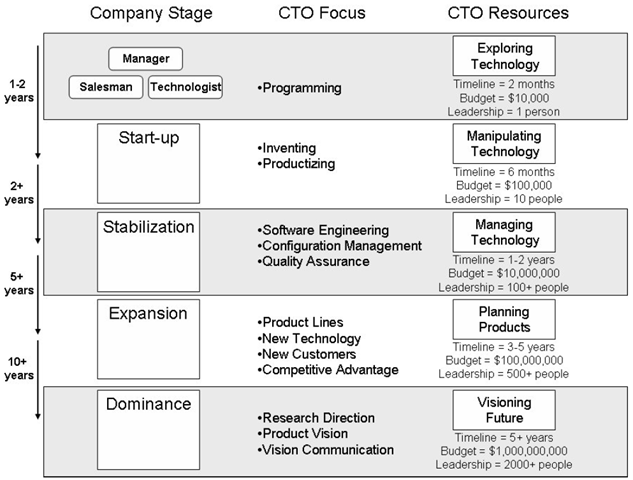
In its earliest days, a startup’s top need is often to produce a product. Getting something to market and getting funding override any other concerns. That’s why the CTO’s attention is on programming for the earliest stage.
But be careful, and mind the gap – the Founder-Developer Gap, that is! Hiring a hands-on lead developer might seem like the right move for an early stage startup. It’s understandable – a hands-on developer can produce a product. But hiring a lead developer, or even a VP of Engineering, can create a gap between the founders and the developers.
How big is your startup’s Founder-Developer Gap? Is it a tiny crack, or a widening chasm? And how can you tell?
One sign of a gap is questions – really, a lack of questions – coming from your developers. Check out our blog post 53 Questions Developers Should Ask Innovators. If you’re not hearing those questions from your developers, you’ve got the gap.
Often, developers don’t think to answer these questions. Instead, given a startup project, they’ll default to building everything in-house, using technologies that they’re already familiar with. This is a safe choice, of course – but is it the best choice? Is it the best path to profitability?
It might be. But you shouldn’t rely on the defaults. A CTO can help you find the right answers.
We’re not suggesting that early-stage startups should hire a full-time CTO. Instead, they should consider a Fractional CTO who can help close the gap. This is especially true when a founder has a strong vision but limited knowledge of the technology needed to make it a reality.
Bottom line – if you recognize this gap, then reach out to get a slice of a CTO who can help bridge the gap.
Theoretically, an outstanding lead developer can provide good answers to all these questions. But our experience suggests it doesn’t usually work out that way. And even if you prompt a good lead developer to answer, you’ll likely still have a gap. This is because the lead developer will often be:
Again, it can be done. It’s just not a realistic expectation. You don’t want to be in the meeting when the investor asks why you didn’t use their favorite new technology – at least, not without a good answer! And you certainly don’t want to be the company that spends time and money building something you could have picked up off the shelf.
Eric Ries, a great resource, answers the question What Does a Startup CTO actually do?
And here are some links that are less Startup CTO, and CTO more generally:
If you know of more resources on this topic, we’d love to hear from you. Please write us at blog@techempower.com !
此内容由惯性聚合(RSS阅读器)自动聚合整理,仅供阅读参考。 原文来自 — 版权归原作者所有。