




惯性聚合 高效追踪和阅读你感兴趣的博客、新闻、科技资讯
阅读原文 在惯性聚合中打开

推荐订阅源

W
WeLiveSecurity
The GitHub Blog
The GitHub Blog
Engineering at Meta
Engineering at Meta
Microsoft Azure Blog
The Register - Security
Stack Overflow Blog
Stack Overflow Blog
博客园 - 三生石上(FineUI控件)
T
Threat Research - Cisco Blogs
S
SegmentFault 最新的问题
V2EX - 技术
V2EX - 技术
Hacker News: Ask HN
Hacker News: Ask HN
K
KPMG report finds enterprise disconnect between AI and its ROI | CIO
P
Proofpoint News Feed
J
Java Code Geeks
Microsoft Security Blog
M
MIT News - Artificial intelligence
AI
AI
cs.CL updates on arXiv.org
P
Proofpoint News Feed
Hacker News - Newest:
Hacker News - Newest: "LLM"
B
Blog
N
News and Events Feed by Topic
N
News | PayPal Newsroom
Google DeepMind News
酷 壳 – CoolShell
酷 壳 – CoolShell
freeCodeCamp Programming Tutorials: Python, JavaScript, Git & More
WordPress大学
WordPress大学
C
Cybersecurity and Infrastructure Security Agency CISA
Cyber Security Advisories - MS-ISAC
博客园 - 【当耐特】
U
Unit 42
腾讯CDC
Threat Intelligence Blog | Flashpoint
The Cloudflare Blog
H
Help Net Security
Recent Announcements
P
Privacy & Cybersecurity Law Blog
IT之家
IT之家
钛媒体:引领未来商业与生活新知
钛媒体:引领未来商业与生活新知
Security Archives - TechRepublic
L
LINUX DO - 热门话题
Martin Fowler
Martin Fowler
MongoDB | Blog
MongoDB | Blog
cs.CV updates on arXiv.org
H
Heimdal Security Blog
博客园 - 聂微东
S
Securelist
大猫的无限游戏
大猫的无限游戏
Cloudbric
Cloudbric
Cisco Talos Blog
Cisco Talos Blog

product Archives – TechEmpower

Agentic Coding in Practice Product meets Engineering in the AI Era Using Generative AI to Drive Corporate Impact Selecting a Software Development Company in 2024 Generative AI – The End of Empty Textboxes How to Use Generative AI and LLMs to Improve Search The Top 20 Symptoms of a Weak Development Team Technical Review: A Trusted Look Under the Hood Startup CTO or Developer 53 Questions Developers Should Ask Innovators
Startup Metrics
Alan Laser · 2023-07-31 · via product Archives – TechEmpower

When talking to startup founders or other innovators, we always ask questions to better understand their business as a core. What does the business do? How does it meet customers’ needs? And most importantly, how does it make money?  One way to approach that last question is to use this simple model:
  • Customer Acquisition Cost  (CAC)

How will your business reach prospects? How will you convert them? And how much will it cost to win them?

  • Customer Lifetime Value (CLV)

How much money will your business generate from each converted customer?

These two questions/answers can help define the early proof points for your company. If you can demonstrate that your CAC and CLV numbers work as expected, then you’ve proven you can make money.  

Proving your Business Model Works – Build, Define, and Review

But how do you prove your numbers?  

Start by building just enough of your product to get early CAC and CLV signals (they won’t be perfect). Don’t worry about scaling just yet. If your numbers work out, then scaling becomes a question of capital. 

Next, define what you need from a metrics and reporting standpoint. Look at different customer acquisition channels, how they are converting, and the expected lifetime value of customers acquired through those channels. Apply costs to each channel. We need to make sure we have these numbers. Quite often the goal is to get them into a spreadsheet in a form that allows people to easily play with them.

Finally, review the numbers with your partners. Don’t overcomplicate things with reporting tools.  Just get your numbers into a Google sheet so you can work with them easily.

Startup Metrics with Dave McClure

Dave McClure has a great presentation on Startup Metrics where he points to some additional metrics that are useful to consider:

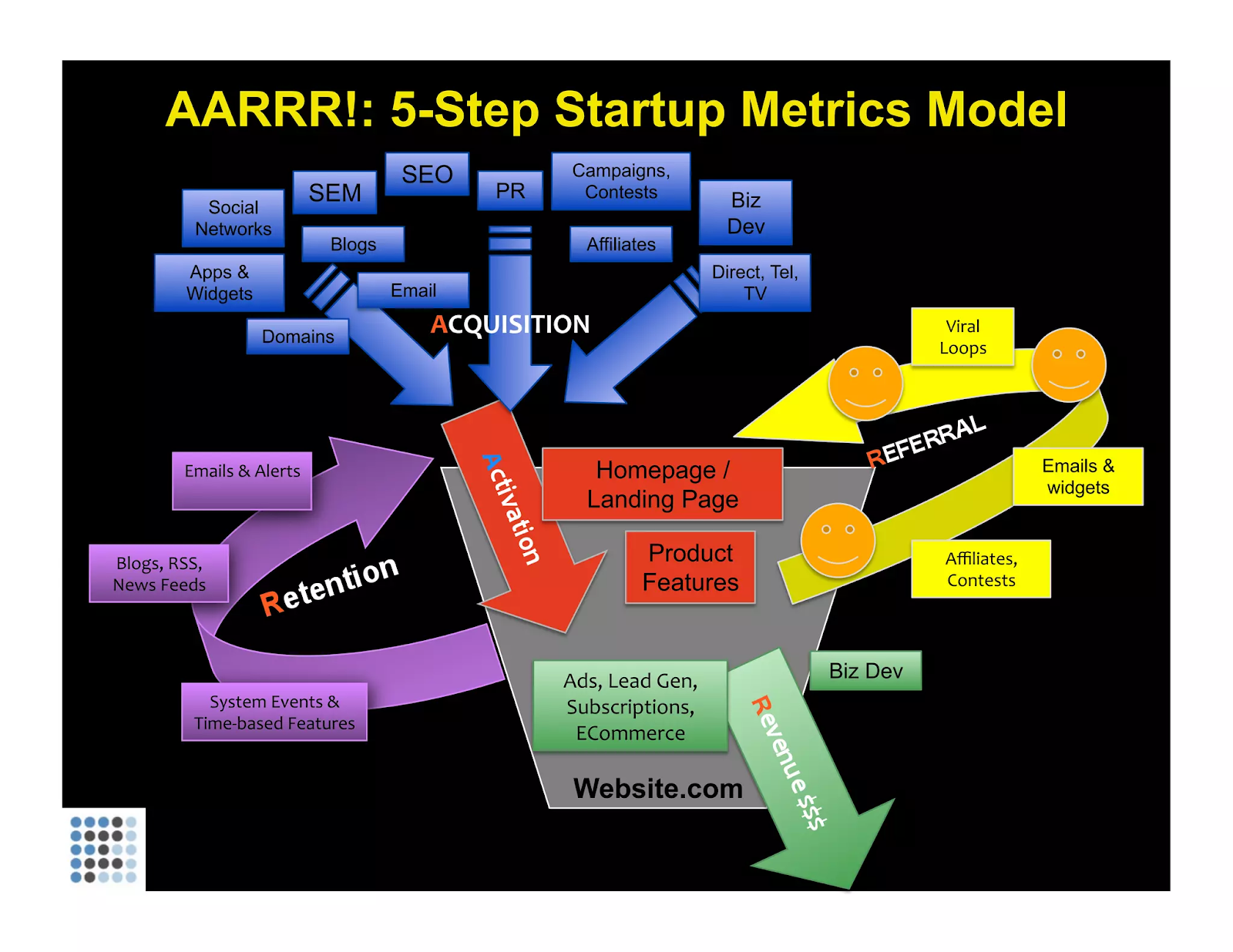
  • A: Acquisition – Where / what channels do users come from?
  • A: Activation – What % have a “happy” initial experience?
  • R: Retention – Do they come back & re-visit over time?
  • R: Referral – Do they like it enough to tell their friends?
  • R: Revenue – Can you monetize any of this behavior?

The metrics, and how they relate, are captured in his slide:
Startup Metrics
Note the relationship between retention/referral efforts and lifetime value. This isn’t a simple, first-cut acquisition pipeline! Dave’s model provides a much richer understanding of what’s happening, but in a way that’s understandable and measurable.

Another thing that Dave has done well is to look at the value of different marketing channels:
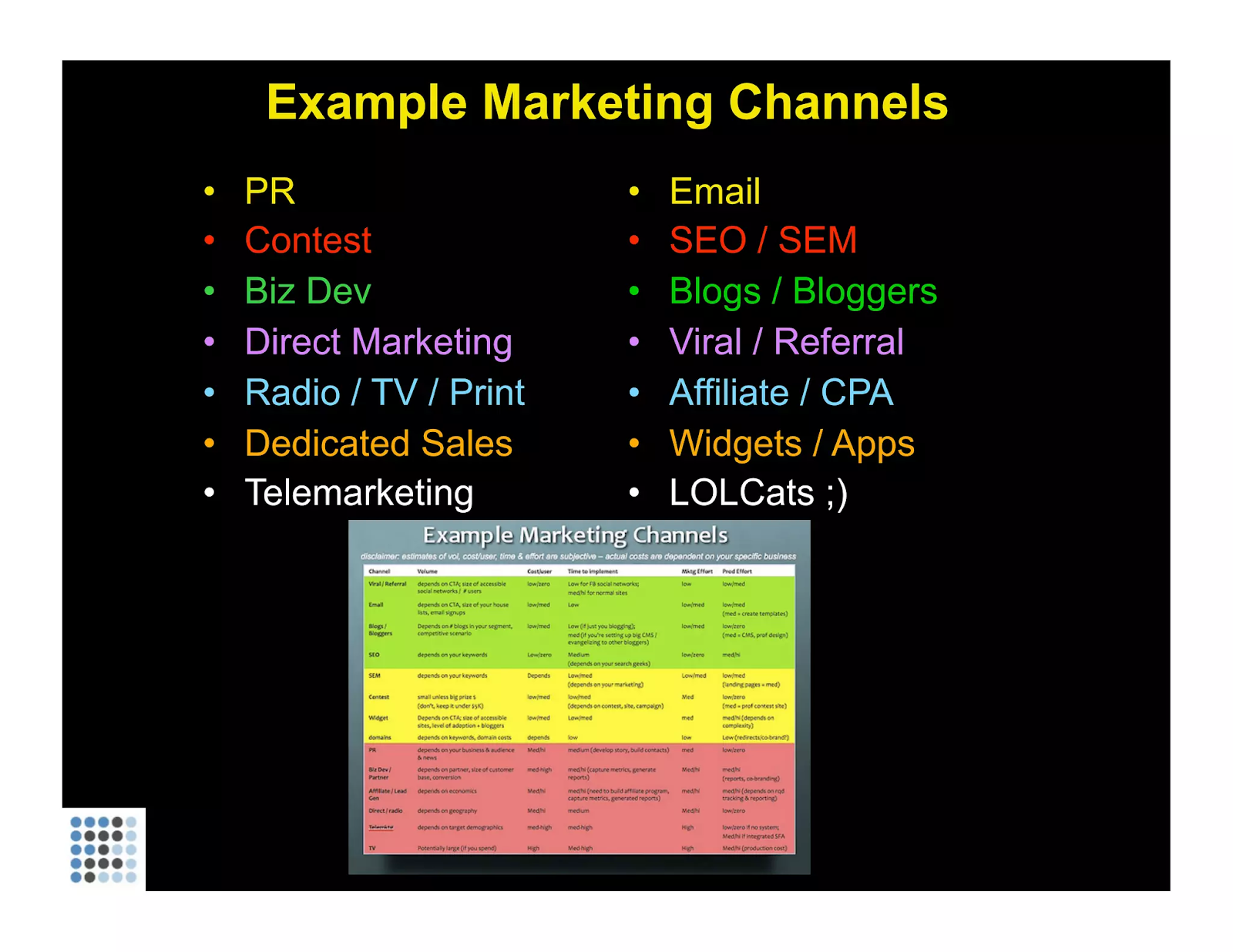
Example Marketing Channels
There’s a lot of value in this presentation. Some key slides to check out:

The Startup Metrics Religion

  • The Progress is not equal to features (Less is More)
  • Focus on User Experience
  • Measure Conversion; Compare 2+ Options
  • Fast, Frequent Iteration + Feedback Loop
  • Keep it Simple and Actionable

What’s my business model?

  • Get Users (= Acquisition, Referral)
  • Drive Usage (= Activation, Retention)
  • Make Money (= Monetize)

Startup Challenges

  • Management: Setting priorities, defining key metrics, reporting progress
  • Product: Build the right features, getting product out quickly, testing for conversion/adoption
  • Marketing: Accessing “web 2.0” channels (search, social, viral, new media), cost-efficient distribution

We often reference Dave’s work when talking to innovators. Be sure to check out the entire presentation.

Conclusion

Startup metrics are an invaluable tool for founders and innovators. Focus on building an MVP to gather startup metrics. Then use what you’ve learned in this blog post to decide if the numbers validate your business model, or if you need to rethink your approach.

If you know of more resources on this topic, or want to talk about anything startup or tech related, we’d love to hear from you. Please write us at blog@techempower.com !