








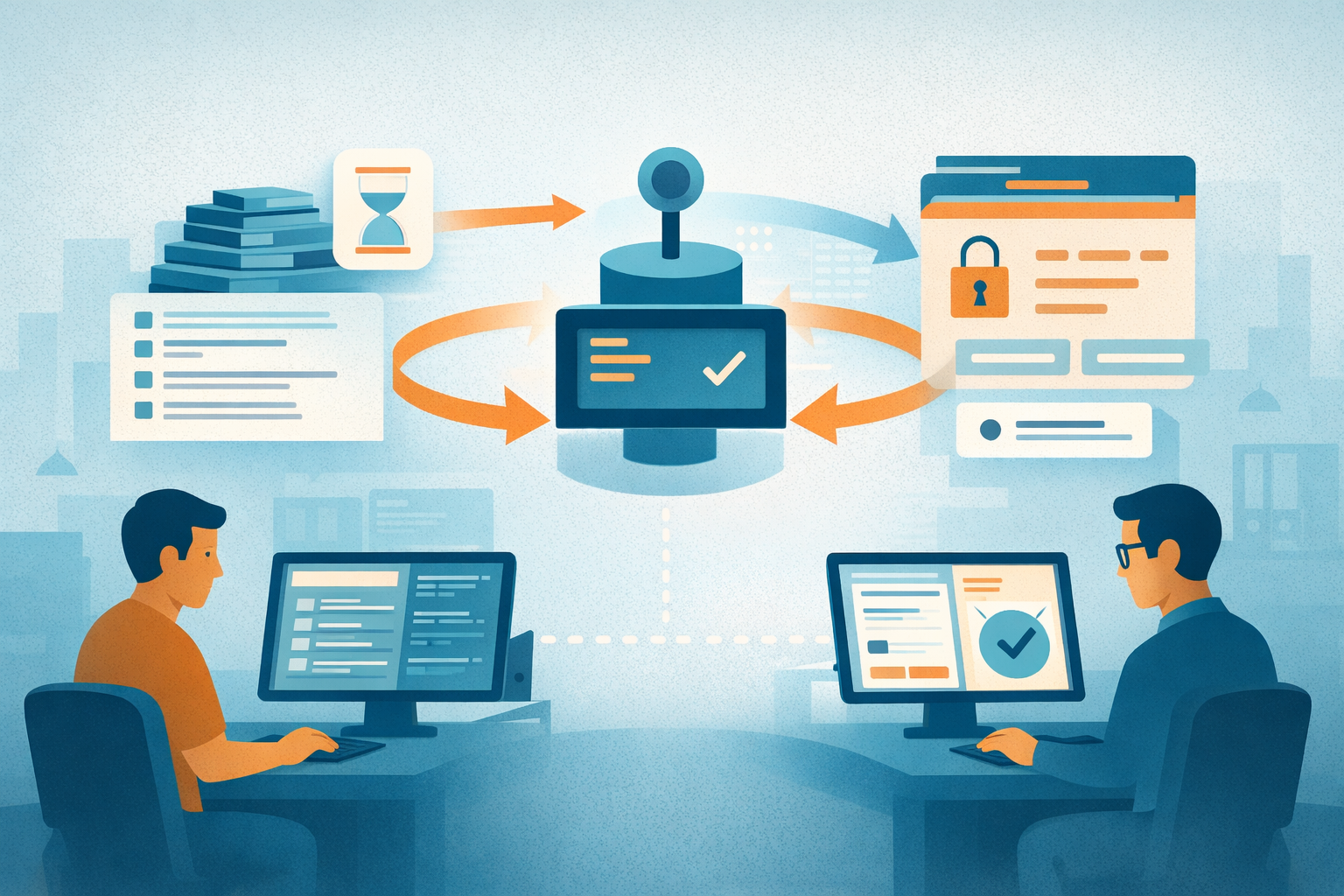
Autonomous agentic system: an LLM wrapped in a loop that can plan, take actions via tools, observe results, and continue until it reaches a stop condition (or it’s forced to stop).
Tool calling: the agent selecting from a constrained action space (tool names + schemas) and emitting structured calls; your runtime executes them, validates outputs, and feeds results back into the loop.
Orchestration (the “real software” around the model): state management, retries, idempotency, timeouts, tool gating, context assembly/pruning, audit logging, and escalation paths.
Closed-loop evaluation (Plan -> Act -> Judge -> Revise): a repeatable harness where you run realistic tasks, score outcomes (ideally against ground truth and human-calibrated judges), learn what broke, and iterate.
Guardrails + safe stopping: runtime-enforced constraints (policies, budgets, circuit breakers, permissions) that limit what the agent can do and force it to stop or escalate when risk rises or progress stalls.
Treat your tools like a product surface, not a pile of functions.
The failure mode is “death by a thousand tools”: overlapping capabilities, ambiguous names, and huge schemas that make selection brittle. Keep tools narrow, make them obviously distinct, and hide tools by default unless they’re relevant to the current step. “Just-in-time” instructions and tool visibility is a pragmatic way to scale without drowning the model in choices.
Move reliability into deterministic infrastructure (not prompt magic).
If an agent can trigger side effects (create a ticket, refund an order, email a customer), you need transactional thinking: idempotent tools, checkpointing, “undo stacks,” and clear commit points. Prompts don’t roll back production systems; your runtime does.
Put hard budgets and explicit stop reasons into the main loop.
Most “runaway agents” are simply missing guardrails that set limits on: iterations, tool calls, dollars, and wall-clock time; and “no progress” detectors (same tool call repeating, same plan restated, same error class recurring). When the agent hits a threshold, it should stop with a structured summary: what it tried, learned, and needs from a human.
Design for long-running work with durable state and resumability.
If the agent’s job can outlast a single context window (or a single process), assume it will crash, time out, or be interrupted. Store state externally, make steps replayable, and separate “planning notes” from the minimal context required to proceed. The goal is to resume cleanly without redoing expensive work or compounding earlier mistakes.
Make evaluation real: production-like tasks, ground truth, and judges you can trust.
Vibe checks don’t catch regressions. You want a small-but-representative set of real tasks sampled from production distributions, with ground truth where possible, and automated judges that are calibrated against human agreement (so you know what “good” means). Also assume reward hacking and metric gaming will happen. Build detection for it the same way you do for any other adversarial input.
Security guardrails: constrain action space, validate everything, and sandbox execution.
Tool calling expands your attack surface (prompt injection is just one angle). Practical defaults: strict schema validation, allow-lists for tool targets, content sanitization, least-privilege credentials, and sandboxed execution for anything that can run code or touch sensitive systems.
Want to learn how TechEmpower can help you or your team with Agentic AI?
Building production-ready agentic systems: Lessons from Shopify Sidekick (Shopify, Aug 26, 2025)
The most “copyable” part is how they hit tool sprawl in the real world and moved to just-in-time instructions, plus a very concrete evaluation approach (ground-truth sets, human agreement, judge calibration, and the reality of reward hacking).
AI grew up and got a job: Lessons from 2025 on agents and trust (Dec 18, 2025, Google Cloud)
A CTO-level framing of why “agents” change the trust model: autonomy, integration into workflows, atomicity/rollback thinking, and why governance has to be part of the architecture.
Effective harnesses for long-running agents (Nov 26, 2025, Anthropic)
Focuses on the annoying reality: agents that run for hours/days need a harness that’s built for resumability, recoverability, and controlled progress—not just bigger context windows.
What 1,200 Production Deployments Reveal About LLMOps in 2025 (Dec 19, 2025, ZenML)
A dense, case-study-heavy sweep of what shows up across production systems: context engineering, infrastructure guardrails, circuit breakers, and why “software fundamentals” keep winning over clever prompting.
Ground Truth Curation Process for AI Systems (Aug 20, 2025, Microsoft).
If you’re serious about closed-loop improvement, this is the unglamorous foundation: how to build and maintain ground truth sets that support regression testing and meaningful “judge” signals.
Function calling using LLMs (May 6, 2025, Martin Fowler).
A solid mental model for “tools as a constrained action space,” plus practical guardrails (unit tests around tool selection, injection defenses, and how to reduce boilerplate as your toolset grows).
How to build your first agentic AI system (Oct 2, 2025, TechTarget).
A pragmatic implementation-oriented checklist, including explicit loop limits, retry patterns, and when to escalate—useful for teams moving from prototypes to something operational.
此内容由惯性聚合(RSS阅读器)自动聚合整理,仅供阅读参考。 原文来自 — 版权归原作者所有。