





How much does your framework choice affect performance? The answer may surprise you.
Authors’ Note: We’re using the word “framework” loosely to refer to platforms, micro-frameworks, and full-stack frameworks. We have our own personal favorites among these frameworks, but we’ve tried our best to give each a fair shot.
We know you’re curious (we were too!) so here is a chart of representative results.
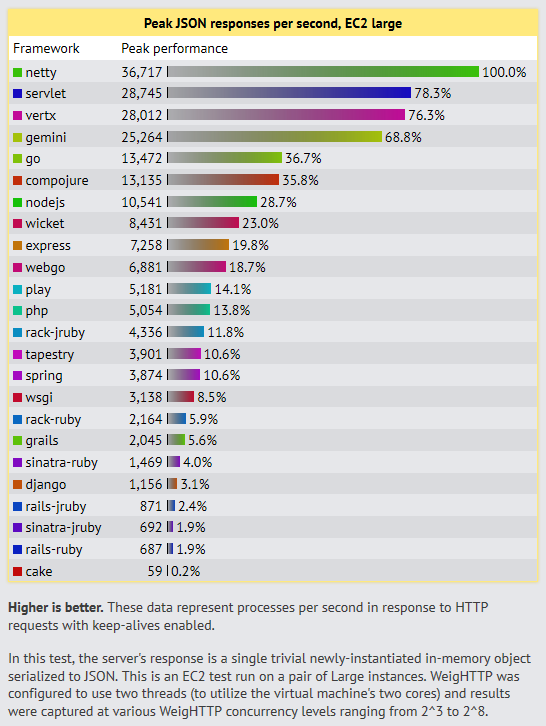
Whoa! Netty, Vert.x, and Java servlets are fast, but we were surprised how much faster they are than Ruby, Django, and friends. Before we did the benchmarks, we were guessing there might be a 4x difference. But a 40x difference between Vert.x and Ruby on Rails is staggering. And let us simply draw the curtain of charity over the Cake PHP results.
If these results were surprising to you, too, then read on so we can share our methodology and other test results. Even better, maybe you can spot a place where we mistakenly hobbled a framework and we can improve the tests. We’ve done our best, but we are not experts in most of them so help is welcome!
Among the many factors to consider when choosing a web development framework, raw performance is easy to objectively measure. Application performance can be directly mapped to hosting dollars, and for a start-up company in its infancy, hosting costs can be a pain point. Weak performance can also cause premature scale pain, user experience degradation, and associated penalties levied by search engines.
What if building an application on one framework meant that at the very best your hardware is suitable for one tenth as much load as it would be had you chosen a different framework? The differences aren’t always that extreme, but in some cases, they might be. It’s worth knowing what you’re getting into.
For this exercise, we aimed to configure every framework according to the best practices for production deployments gleaned from documentation and popular community opinion. Our goal is to approximate a sensible production deployment as accurately as possible. For each framework, we describe the configuration approach we’ve used and cite the sources recommending that configuration.
We want it all to be as transparent as possible, so we have posted our test suites on GitHub.
We ran each test on EC2 and our i7 hardware. See Environment Details below for more information.
First up is plain JSON serialization on Amazon EC2 large instances. This is repeated in the introduction, above.
The high-performance Netty platform takes a commanding lead for JSON serialization on EC2. Since Vert.x is built on Netty, it too achieved full saturation of the CPU cores and impressive numbers. In third place is plain Java Servlets running on Caucho’s Resin Servlet container. Plain Go delivers the best showing for a non-JVM framework.
We expected a fairly wide field, but we were surprised to see results that span four orders of magnitude.
Here is the same test on our Sandy Bridge i7 hardware.
On our dedicated hardware, plain Servlets take the lead with over 210,000 requests per second. Vert.x remains strong but tapers off at higher concurrency levels despite being given eight workers, one for each HT core.
How many requests can be handled per second if each request is fetching a random record from a data store? Starting again with EC2.
For database access tests, we considered dropping Cake to constrain our EC2 costs. This test exercises the database driver and connection pool and illustrates how well each scales with concurrency. Compojure makes a respectable showing but plain Servlets paired with the standard connection pool provided by MySQL is strongest at high concurrency. Gemini is using its built-in connection pool and lightweight ORM.
It’s worth pausing to appreciate that this shows an EC2 Large instance can query a remote MySQL instance at least 8,800 times per second, putting aside the additional work of each query being part of an HTTP request and response cycle.
The dedicated hardware impresses us with its ability to process nearly 100,000 requests per second with one query per request. JVM frameworks are especially strong here thanks to JDBC and efficient connection pools. In this test, we suspect Vert.x is being hit very hard by its connectivity to MongoDB. We are especially interested in community feedback related to tuning these MongoDB numbers.
The following tests are all run at 256 concurrency and vary the number of database queries per request. The tests are 1, 5, 10, 15, and 20 queries per request. The 1-query samples, leftmost on the line charts, should be similar (within sampling error) of the single-query test above.
As expected, as we increase the number of queries per request, the lines converge to zero. However, looking at the 20-queries bar chart, roughly the same ranked order we’ve seen elsewhere is still in play, demonstrating the headroom afforded by higher-performance frameworks.
We were surprised by the performance of Raw PHP in this test. We suspect the PHP MySQL driver and connection pool are particularly well tuned. However, the penalty for using an ORM on PHP is severe.
The dedicated hardware produces numbers nearly ten times greater than EC2 with the punishing 20 queries per request. Again, Raw PHP makes an extremely strong showing, but PHP with an ORM and Cake—the only PHP framework in our test—are at the opposite end of the spectrum.
This exercise aims to provide a “baseline” for performance across the variety of frameworks. By baseline we mean the starting point, from which any real-world application’s performance can only get worse. We aim to know the upper bound being set on an application’s performance per unit of hardware by each platform and framework.
But we also want to exercise some of the frameworks’ components such as its JSON serializer and data-store/database mapping. While each test boils down to a measurement of the number of requests per second that can be processed by a single server, we are exercising a sample of the components provided by modern frameworks, so we believe it’s a reasonable starting point.
For the data-connected test, we’ve deliberately constructed the tests to avoid any framework-provided caching layer. We want this test to require repeated requests to an external service (MySQL or MongoDB, for example) so that we exercise the framework’s data mapping code. Although we expect that the external service is itself caching the small number of rows our test consumes, the framework is not allowed to avoid the network transmission and data mapping portion of the work.
Not all frameworks provide components for all of the tests. For these situations, we attempted to select a popular best-of-breed option.
Each framework was tested using 2^3 to 2^8 (8, 16, 32, 64, 128, and 256) request concurrency. On EC2, WeigHTTP was configured to use two threads (one per core) and on our i7 hardware, it was configured to use eight threads (one per HT core). For each test, WeigHTTP simulated 100,000 HTTP requests with keep-alives enabled.
For each test, the framework was warmed up by running a full test prior to capturing performance numbers.
Finally, for each framework, we collected the framework’s best performance across the various concurrency levels for plotting as peak bar charts.
We used two machines for all tests, configured in the following roles:
Ultimately, a three-machine configuration would dismiss the concern of double-duty for the second machine. However, we doubt that the results would be noticeably different.
We ran three types of tests. Not all tests were run for all frameworks. See details below.
For this test, each framework simply responds with the following object, encoded using the framework’s JSON serializer.
{"message" : "Hello, World!"}
With the content type set to application/json. If the framework provides no JSON serializer, a best-of-breed for the platform is selected. For example, on the Java platform, Jackson was used for frameworks that do not provide a serializer.
In this test, we use the ORM of choice for each framework to grab one simple object selected at random from a table containing 10,000 rows. We use the same JSON serialization tested earlier to serialize that object as JSON. Caveat: when the data store provides data as JSON in situ (such as with the MongoDB tests), no transcoding is done; the string of JSON is sent as-is.
As with JSON serialization, we’ve selected a best-of-breed ORM when the framework is agnostic. For example, we used Sequelize for the JavaScript MySQL tests.
We tested with MySQL for most frameworks, but where MongoDB is more conventional (as with node.js), we tested that instead or in addition. We also did some spot tests with PostgreSQL but have not yet captured any of those results in this effort. Preliminary results showed RPS performance about 25% lower than with MySQL. Since PostgreSQL is considered favorable from a durability perspective, we plan to include more PostgreSQL testing in the future.
This test repeats the work of the single-query test with an adjustable queries-per-request parameter. Tests are run at 5, 10, 15, and 20 queries per request. Each query selects a random row from the same table exercised in the previous test with the resulting array then serialized to JSON as a response.
This test is intended to illustrate how all frameworks inevitably will converge to zero requests per second as the complexity of each request increases. Admittedly, especially at 20 queries per request, this particular test is unnaturally database heavy compared to real-world applications. Only grossly inefficient applications or uncommonly complex requests would make that many database queries per request.
You can find the full source code for all of the tests on Github. Below are the relevant portions of the code to fetch a configurable number of random database records, serialize the list of records as JSON, and then send the JSON as an HTTP response.
public function index() {
    $query_count = $this->request->query('queries');
    if ($query_count == null) {
        $query_count = 1;
    }
    $arr = array();
    for ($i = 0; $i < $query_count; $i++) { $id = mt_rand(1, 10000); $world = $this->World->find('first', array('conditions' =>
            array('id' => $id)));
        $arr[] = array("id" => $world['World']['id'], "randomNumber" =>
            $world['World']['randomNumber']);
    }
    $this->set('worlds', $arr);
    $this->set('_serialize', array('worlds'));
}
(defn get-world []
  (let [id (inc (rand-int 9999))] ; Num between 1 and 10,000
    (select world
            (fields :id :randomNumber)
            (where {:id id }))))

(defn run-queries [queries]
  (vec ; Return as a vector
    (flatten ; Make it a list of maps
      (take
        queries ; Number of queries to run
        (repeatedly get
def db(request):
    queries = int(request.GET.get('queries', 1))
    worlds = []
    for i in range(queries):
        worlds.append(World.objects.get(id=random.randint(1, 10000)))
    return HttpResponse(serializers.serialize("json", worlds), mimetype="application/json")
app.get('/mongoose', function(req, res) {
    var queries = req.query.queries || 1,
        worlds = [],
        queryFunctions = [];

    for (var i = 1; i <= queries; i++ ) {
        queryFunctions.push(function(callback) {
            MWorld.findOne({ id: (Math.floor(Math.random() * 10000) + 1 )})
            .exec(function (err, world) {
                worlds.push(world);
                callback(null, 'success');
            });
        });
    }

    async.parallel(queryFunctions, function(err, results) {
        res.send(worlds);
    });
});
@PathSegment
public boolean db() {
    final Random random = ThreadLocalRandom.current();
    final int queries = context().getInt("queries", 1, 1, 500);
    final World[] worlds = new World[queries];
    for (int i = 0; i < queries; i++) {
        worlds[i] = store.get(World.class, random.nextInt(DB_ROWS) + 1);
    }
    return json(worlds);
}
def db() {
    def random = ThreadLocalRandom.current()
    def queries = params.queries ? params.int('queries') : 1
    def worlds = []

    for (int i = 0; i < queries; i++) {
        worlds.add(World.read(random.nextInt(10000) + 1))
    }

    render worlds as JSON
}
if (path === '/mongoose') {
    var queries = 1;
    var worlds = [];
    var queryFunctions = [];
    var values = url.parse(req.url, true);

    if (values.query.queries) {
        queries = values.query.queries;
    }
    res.writeHead(200, {'Content-Type': 'application/json; charset=UTF-8'});

    for (var i = 1; i <= queries; i++) {
        queryFunctions.push(function(callback) {
            MWorld.findOne({ id: (Math.floor(Math.random() * 10000) + 1 )})
                .exec(function (err, world) {
                    worlds.push(world);
                    callback(null, 'success');
                });
        });
    }

    async.parallel(queryFunctions, function(err, results) {
        res.end(JSON.stringify(worlds));
$query_count = 1;
if (!empty($_GET)) {
    $query_count = $_GET["queries"];
}
$arr = array();
$statement = $pdo->prepare("SELECT * FROM World WHERE id = :id");
for ($i = 0; $i < $query_count; $i++) { $id = mt_rand(1, 10000); $statement->bindValue(':id', $id, PDO::PARAM_INT);
    $statement->execute();
    $row = $statement->fetch(PDO::FETCH_ASSOC);
    $arr[] = array("id" => $id, "randomNumber" => $row['randomNumber']);
}
echo json_encode($arr);
$query_count = 1;
if (!empty($_GET)) {
    $query_count = $_GET["queries"];
}
$arr = array();
for ($i = 0; $i < $query_count; $i++) { $id = mt_rand(1, 10000); $world = World::find_by_id($id); $arr[] = $world->to_json();
}
echo json_encode($arr);
public static Result db(Integer queries) {
    final Random random = ThreadLocalRandom.current();
    final World[] worlds = new World[queries];

    for (int i = 0; i < queries; i++) {
        worlds[i] = World.find.byId((long)(random.nextInt(DB_ROWS) + 1));
    }

    return ok(Json.toJson(worlds));
}
def db
  queries = params[:queries] || 1
  results = []

  (1..queries.to_i).each do
    results << World.find(Random.rand(10000) + 1) end render :json => results
        res.setHeader(HEADER_CONTENT_TYPE, CONTENT_TYPE_JSON);

final DataSource source = mysqlDataSource;
int count = 1;

try {
    count = Integer.parseInt(req.getParameter("queries"));
} catch (NumberFormatException nfexc) {
    // Handle exception
}

final World[] worlds = new World[count];
final Random random = ThreadLocalRandom.current();

try (Connection conn = source.getConnection()) {
    try (PreparedStatement statement = conn.prepareStatement(
            DB_QUERY,
            ResultSet.TYPE_FORWARD_ONLY,
            ResultSet.CONCUR_READ_ONLY)) {

        for (int i = 0; i < count; i++) {
            final int id = random.nextInt(DB_ROWS) + 1;
            statement.setInt(1, id);

            try (ResultSet results = statement.executeQuery()) {
                if (results.next()) {
                    worlds[i] = new World(id, results.getInt("randomNumber"));
                }
            }
        }
    }
} catch (SQLException sqlex) {
    System.err.println("SQL Exception: " + sqlex);
}

try {
    mapper.writeValue(res.getOutputStream(), worlds);
} catch (IOException ioe) {
    }
get '/db' do
  queries = params[:queries] || 1
  results = []

  (1..queries.to_i).each do
    results << World.find(Random.rand(10000) + 1)
  end

  results.to_json
end
@RequestMapping(value = "/db")
public Object index(HttpServletRequest request,
                    HttpServletResponse response, Integer queries) {

    if (queries == null) {
        queries = 1;
    }

    final World[] worlds = new World[queries];
    final Random random = ThreadLocalRandom.current();
    final Session session = HibernateUtil.getSessionFactory().openSession();

    for(int i = 0; i < queries; i++) {
        worlds[i] = (World)session.byId(World.class).load(random.nextInt(DB_ROWS) + 1);
    }

    session.close();

    try {
        new MappingJackson2HttpMessageConverter().write(
        worlds, MediaType.APPLICATION_JSON,
        new ServletServerHttpResponse(response));
    } catch (IOException e) {
        // Handle exception
    }

    return null;
}
StreamResponse onActivate() {
    int queries = 1;
    String qString = this.request.getParameter("queries");

    if (qString != null) {
        queries = Integer.parseInt(qString);
    }

    if (queries <= 0) {
        queries = 1;
    }

    final World[] worlds = new World[queries];
    final Random rand = ThreadLocalRandom.current();

    for (int i = 0; i < queries; i++) {
        worlds[i] = (World)session.get(World.class, new Integer(rand.nextInt(DB_ROWS) + 1));
    }

    String response = "";

    try {
        response = HelloDB.mapper.writeValueAsString(worlds);
    } catch (IOException ex) {
        // Handle exception
    }

    return new TextStreamResponse("application/json", response);
}
private void handleDb(final HttpServerRequest req) {
    int queriesParam = 1;
    try {
        queriesParam = Integer.parseInt(req.params().get("queries"));
    } catch(Exception e) {
    }
    final DbHandler dbh = new DbHandler(req, queriesParam);
    final Random random = ThreadLocalRandom.current();
    for (int i = 0; i < queriesParam; i++) {
        this.getVertx().eventBus().send(
            "hello.persistor",
            new JsonObject()
                .putString("action", "findone")
                .putString("collection", "world")
                .putObject("matcher", new JsonObject().putNumber("id",
                (random.nextInt(10000) + 1))), dbh);
    }
}

class DbHandler implements Handler<Message<JsonObject>> {
    private final HttpServerRequest req;
    private final int queries;
    private final List<Object> worlds = new CopyOnWriteArrayList<>();

    public DbHandler(HttpServerRequest request, int queriesParam) {
        this.req = request;
        this.queries = queriesParam;
    }

    @Override
    public void handle(Message<JsonObject> reply) {
        final JsonObject body = reply.body;

        if ("ok".equals(body.getString("status"))) {
            this.worlds.add(body.getObject("result"));
        }

        if (this.worlds.size() == this.queries) {
            try {
                final String result = mapper.writeValueAsString(worlds);
                final int contentLength = result
                    .getBytes(StandardCharsets.UTF_8).length;
                this.req.response.putHeader("Content-Type",
                    "application/json; charset=UTF-8");
                this.req.response.putHeader("Content-Length", contentLength);
                this.req.response.write(result);
                this.req.response.end();
            } catch (IOException e) {
                req.response.statusCode = 500;
                req.response.end();
            }
        }
    }
}
protected ResourceResponse newResourceResponse(Attributes attributes) {
    final int queries = attributes.getRequest().getQueryParameters()
        .getParameterValue("queries").toInt(1);
    final World[] worlds = new World[queries];
    final Random random = ThreadLocalRandom.current();
    final ResourceResponse response = new ResourceResponse();
    response.setContentType("application/json");
    response.setWriteCallback(new WriteCallback() {
        public void writeData(Attributes attributes) {
            final Session session = HibernateUtil.getSessionFactory()
                .openSession();
            for (int i = 0; i < queries; i++) {
                worlds[i] = (World)session.byId(World.class)
                    .load(random.nextInt(DB_ROWS) + 1);
            }
            session.close();
            try {
                attributes.getResponse().write(HelloDbResponse.mapper
                    .writeValueAsString(worlds));
            } catch (IOException ex) {
            }
        }
    });
    return response;
}
We expect that you might have a bunch of questions. Here are some that we’re anticipating. But please contact us if you have a question we’re not dealing with here or just want to tell us we’re doing it wrong.
Let go of your technology prejudices.
We think it is important to know about as many good tools as possible to help make the best choices you can. Hopefully we’ve helped with one aspect of that.
Thanks for sticking with us through all of this! We had fun putting these tests together, and experienced some genuine surprises with the results. Hopefully others find it interesting too. Please let us know what you think or submit Github pull requests to help us out.
We provide web and mobile application development services and are passionate about application performance. Read more about what we do.
此内容由惯性聚合(RSS阅读器)自动聚合整理,仅供阅读参考。 原文来自 — 版权归原作者所有。