


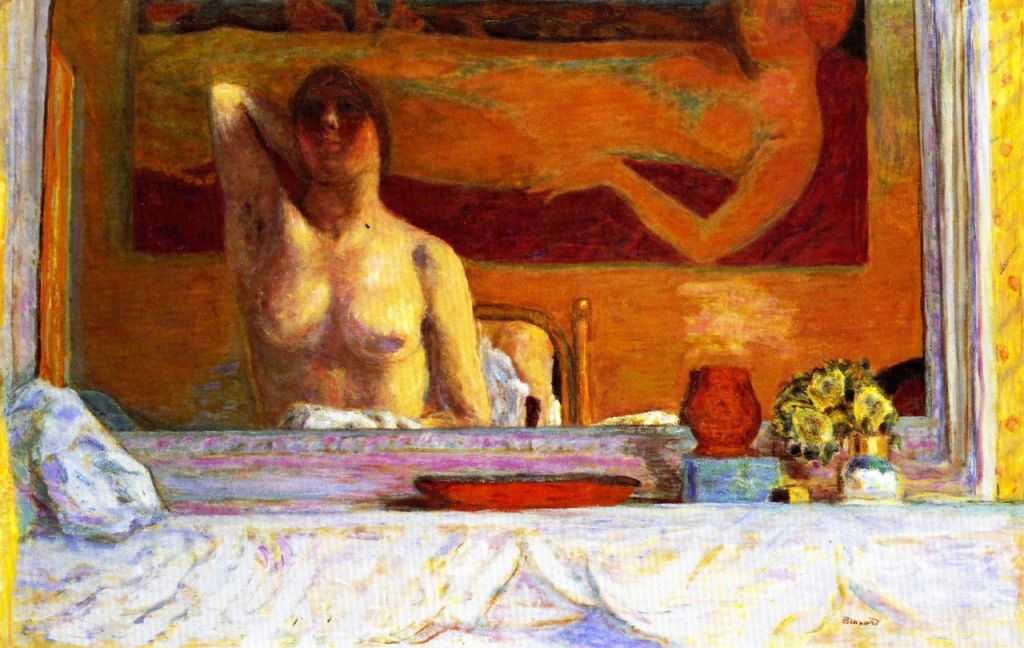
 Pierre Bonnard (1867-1947), The Mantlepiece (1916), oil on canvas, 80.7 x 126.7 cm, Private collection. The Athenaeum.
By the end of the first decade of the twentieth century, Pierre Bonnard was painting several scenes involving mirror play each year.

Among his intimate domestic scenes, Reflection or The Tub (1909) is one of his best pieces of mirror play. He again opts for a view from an elevated position, looking down and into an angled plane mirror in the bathroom. The reflected view almost fills his canvas, with the nude Marthe (most probably) crouching slightly in the upper left corner, as she dries herself after a bath.
The angle of view plays some odd tricks. The washing bowl on the dressing table is brought to overlie the larger shallow bathtub on the floor, for example. Some of the objects on the dressing table are shown directly, others only in the reflected image. And over on the opposite side of the room is a chair, and a coffee tray.

The Dressing Table with a Bunch of Red and Yellow Flowers (1913) presents us with another visual riddle that we struggle to resolve. Shown in the mirror above the dressing table is a reflection of what lies behind the artist. There’s a nearly-nude figure sat in the corner, and what appears to be a bath, or a bed on which there is a large black object, possibly a dog. As ever, the artist is nowhere to be seen, unless of course that headless figure is male rather than female.

The following year Bonnard moved back from the dressing table and its mirror, for The Bathroom Mirror (1914). Marthe’s reflection is now but a small image within the image, showing her sat on the side of the bed, with a bedspread matching the red floral pattern of the drapes around the dressing table. The artist has worked his usual vanishing trick for himself, and a vertical mirror at the right adds a curiously dark reflection of the room.
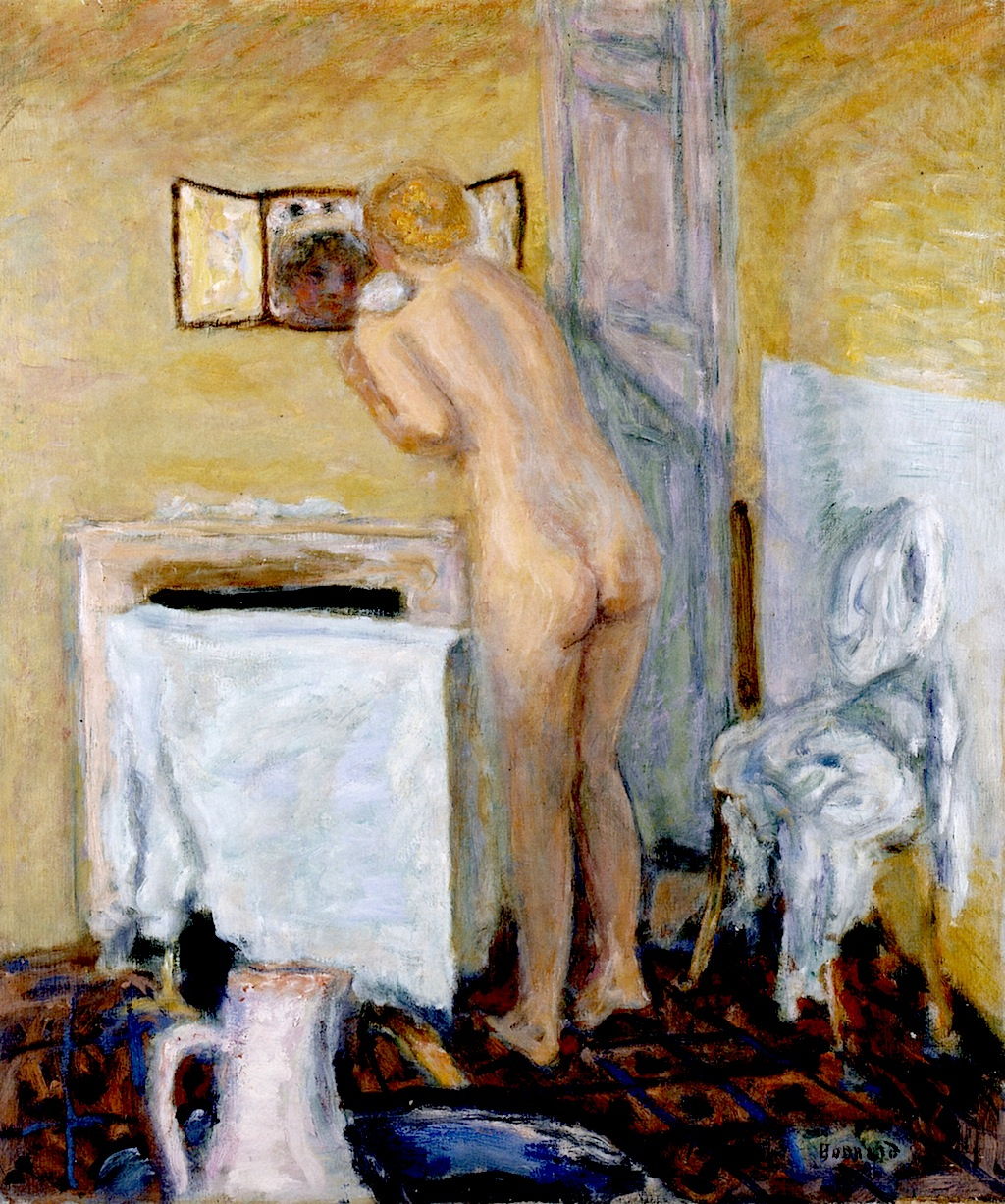
In his Nude before the Mirror (Bather) of about 1915, Bonnard inverts his mirror play with a small mirror mounted at head height. Instead of using the reflection as a picture within the picture, to reveal figures behind the position of the painter, the artist is here set well back and his model is close to the mirror, so that it frames her face. This transforms the painting by giving the figure a face, an identity, and a character, rather than just the expanse of flesh of her back.
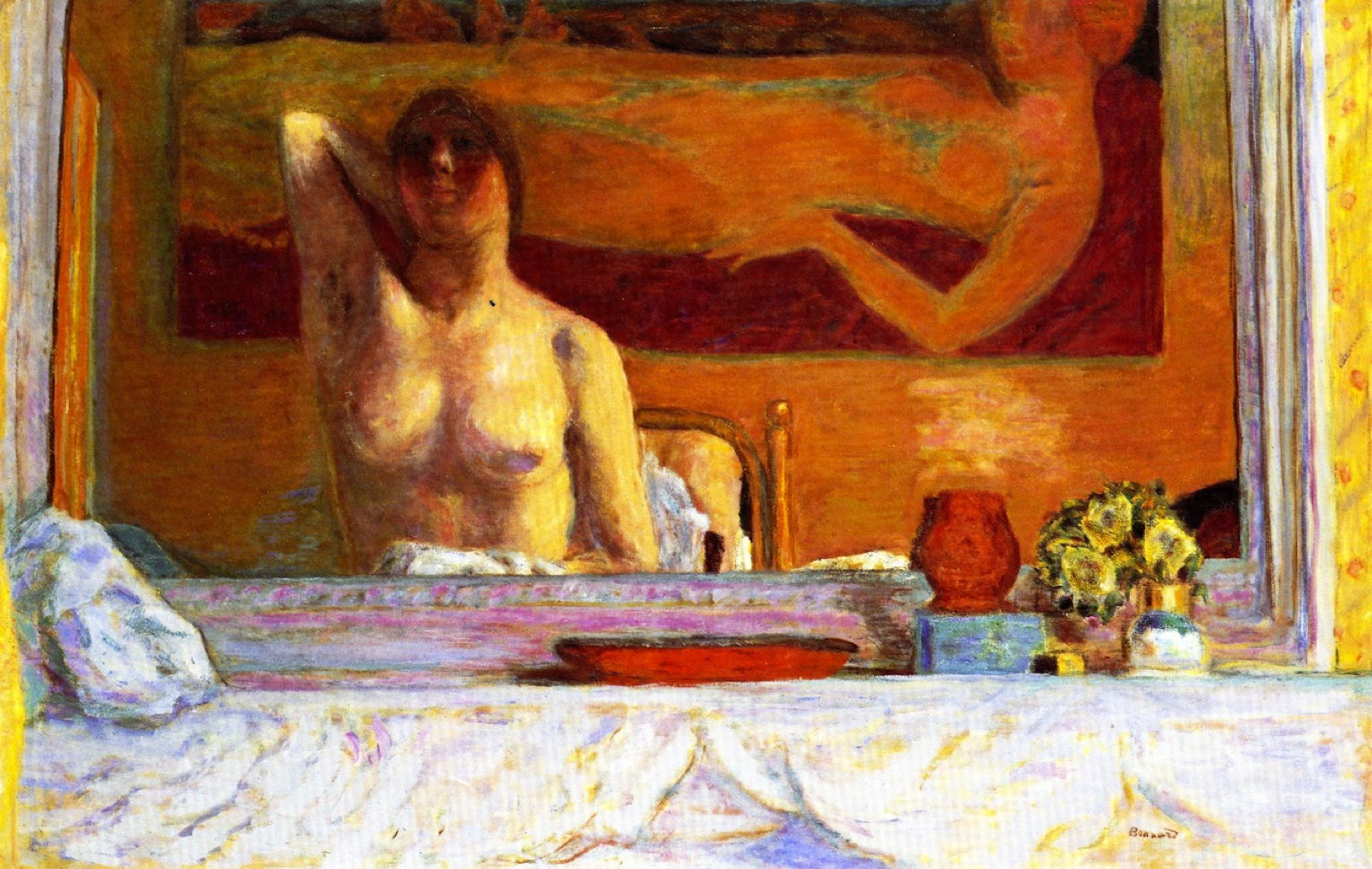
The Mantlepiece (1916) is another complex piece of mirror play. Bonnard has viewed this from an unusually low position, level with the surface of the mantlepiece and looking slightly up. Behind him is his nude model, who appears slightly odd as she is both lit and viewed from below. On the wall behind them is a very long painting of a reclining nude (which certainly doesn’t look like one of Bonnard’s works), below which is a dressing table mirror. In this case, Bonnard appears to have used the reflections to bring together quite disjoint images into a single composite.
He then seems to have painted little if any mirror play for fifteen years.

Of his surviving paintings from the 1930s I have been able to locate, intimate domestic scenes and nude figures again predominate. The Toilette (Nude at the Mirror) (1931) marks the return of mirror play different from his earlier practice: the nude stands in front of the mirror, but she isn’t seen in reflection at all, only directly. Instead, the mirror reinforces the verticals of the window and curtain off to the right.
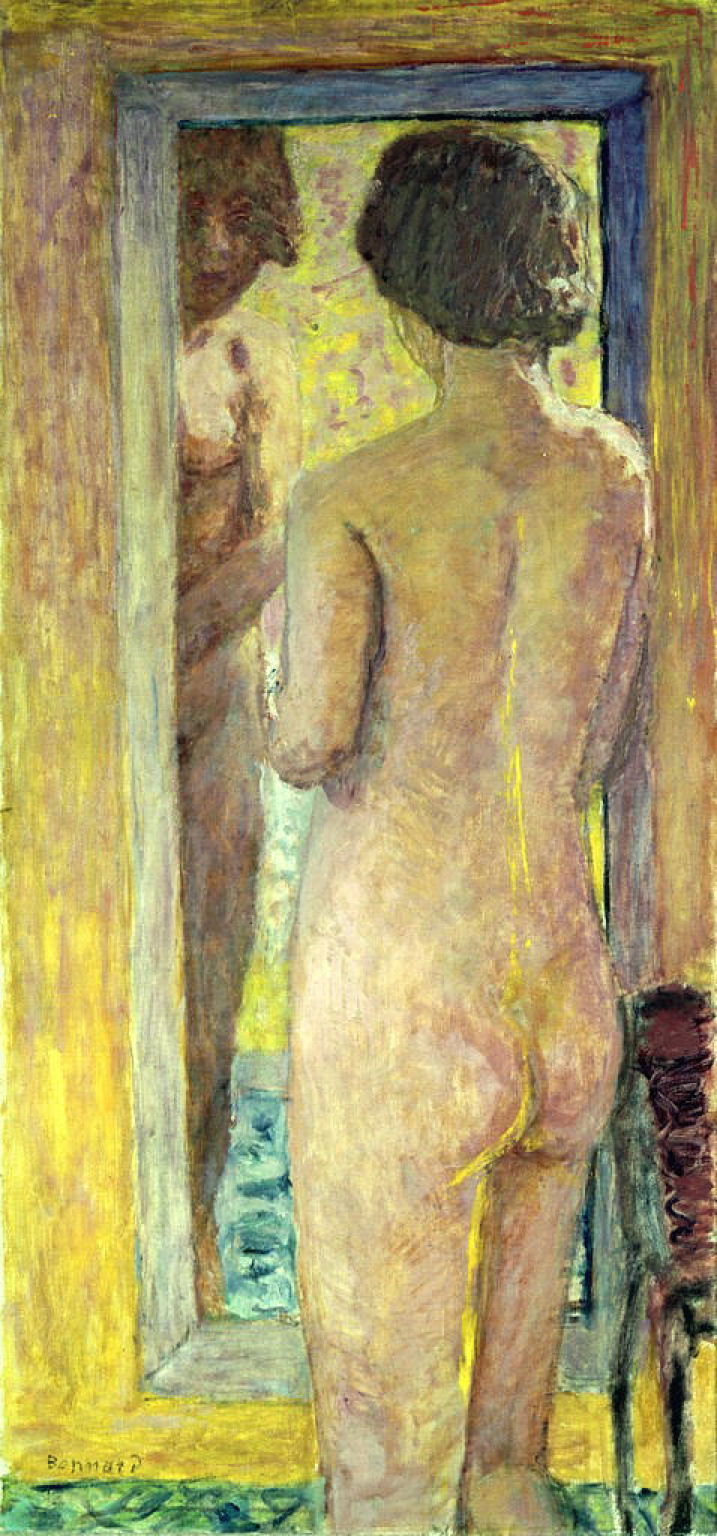
At last, in about 1933, Bonnard returns to his earlier mirror play in his Nude before a Mirror. Marthe (presumably) stands slightly to one side of a full-length mirror, the yellow light catching her back, buttock, and thigh. Instead of her head being cast down, almost obscuring her face, she looks at the mirror, and her reflection looks back at the viewer in a Venus effect.
This is, of course, optically impossible: both Marthe and the viewer are to the right of the midline of the mirror. The viewer could only see Marthe on the left side of the mirror if that mirror were angled so that its plane was parallel to Marthe’s shoulders. What Bonnard shows is really Marthe’s doppelgänger, not her reflection.
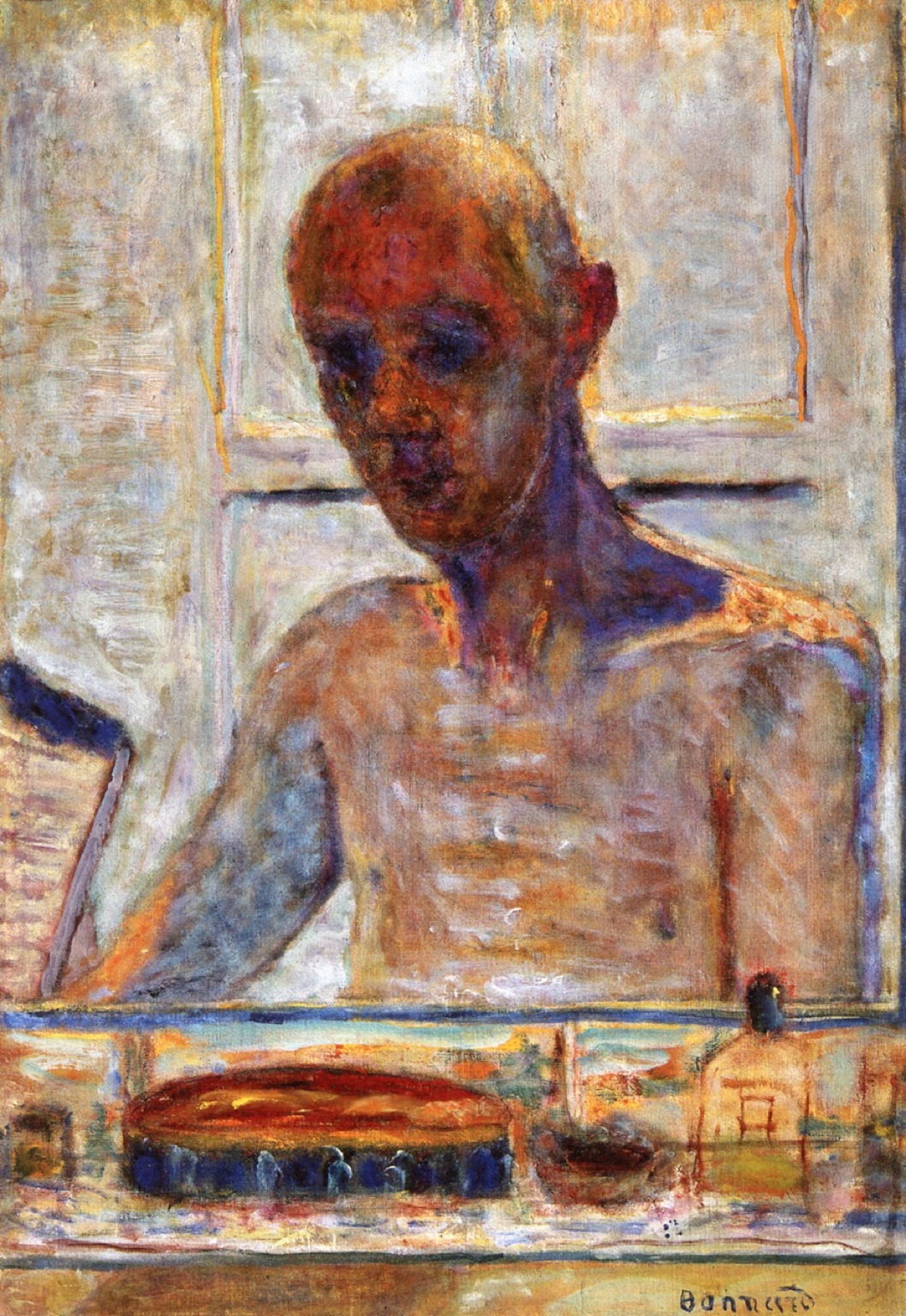
Late in his life, after the death of Marthe, Bonnard painted some self-portraits in a mirror, including this Portrait of the Artist in the Bathroom Mirror from between 1939-46, as he is looking increasingly frail. And those appear to be his final reflections.
此内容由惯性聚合(RSS阅读器)自动聚合整理,仅供阅读参考。 原文来自 — 版权归原作者所有。