


惯性聚合 高效追踪和阅读你感兴趣的博客、新闻、科技资讯
阅读原文 在惯性聚合中打开

推荐订阅源

有赞技术团队
有赞技术团队
cs.CV updates on arXiv.org
P
Palo Alto Networks Blog
C
Cisco Blogs
The Hacker News
The Hacker News
T
Threatpost
S
Schneier on Security
K
Kaspersky official blog
Spread Privacy
Spread Privacy
博客园_首页
钛媒体:引领未来商业与生活新知
钛媒体:引领未来商业与生活新知
NISL@THU
NISL@THU
量子位
cs.CL updates on arXiv.org
Google DeepMind News
Security Latest
Security Latest
博客园 - 司徒正美
云风的 BLOG
云风的 BLOG
博客园 - 叶小钗
H
Hackread – Cybersecurity News, Data Breaches, AI and More
N
News and Events Feed by Topic
爱范儿
爱范儿
P
Proofpoint News Feed
C
CERT Recently Published Vulnerability Notes
Project Zero
Project Zero
Application and Cybersecurity Blog
Cisco Talos Blog
Cisco Talos Blog
GbyAI
GbyAI
cs.AI updates on arXiv.org
Apple Machine Learning Research
T
Tenable Blog
Threat Intelligence Blog | Flashpoint
V
Vulnerabilities – Threatpost
Forbes - Security
Forbes - Security
博客园 - 三生石上(FineUI控件)
C
Cyber Attacks, Cyber Crime and Cyber Security
N
News and Events Feed by Topic
V
V2EX
Webroot Blog
Webroot Blog
The Register - Security
OSCHINA 社区最新新闻
OSCHINA 社区最新新闻
阮一峰的网络日志
阮一峰的网络日志
freeCodeCamp Programming Tutorials: Python, JavaScript, Git & More
Blog — PlanetScale
Blog — PlanetScale
M
MIT News - Artificial intelligence
Scott Helme
Scott Helme
Simon Willison's Weblog
L
LangChain Blog
W
WeLiveSecurity
Cloudbric
Cloudbric

The Eclectic Light Company

Apple has released an update to XProtect for all macOS Hero or hooligan: Theseus’ later years BSD flags are incompatible with iCloud Drive Apple has released macOS Tahoe 26.5.1 In memoriam Mary Cassatt: 1, 1868-1880 Solutions to Saturday Mac riddles 362 What Location Services do in macOS Eclectic paintings of Joseph Stella: 2 European myths Last Week on My Mac: Razzle and dazzle Eclectic paintings of Joseph Stella: 1 American landscapes Saturday Mac riddles 362 Protect files with the Locked or Immutable flag Reading Visual Art: 252 Dragonfly What happens in the log when an app crashes as it starts up? Portraits of trees: Introduction On Reflection: Conclusions and contents Which tasks require mains power? Medium and message: Vast canvases Online reference to external displays for Apple silicon Macs What’s in that phishing email? Hero or hooligan: Theseus and Ariadne Solutions to Saturday Mac riddles 361 How to search document versions Rubens’ Consequences of War Rubens’ Peace and War Saturday Mac riddles 361 How to search Time Machine backups? Naturalists: Contents and artists On Reflection: Extending the image Tackle QuickLook problems Medium and message: Pottery Hero or hooligan: Theseus and the sandals How QuickLook provides thumbnails and previews Last Week on My Mac: Syncing metadata in iCloud Drive Paintings of visits to India 1778-1877 Saturday Mac riddles 360 Naturalists: Sorolla and Zorn On Reflection: Pierre Bonnard 1909-1946 SpotTest 1.2 can display Spotlight metadata directly On Reflection: Pierre Bonnard 1899-1908 How to preserve versions, and how to create versioned PDFs Medium and message: Sculpture What gets synced in iCloud Drive? Hero or hooligan: Perseus 2 Solutions to Saturday Mac riddles 359 Last Week on My Mac: snapshots, the elephant in APFS Paintings of Beatrice Portinari: to 1862 Saturday Mac riddles 359 Naturalists: Into the 20th century How to check whether Spotlight is getting the right metadata On Reflection: Mirror play Hero or hooligan: Perseus 1 The bicentenary of Frederic Edwin Church: 1857-77 Solutions to Saturday Mac riddles 358 macOS virtual machines and audio-video syncing A walk in the parks of Rome, Vienna, Manhattan and Brooklyn Saturday Mac riddles 358 Naturalists: Photography Use Finder tags for categories Control what gets written to the log Medium and message: Tapestry Virtualisation on Apple silicon Macs is different Jerusalem Delivered: Overview and contents The bicentenary of Frederic Edwin Church: 1849-57 Solutions to Saturday Mac riddles 357 Painting Pandora and her box: 1883-1919 Painting Pandora and her box: 1550-1882 Saturday Mac riddles 357 Reading Visual Art: 250 Winged sandals The secret life of the xattr The macOS Natural Language framework and Nalaprop Medium and Message: Stained glass The MACL extended attribute Jerusalem Delivered: 13 Leading characters Solutions to Saturday Mac riddles 356 Privacy: How locations are protected Painting Spring blossom 2 Last Week on My Mac: Don’t be a victim of fraud Painting Spring blossom 1 Saturday Mac riddles 356 Explainer: Recovery Reading Visual Art: 249 Mask Naturalists: Urban poverty On Reflection: Cézanne Privacy: Which folders are protected in Tahoe? Medium and Message: Mosaic Jerusalem Delivered: 12 Delivery Solutions to Saturday Mac riddles 355 Centaurs 2: Revenge Centaurs 1: Fights Saturday Mac riddles 355 Explainer: sandboxes Naturalists: The modern meal Why you can’t trust Privacy & Security Apple has just released an update to macOS Tahoe, to version 26.4.1 On Reflection: Divisionism Please help update CPU frequencies for Apple silicon Macs Privacy: Files & Folders or Full Disk Access? Jerusalem Delivered: 11 Into Jerusalem Privacy: protected folders
Commemorating the centenary of the death of John Ferguson Weir
2026-04-08 · via The Eclectic Light Company

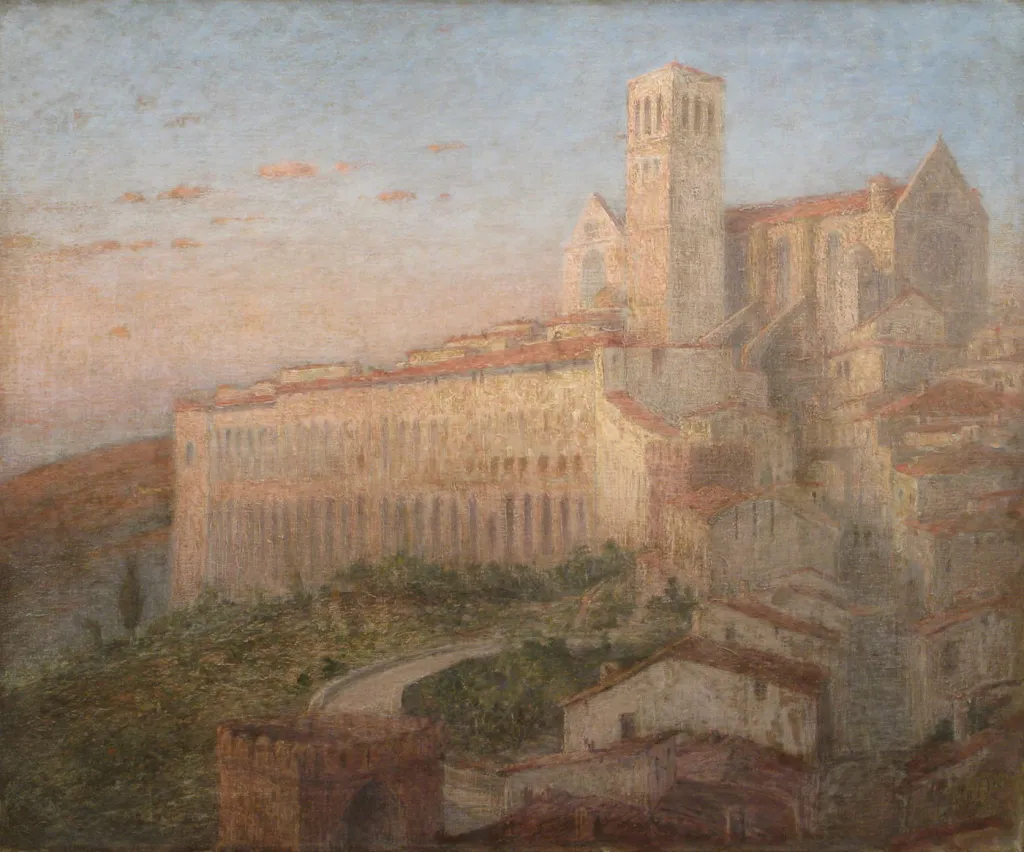
John Ferguson Weir (1841-1926), Basilica of San Francesco d'Assisi, Italy (1902), oil on canvas, 63.5 x 76.8 cm, Private collection. Wikimedia Commons.

One hundred years ago today, on 8 April 1926, the American painter, sculptor and educator John Ferguson Weir died. This article briefly summarises his career, his importance in American art, and shows a selection of his paintings.

John Ferguson Weir came from an illustrious artistic family. His father Robert Walter Weir (1803-1889) was a professor of drawing at West Point, New York, and his younger half-brother Julian Alden Weir (1852-1919) was a notable American Impressionist painter.

John trained at West Point, New York, and at the National Academy. This was briefly interrupted in 1861 when he served in the US Civil War. He received his first commission in 1862, when he was only 21, and set up his studio in the Tenth Street Studio, New York.

weirjfartistsstudio
John Ferguson Weir (1841-1926), An Artist’s Studio (1864), oil on canvas, 64.8 x 77.5 cm, Los Angeles County Museum of Art, Los Angeles, CA. Courtesy of Los Angeles County Museum of Art, via Wikimedia Commons.

After that commission, his first major work was An Artist’s Studio from 1864, in which the artist in question is his father, not himself. To his delight it was exhibited, sold, and resulted in his election as an associate of the National Academy.

weirjfgunfoundry
John Ferguson Weir (1841-1926), The Gun Foundry (1866), oil on canvas, 118.1 x 157.5 cm, Putnam County Historical Society, Cold Spring, NY. Wikimedia Commons.

He next took his dark realism before an unusual motif for American painting at that time, in the hot, harsh, and dangerous world of the West Point Iron and Cannon Factory, in his The Gun Foundry (1866). The moment shown is the casting of a Parrott Gun, in the foundry responsible for making most of the large guns used by Union forces during the Civil War.

This is similar to the earlier works of Joseph Wright of Derby, de Loutherbourg and others who had painted the Industrial Revolution in Europe during the late eighteenth century, and led to his election as a full Academician.

weirjfforgingshaft
John Ferguson Weir (1841-1926), Forging the Shaft (1874-7 after original of 1868), oil on canvas, 132.1 x 186.1 cm, The Metropolitan Museum of Art (Purchase, Lyman G. Bloomingdale Gift, 1901), New York, NY. Courtesy of The Metropolitan Museum of Art.

His Forging the Shaft is a replica he painted in 1874-7, after the original of 1868 was destroyed in a fire at a New York gallery. It shows the same foundry, this time working the massive propellor shaft for an ocean liner, more a symbol of peace and trade than past conflict. The success of the original painting led to the offer to become Professor and the first Director of the School of Fine Arts at Yale University, which he accepted.

Seizing the opportunity before he started at Yale, in late 1868 Weir set out for Europe, where he travelled from Paris to Italy, Switzerland, Germany, the Netherlands, and Belgium. He produced a remarkable series of landscapes showing many of the places he visited, a series that compares with any of JMW Turner’s, although Weir generally kept to his detailed realism.

weirjflagomaggiore
John Ferguson Weir (1841-1926), Lago Maggiore, Italy (1869), oil on paper, 20.3 x 33 cm, Private collection. Wikimedia Commons.

Lago Maggiore, Italy (1869) appears to have been painted en plein air on 31 May 1869, during his return journey from Italy towards Switzerland.

weirjflakeleman
John Ferguson Weir (1841-1926), Lake Leman (Lake Geneva), Switzerland (1869), oil on paper, 20.3 x 33 cm, Private collection. Wikimedia Commons.

Despite its finish, his Lake Leman (Lake Geneva), Switzerland (1869) may have been painted en plein air, on 11 June 1869.

weirjfcadenabbia
John Ferguson Weir (1841-1926), Cadenabbia on Lake Como (1869), oil on canvas, 22.9 x 38.1 cm, Private collection. The Athenaeum.

Although his Cadenabbia on Lake Como has been dated to 1869, it’s larger, and was almost certainly the result of more prolonged work in the studio. Its dramatic use of light on the town and the hills above is remarkable.

weirjfgrandcanal
John Ferguson Weir (1841-1926), The Grand Canal, Venice (1869), oil on canvas, 121.9 x 91.4 cm, Mattatuck Museum Arts and History Center, Waterbury, CT. The Athenaeum.

The Grand Canal, Venice (1869) is a much larger canvas that was clearly painted in the studio, probably after his return home to the USA in the autumn of 1869.

Weir then started work at the School of Fine Arts at Yale University, where he remained until his retirement in 1913, forty-four years later. With the advice of his younger half-brother, then studying at the École des Beaux-Arts in Paris and becoming steadily more Impressionist, John Ferguson Weir modelled Yale’s programme on European methods. Both brothers were also pioneers in the education of women artists.

weirjfbeacheasthampton
John Ferguson Weir (1841-1926), Beach at Easthampton (c 1875), oil on canvas, 51.8 × 85.1 cm, Florence Griswold Museum, Old Lyme, CT. Wikimedia Commons.

Beach at Easthampton (c 1875) shows this Long Island beach, now more usually referred to as East Hampton, with its almost military encampment of huts, shades, and tents.

weirjfrockymountain
John Ferguson Weir (1841-1926), A Rocky Mountain Peak, Idaho Territory (1882), oil on canvas, 77.5 x 47 cm, location not known. The Athenaeum.

Weir retained his detailed realism until late in the century, as shown in his impressive depiction of A Rocky Mountain Peak, Idaho Territory from 1882.

weirjfroses
John Ferguson Weir (1841-1926), Roses (1898), oil on canvas, 50.8 x 76.5 cm, Smithsonian American Art Museum, Washington, DC. Wikimedia Commons.

However, from the early 1880s, Weir painted several still lifes, including Roses (1898), in which his brushstrokes became increasingly painterly.

weirjffarmbranchville
John Ferguson Weir (1841-1926), The Farm, Branchville, Connecticut (date not known), oil on canvas, 50.8 x 61 cm, Private collection. Wikimedia Commons.

He also maintained close contact with his half-brother Julian Alden Weir, visiting his farm in Connecticut to paint with him. This led to experiments with more ‘modern’ styles, such as The Farm, Branchville, Connecticut (around 1890-1900) in which his facture has changed completely.
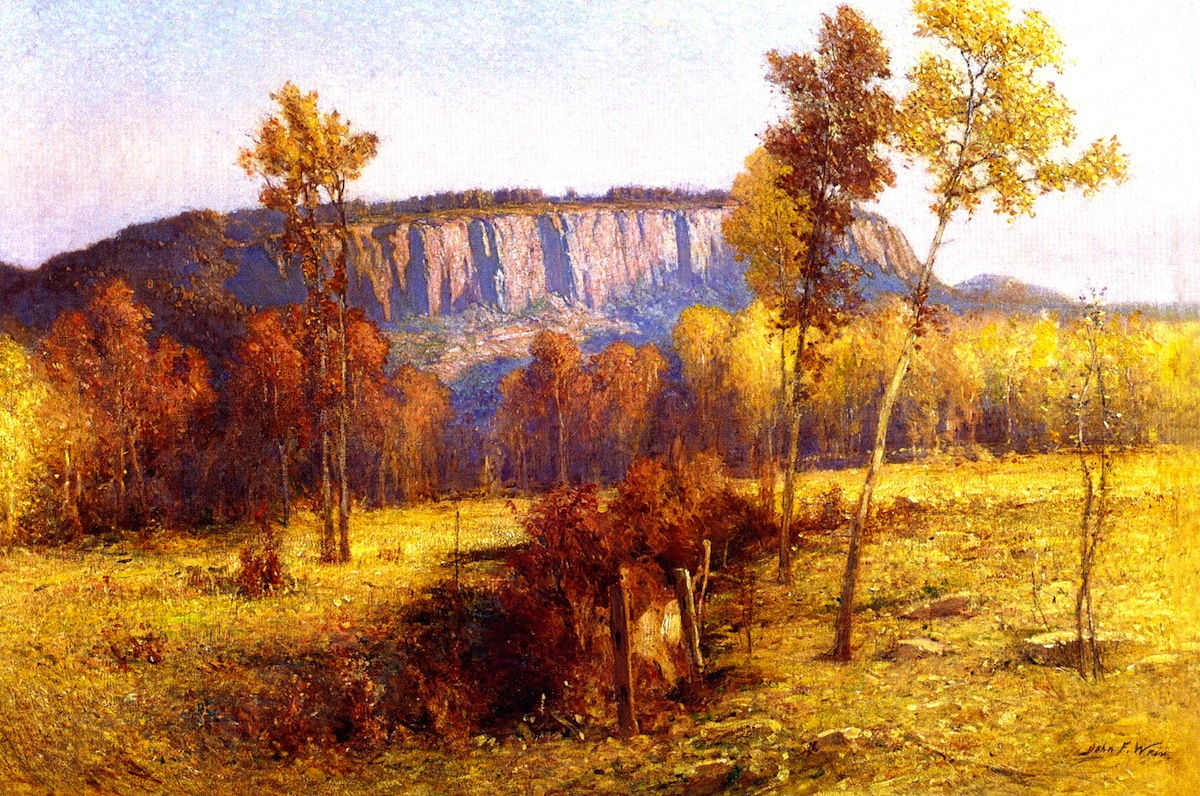
weirjfeastrocknewhaven
John Ferguson Weir (1841-1926), East Rock, New Haven (c 1901), oil on canvas, 77.5 × 113 cm, Florence Griswold Museum, Old Lyme, CT. Wikimedia Commons.

These were followed by an increase in his chroma, as shown in this vibrant painting of East Rock, New Haven (c 1901), which was close to his home and work at Yale.
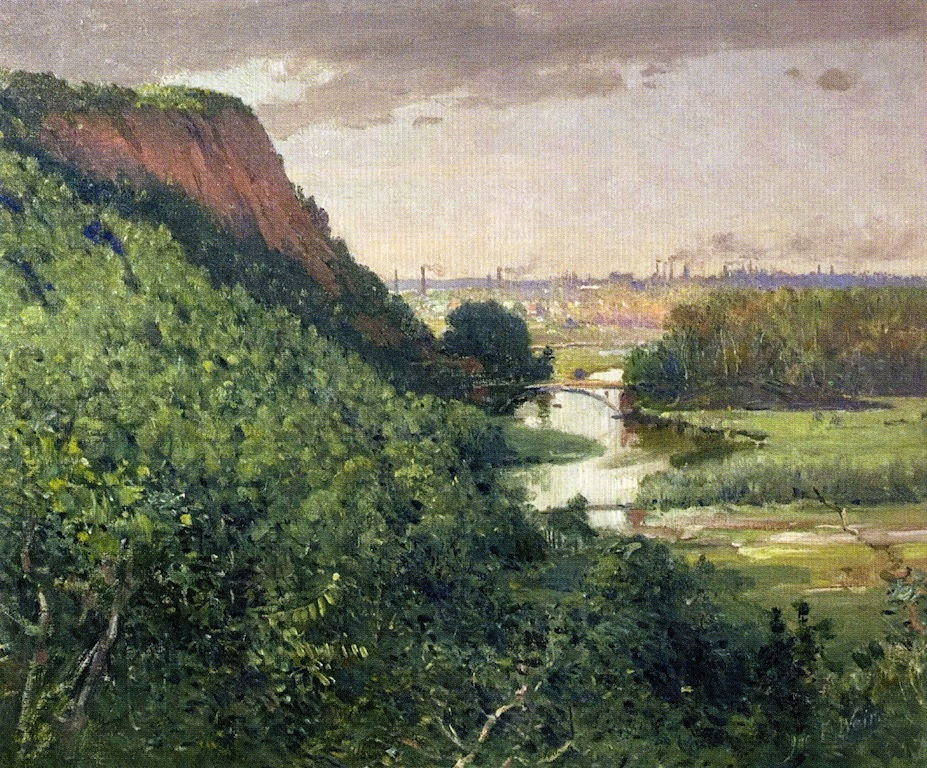
weirjfnewhaven
John Ferguson Weir (1841-1926), New Haven from East Rock (1900-1), oil on canvas, 50.2 x 61 cm, New Haven Museum, New Haven, CT. The Athenaeum.

New Haven from East Rock (1900-1) shows almost the reversed view, looking down on the smoking chimneys of the town.

weirjfalhambra
John Ferguson Weir (1841-1926), The Alhambra, Granada, Spain (c 1901), oil on canvas, 92.1 x 118.1 cm, The Metropolitan Museum of Art (Gift of David T. Owsley, 1964), New York, NY. Courtesy of The Metropolitan Museum of Art.

Although his teaching was a heavy commitment, Weir still found time to travel, and returned to Europe several times. The Alhambra, Granada, Spain (c 1901) is one of the finest of his late paintings, and shows how far he had come from his early works.

weirjfbasilicasanfrancescodassisi
John Ferguson Weir (1841-1926), Basilica of San Francesco d’Assisi, Italy (1902), oil on canvas, 63.5 x 76.8 cm, Private collection. Wikimedia Commons.

But of all his late paintings, I think his Basilica of San Francesco d’Assisi, Italy from 1902 is his most accomplished, and, in his quietly academic way, the most radical in style.

weirjffontainebleau
John Ferguson Weir (1841-1926), Forest of Fontainebleau (c 1902), oil on canvas, 48.9 x 61 cm, Private collection. The Athenaeum.

Forest of Fontainebleau (c 1902) shows his versatility in responding to a very different motif, with its tiny and solitary figure against the fallen trunk.

On his retirement from Yale in 1913, he and his wife moved to Providence, RI. Although he rented a studio and became involved in local art, his eyesight and health imposed increasing limits. He died in 1926.

John Ferguson Weir was much more than Julian’s half-brother, or even the founding father of fine arts at Yale. He was an innovative painter, who pioneered the depiction of heavy industry in the US, made an exquisitely beautiful series of works showing scenes in Europe, and developed his style through his long career. He was one of America’s master painters.

Reference

Wikipedia.