


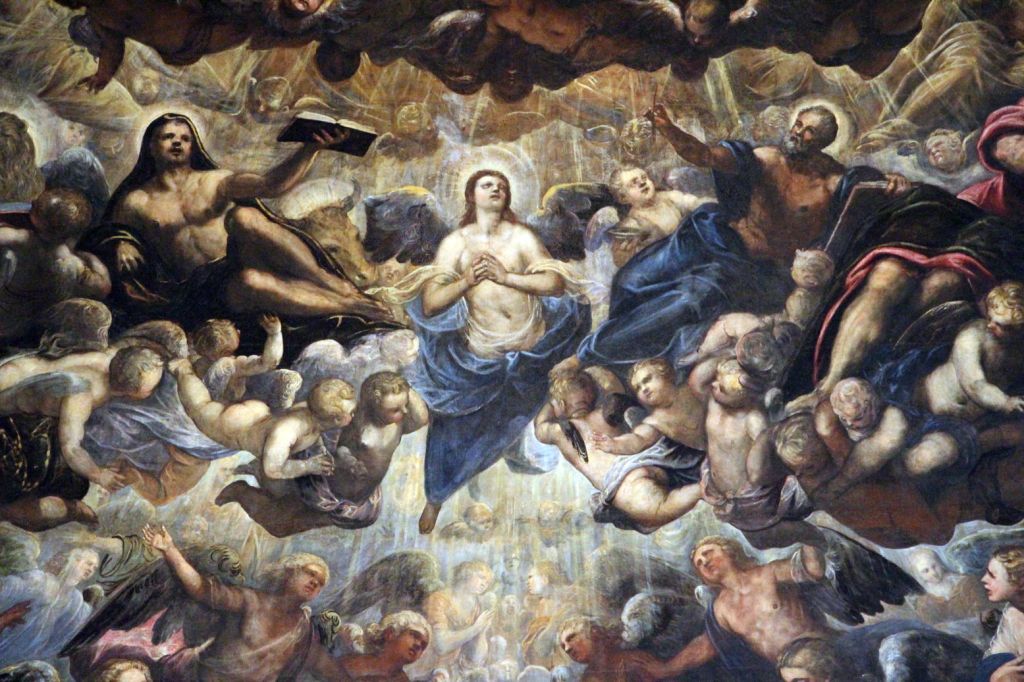
 Jacopo Tintoretto (c 1518-1594) and Domenico Robusti, Paradise (E&I 298) (detail) (1588-1592), oil on canvas, 700 x 2200 cm, Sala del Maggior Consiglio, Palazzo Ducale, Venice. Image by Sailko, via Wikimedia Commons.
Venice became an important part of the southern Renaissance with the paintings of the Bellini brothers in the latter half of the fifteenth century, and flourished in the sixteenth century with their successors Giorgione, Titian, Tintoretto and Veronese. Venetian painting distinguished itself by emphasising colour over line and form, but there were also important differences in media.
From long before the Renaissance, the largest paintings in Europe were made using fresco on the walls and ceilings of churches and other religious buildings. Because Venice had been built on marshy islands in a lagoon, the walls of its buildings remained damp and proved unsuitable for classical fresco technique. Supplies of wood were also limited, and the fabrication of large wooden panels was impractical. It was in Venice that the largest paintings were thus made in oil paints on stretched canvas.
In other circumstances, what are considered to be large canvases might attain five or six metres (16-20 feet) in their longer dimension. This article shows a selection where that exceeds ten metres (33 feet), and in one case twenty-two metres (72 feet), all but one created by Jacopo Tintoretto and his workshop.
In 1559-60, Tintoretto painted two commissions for the church of Madonna dell’Orto, where he was to be buried. Each nearly fifteen metres (50 feet) high, they’re among his most spectacular.

The Last Judgment was probably painted first, and shows apocalyptic scenes from Biblical eschatology, notably the book of Revelation. To some extent, paintings of the last judgement are inevitably chaotic, as that is part of the event, but Tintoretto’s overall composition here isn’t as well-conceived as in the second of the pair. The painting has several focal passages, in particular the horizontal winged angel wearing orange shorts just over half way up, and the figure of Christ at its apex.

The lower sections show a dark base filled with contorted bodies blending in with rock and water, an underworld without the usual fire. Above is a band of sea green, in which there is a reprise of the flood, and bodies are washed along in a great wave. The middle then takes to the air, where figures sit on clouds still bringing rain to those in the waters below. The central crucifix seen at the foot isn’t part of the painting.

In the upper section, above the angel in orange, rays of light are streaming down from Jesus at the apex. Individual figures are now more readily distinguished, and some of them recognisable. At each side are winged angels with long trumpets, and a double band of black clouds marking the threshold of heaven. On the right, a martyr wearing a deep blue loincloth sits with his crucifix against his shoulder: he could be Saint Andrew.
Higher still is the mother of twins, her back to the viewer, looking up towards the heaped black cloud on which Jesus Christ sits at the centre, with the Virgin Mary on one side and Saint John the Baptist on the other. Particularly in the upper section, many of the figures are foreshortened and distorted.

The second, the Making of the Golden Calf, shows one of the more memorable stories of Moses, from the book of Exodus in the Old Testament. During that epic journey from bondage in Egypt to the Promised Land, Moses left the Israelites for a period of forty days and nights, when he ascended Mount Sinai to be given the Ten Commandments. While he was away, the people demanded that Moses’ brother and deputy Aaron made them a graven image to worship.
He gathered all their gold, which was melted down and cast into the form of a calf, which they then worshipped. God told Moses that they had already fallen from his ways, so Moses descended from Sinai. He was so angry with the Israelites that he broke the two tablets containing the commandments. He burnt the golden calf, ground it to powder, scattered it on water, and made the people drink it. The only people who didn’t worship the calf were the tribe of Levi, who became the first priestly class.
Tintoretto’s overall design of this simpler narrative is clearer and well-organised. The lower half of the painting shows the golden calf and the Israelites worshipping and feasting around it. Just over half way up is Moses on the summit of the mountain, being delivered the tablets with the commandments, and above that is heaven, with the Israelites’ God.

The graven image of the golden calf is being carried with difficulty by four men. Piles of golden jewellery, coins, and chain are still apparently being melted down. Sitting on a rock bench above, under an ornamental awning, are several young women, who are being dressed and prepared for ceremonies to take place with the idol. More people are seen feasting on the grass over to the left.

In the upper section of the painting, Moses is stood on the top of the mountain, his arms outstretched to the sky, ready to receive the tablets containing the commandments. God still holds those, immediately above Moses, and two winged angels are just taking the tablets from him, to pass down to Moses. Around them and above are several other figures, flying around the clouds.
One last remark about these two exceptionally tall paintings: recognising that viewers would have to look up sharply to see their upper sections, Tintoretto projected their figures and other details as if they were ceiling panels. The higher up each canvas you look, the more the figures appear to be above you. That is an ingenious projection to enhance their visual impact.
In 1565, commissioned by the Scuola Grande for its albergo, Tintoretto painted one of the major religious works of the century: his vast Crucifixion, more than 5 metres (17 feet) high, and 12 metres (40 feet) across.
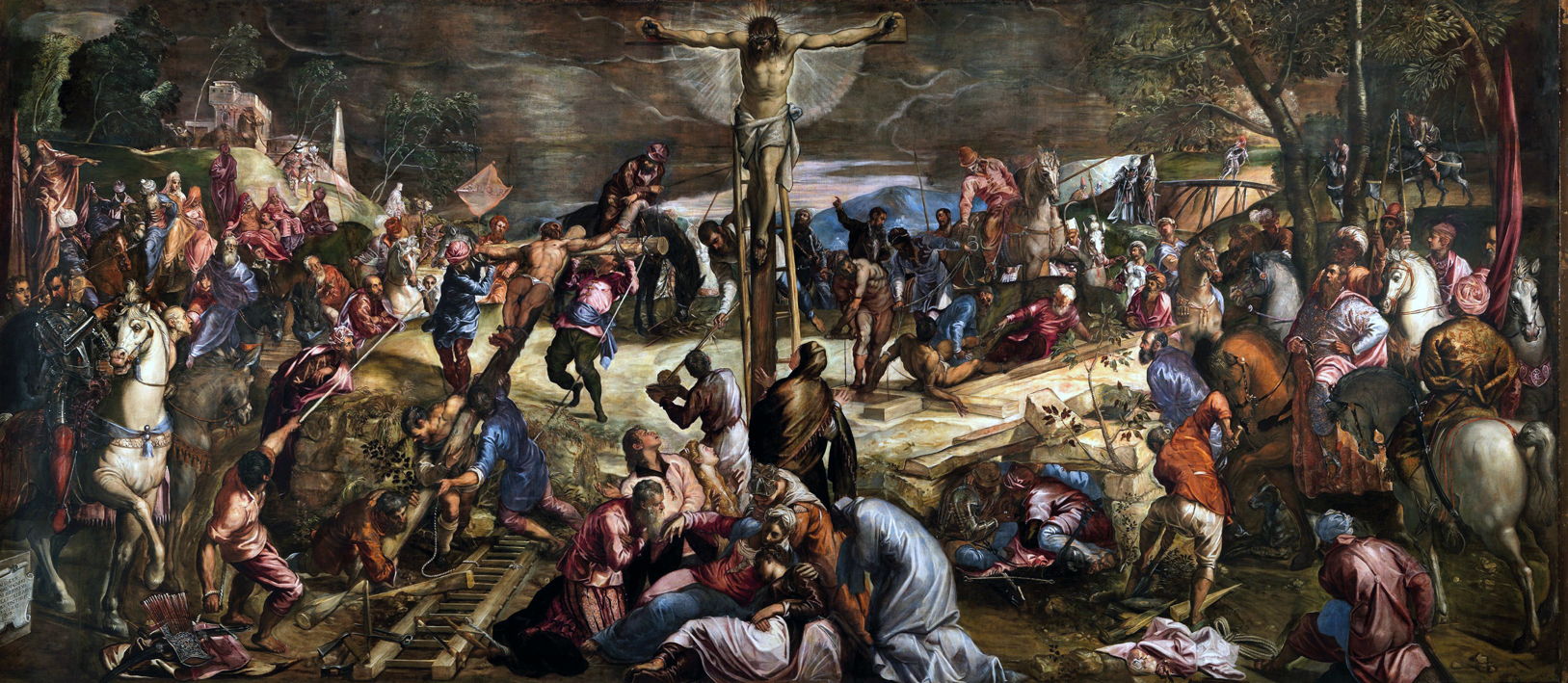
He applied the lessons learned in his tall works for the Madonna dell’Orto. He makes use of space and uses a narrative technique based on the traditional ‘multiplex’ form popular during the Renaissance, in which its single image shows events at more than a single point in time, in an ingenious and modern manner. Naturally, the painting centres on Christ crucified, but the two thieves executed beside him are not shown, as would be traditional, already hanging from their crosses.

Instead, to the right of Christ, the ‘bad’ thief is still being attached to his cross, which rests on the ground. To the left of Christ, the ‘good’ thief is just being raised to the upright position. There is nothing in the well-known gospel accounts to make this anachronistic, but it’s most probable that the crucifixions were more simultaneous.
Spaced out around the canvas are relevant sub-stories from that whole. At the foot of Christ’s cross is his group of mourners, including the Marys. Each of the crosses has attendant workers, busy with the task of conducting the crucifixion, climbing ladders, hauling on lines, and fastening each victim to his cross. This mechanical and human detail brings the scene to life and adds to its credibility, and grim process.
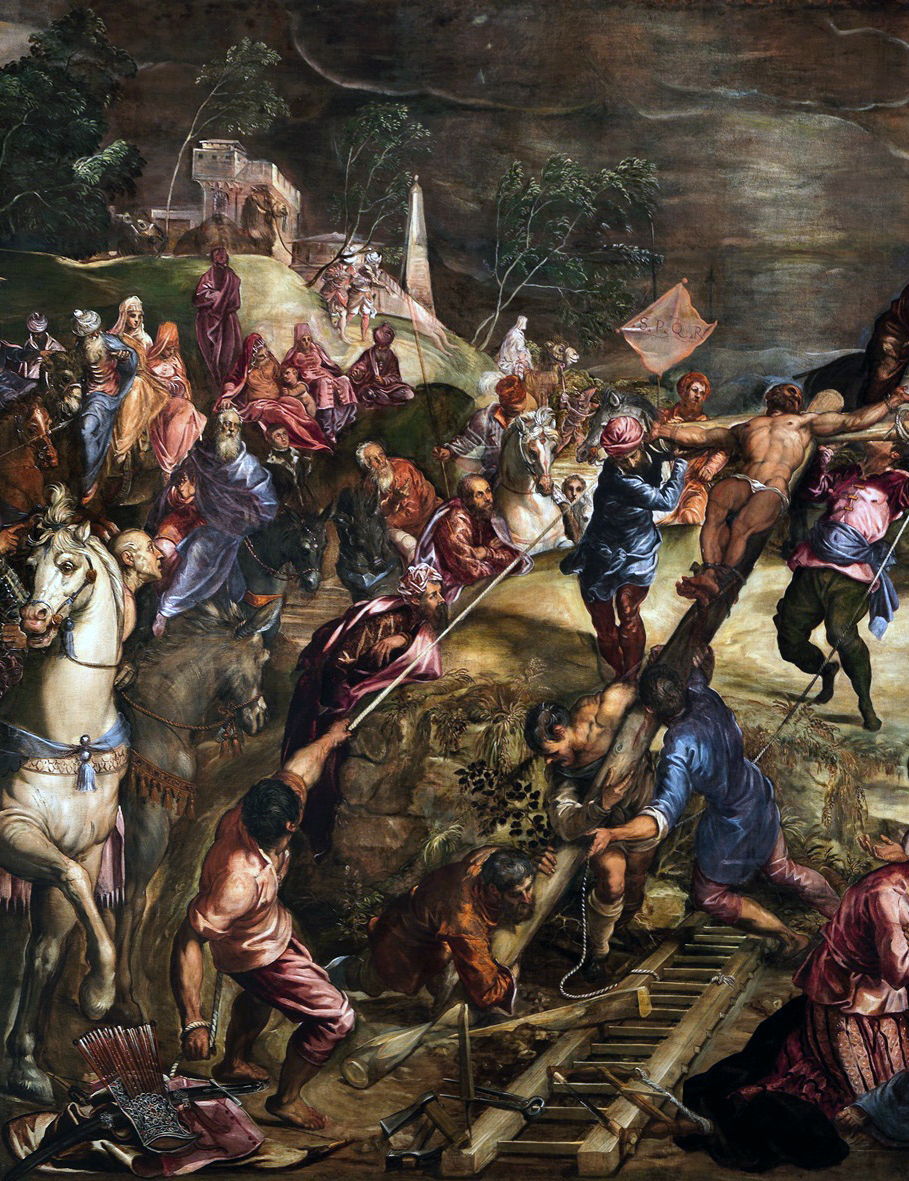
The crowd on the left is more spread out than in an earlier version. In the distance is a flag bearing the letters SPQR representing the Roman Empire, and its link through Pilate. Most faces are turned towards Christ, with their eyes wide in awe.
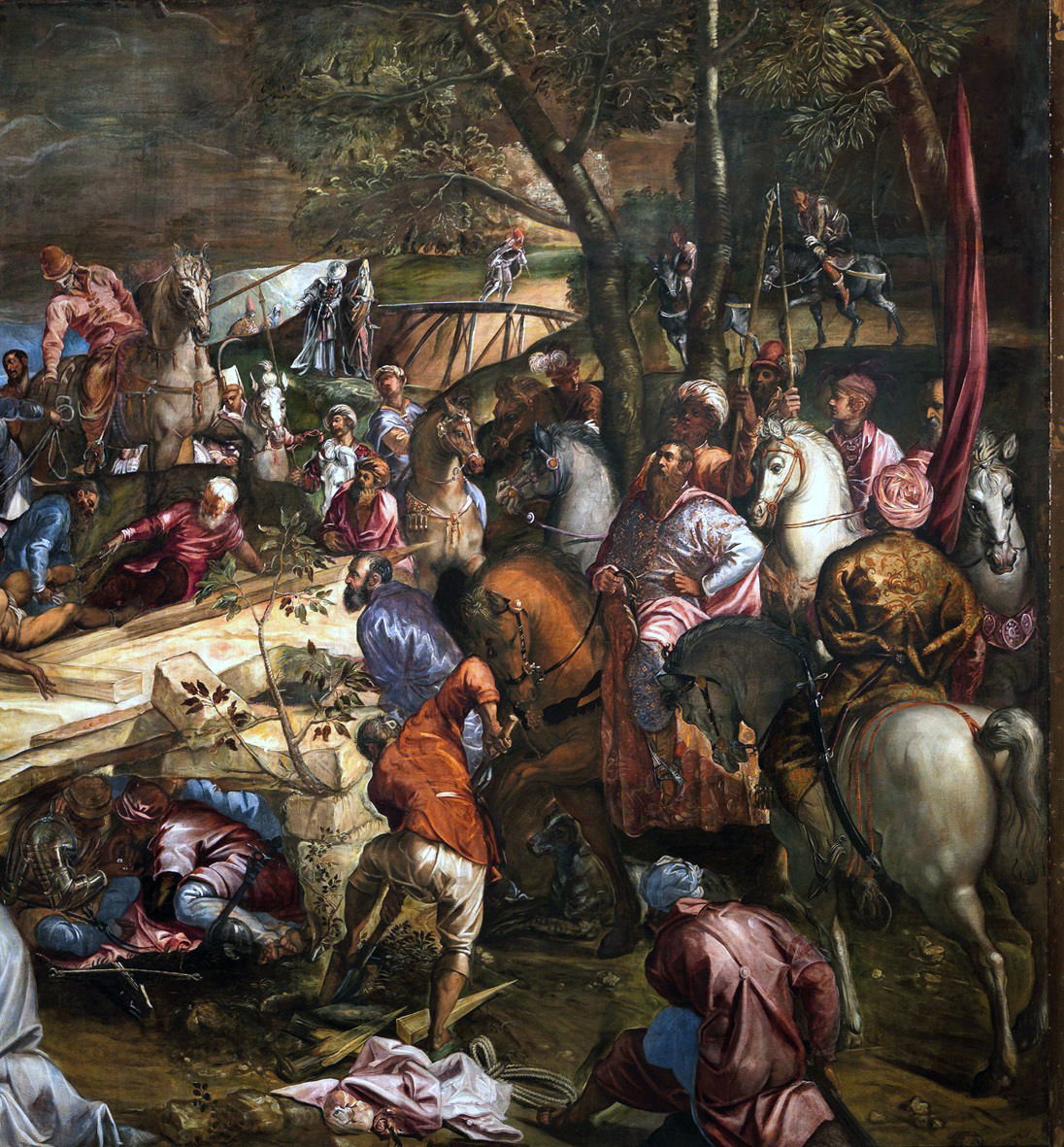
On the right, in a small rock shelter suggestive of a tomb, two men are gambling with dice. To the right of them, a gravedigger has just started his work with a spade. The ruling class, perhaps Herod himself, have turned up on horseback, and they too stare wide-eyed at Christ.
When the Doge’s Palace, or Palazzo Ducale, in Venice was destroyed by fire in 1577, it took with it a fresco from around 1365 by Guariento. Although initially unsuccessful in obtaining the commission to provide a replacement, with the death of Veronese in 1588, Tintoretto was invited to do so. By this time the artist was seventy, so much of the painting was performed by his son Domenico Robusti.
The room in which this painting was to be hung, the Sala del Maggior Consiglio, is one of the most majestic and imposing in the whole building, and was used for meetings of the Grand Council of Venice, at which it considered legislation and elected the city’s magistrates.
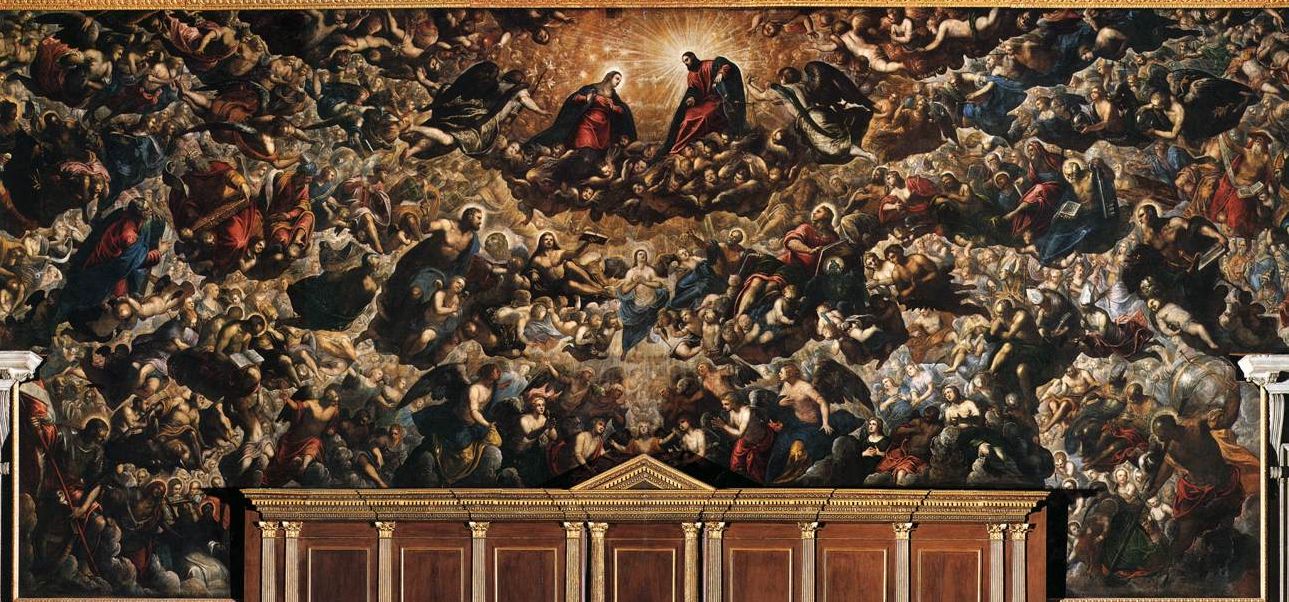
The resulting painting, which is seven metres (almost 23 feet) high and twenty-two metres (72 feet) across, was probably designed by Jacopo and largely entrusted to his son Domenico and the workshop to paint. In conformity with the rules of the commission, its composition focusses on the Coronation of the Virgin, inspired by Dante’s Paradise, as shown in the detail below.
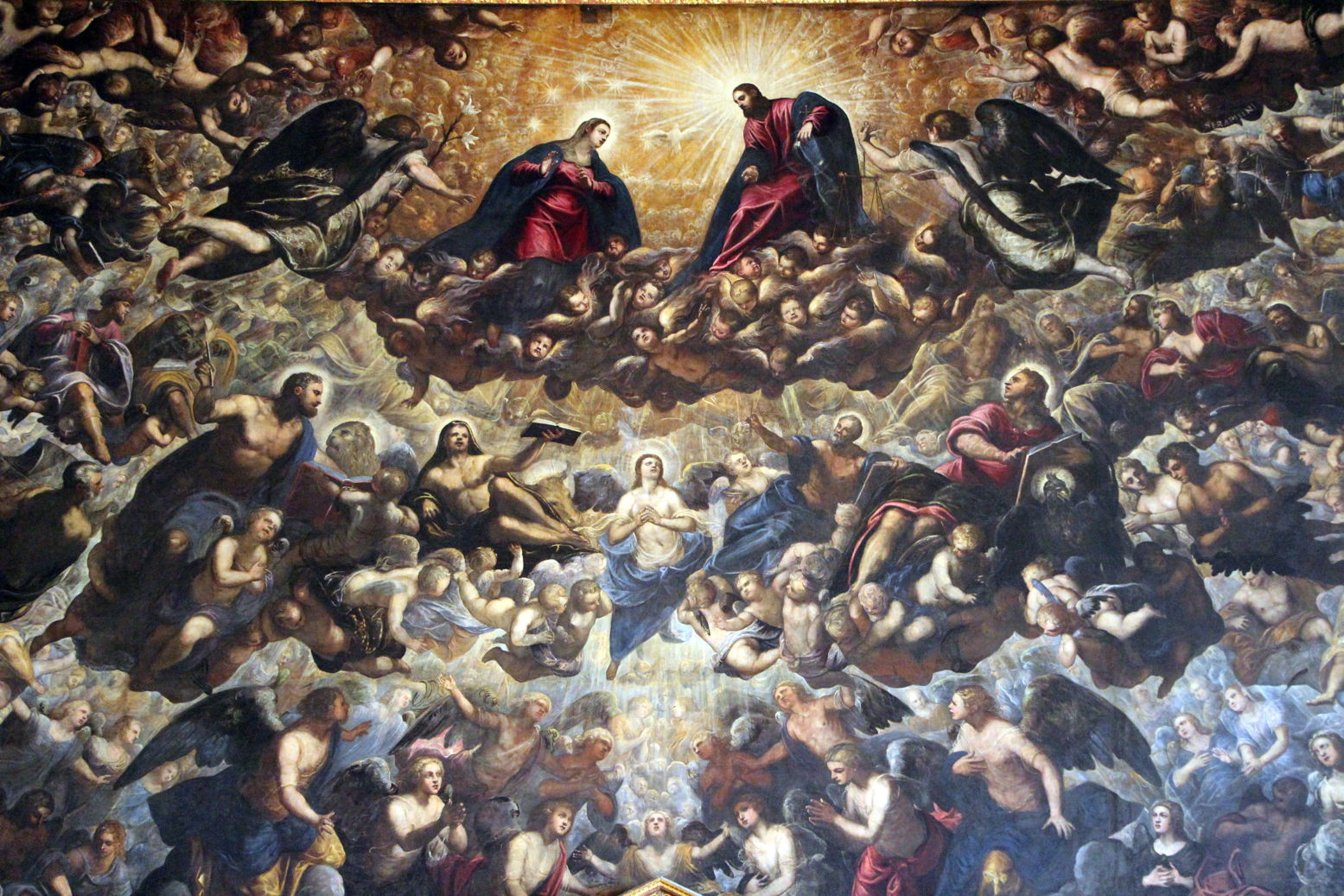
At the top, the Virgin Mary, behind whom is her traditional symbol of the white lily, stands with Jesus Christ, in their matching red and blue robes. Between them is the white dove of the Holy Ghost, and all around are cherubic heads of infant angels. To the right are the scales of justice, also used for the weighing of souls.

Even at the height of his powers, and with his exceptionally fast brushwork, completing such a huge work would have been a major feat for Jacopo.

Paolo Veronese also made a name for himself with his earlier large canvases, but in 1573 exceeded them all in The Feast in the House of Levi, which wasn’t its original title.
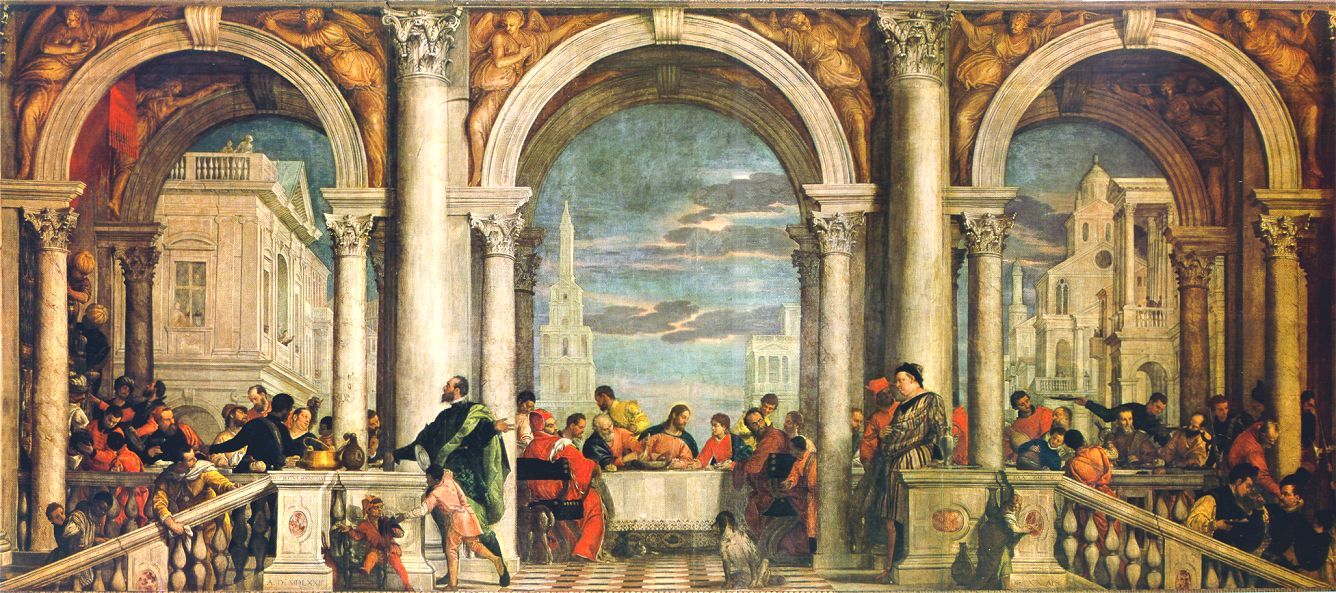
Veronese painted this thirteen metre-long (42 feet) scene for the refectory of the Dominican Friary of the Basilica di Santi Giovanni e Paolo, but it was intended to show the Last Supper, Christ’s last meal with his disciples before he was betrayed and crucified, at which he laid out the sacrament of Communion, a key part of Christian life ever since.
However, he over-reached himself, and the painting was deemed so offensive that he was brought before the Inquisition accused of blasphemy. Thankfully the Inquisition didn’t impose any penalty on Veronese himself, but required that he ‘correct’ the painting within a period of three months. This he did by changing its title, not its content, to The Feast in the House of Levi.
Christ is shown in the centre of the painting, further emphasised by his halo. In addition to the standard row of disciples, Veronese adds a rich collection of other figures, described by the Inquisition as “buffoons, drunken Germans, dwarfs and other such scurrilities”, more in the manner of a Venetian feast.
此内容由惯性聚合(RSS阅读器)自动聚合整理,仅供阅读参考。 原文来自 — 版权归原作者所有。