


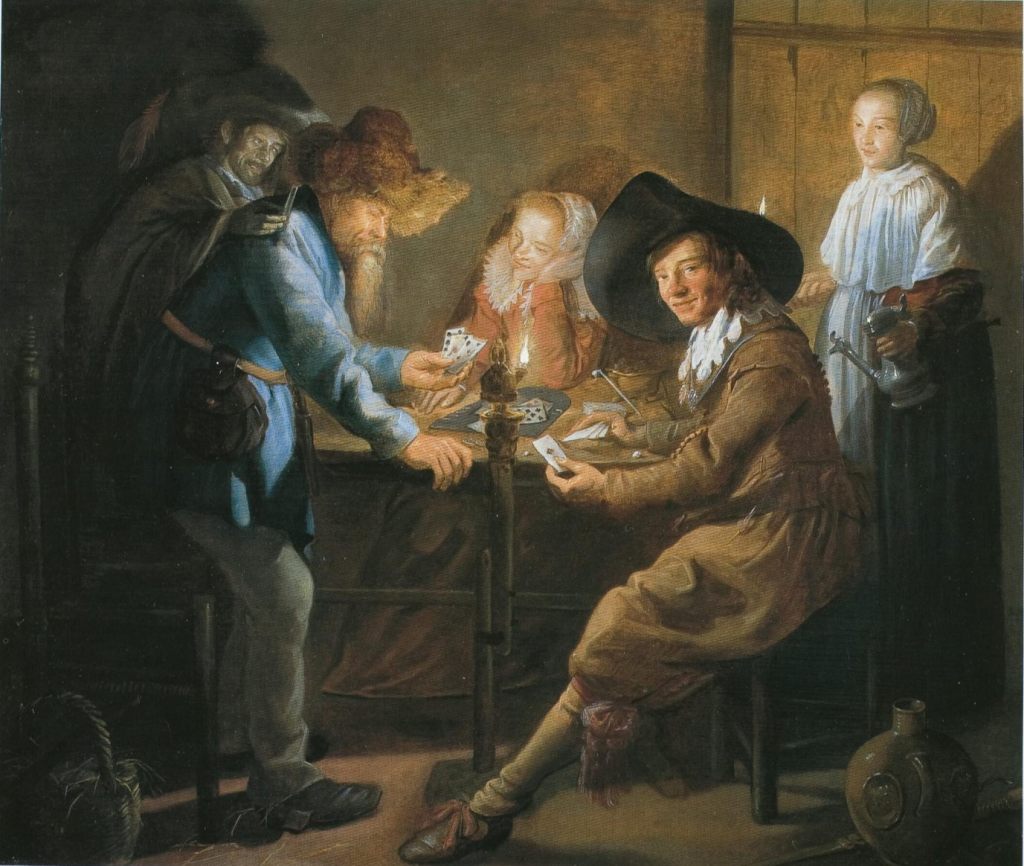
 Jan Miense Molenaer (c 1610–1668), Card Players by Lamplight (c 1634), oil on panel, 44 × 51 cm, Private collection. Wikimedia Commons.
Some visual artists made formal studies of the optical phenomena involved in shade and shadows. Among them was Leonardo da Vinci.
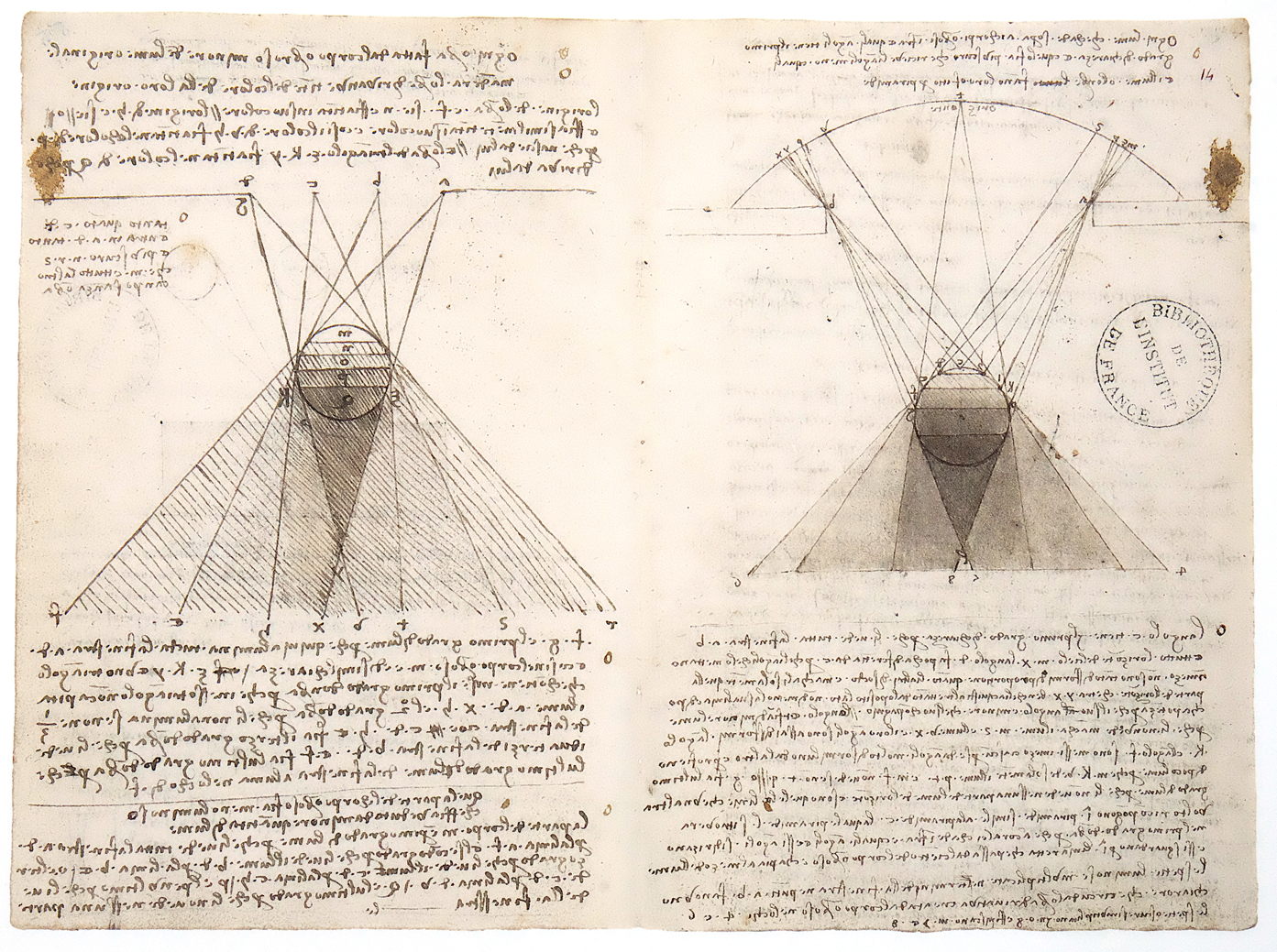
These two pages of shadow studies he made in 1490-92 go into subtle detail. Many early analyses simplified natural light to a single point source, but in reality most light is spread through a solid angle. Leonardo’s diagrams demonstrate elegantly how that leads to partial shadow, or penumbra.
Optics was one of many sciences to enjoy a resurgence in the Dutch Republic during its Golden Age, with the development of refracting telescopes, microscopy by Antonie van Leeuwenhoek (1632-1723) in Delft, and the extensive investigations and writings of Christiaan Huygens (1629–1695). There are known links between those advancing optical science and prominent painters of the day. Van Leeuwenhoek must have known Johannes Vermeer, as the microscopist acted as the artist’s executor after his death. Rembrandt’s early patron and promoter was Constantijn Huygens, father of Christiaan.

When Michiel van Mierevelt and his son Pieter painted their early group portrait of The Anatomy Lesson of Dr. Willem van der Meer in 1617, they were careful to include some cast shadows. Those are visible on the figures in the back row on the left of this gathering of the Surgeons’ Guild of the city of Delft, which is lit from the upper left. However, cast shadows have been omitted from the cadaver at the centre, and a single candle is burning in front of it, perhaps acting as a filler as well as a mark of respect to the deceased.

The city of Utrecht still had some Caravaggists including Gerard van Honthorst, who painted The Soldier and the Girl in about 1621.

By 1627, when Hendrick ter Brugghen painted this religious narrative of Jacob Reproaching Laban for Giving him Leah in Place of Rachel, Caravaggio’s liberal approach to shade and shadow was becoming more optically consistent. This left curious anomalies, such as the attached shadow on the face of Jacob in the red robe.
Successors came in the form of tavern, gambling and brothel scenes.
Although remarkably little is known of the paintings of Judith Leyster, she seems to have become interested in the effect of shadows when painting in Haarlem.

Like most of her surviving paintings, A Game of Tric-Trac was made before her marriage to Jan Miense Molenaer, in this case in 1630. She has lit this gambling scene using the single oil lamp, and pays close attention to the shadows it casts.

Her husband Jan Miense Molenaer also painted many scenes inside taverns and other places where drinking and gambling took place. His Card Players by Lamplight from about 1634 shows a card game in progress by the light of a lamp mounted on a stand in the foreground, as well as a candle held by the right hand of the woman at the right. This more complex combination reveals more details such as the large earthenware pot in the right foreground.
It was Rembrandt perhaps who became the greatest exponent of shade and shadow.

In 1626-27, Rembrandt painted this portrait of a Man in a Gorget and a Plumed Cap, demonstrating the strange effects that cast shadows can have on perception of the face. This also shows his early mastery of surface textures and reflected highlights.
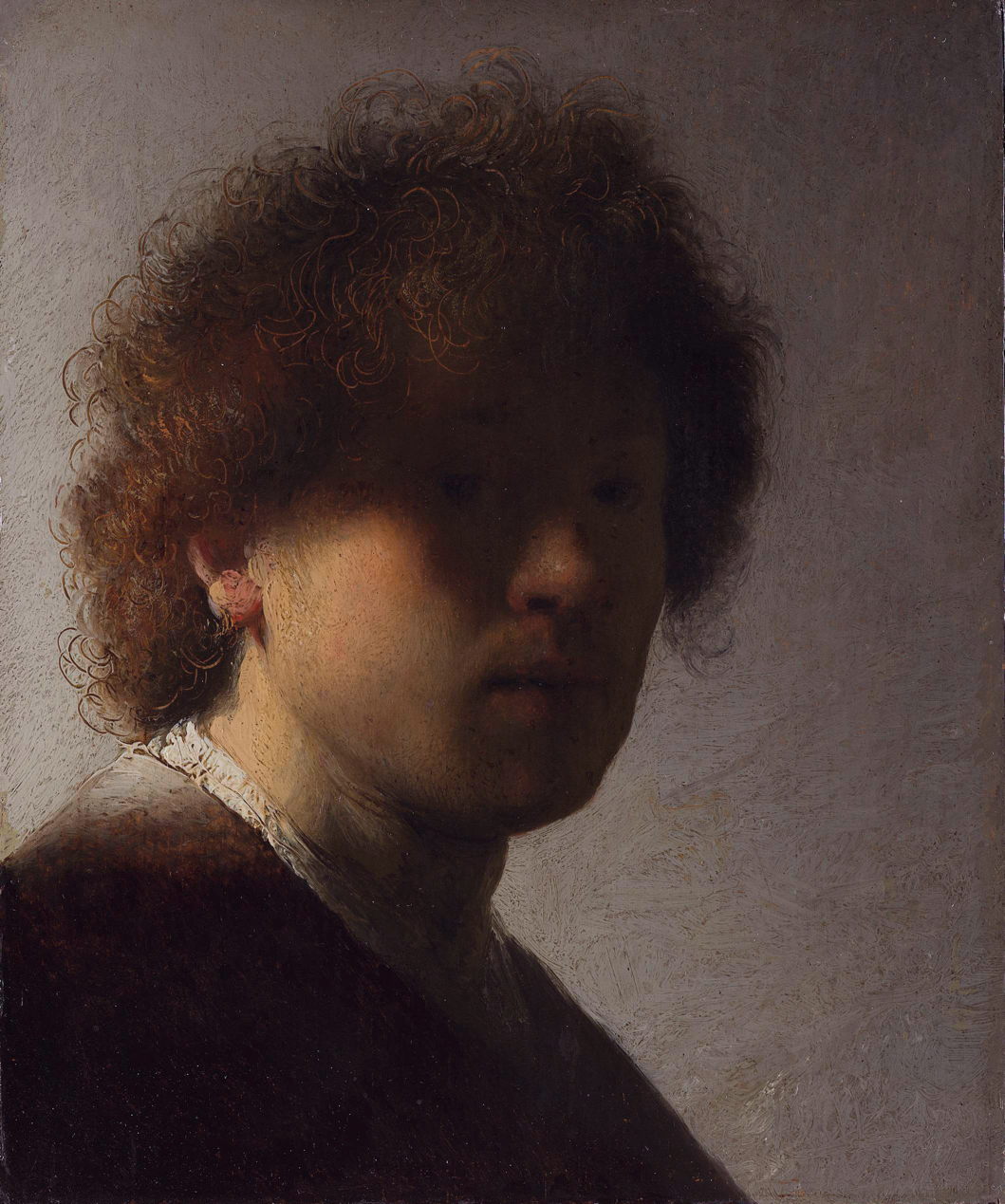
A year or two later, in 1628-29, he painted this Self-portrait with Dishevelled Hair, proving the point.
Rembrandt’s break came in 1629, when he was discovered by a distinguished poet and composer Constantijn Huygens, who was secretary to the head of state, held influence in the Hague, and the father of Christiaan Huygens. He helped arrange commissions for Rembrandt, and introduced his work to Prince Frederik Hendrik, then head of state.
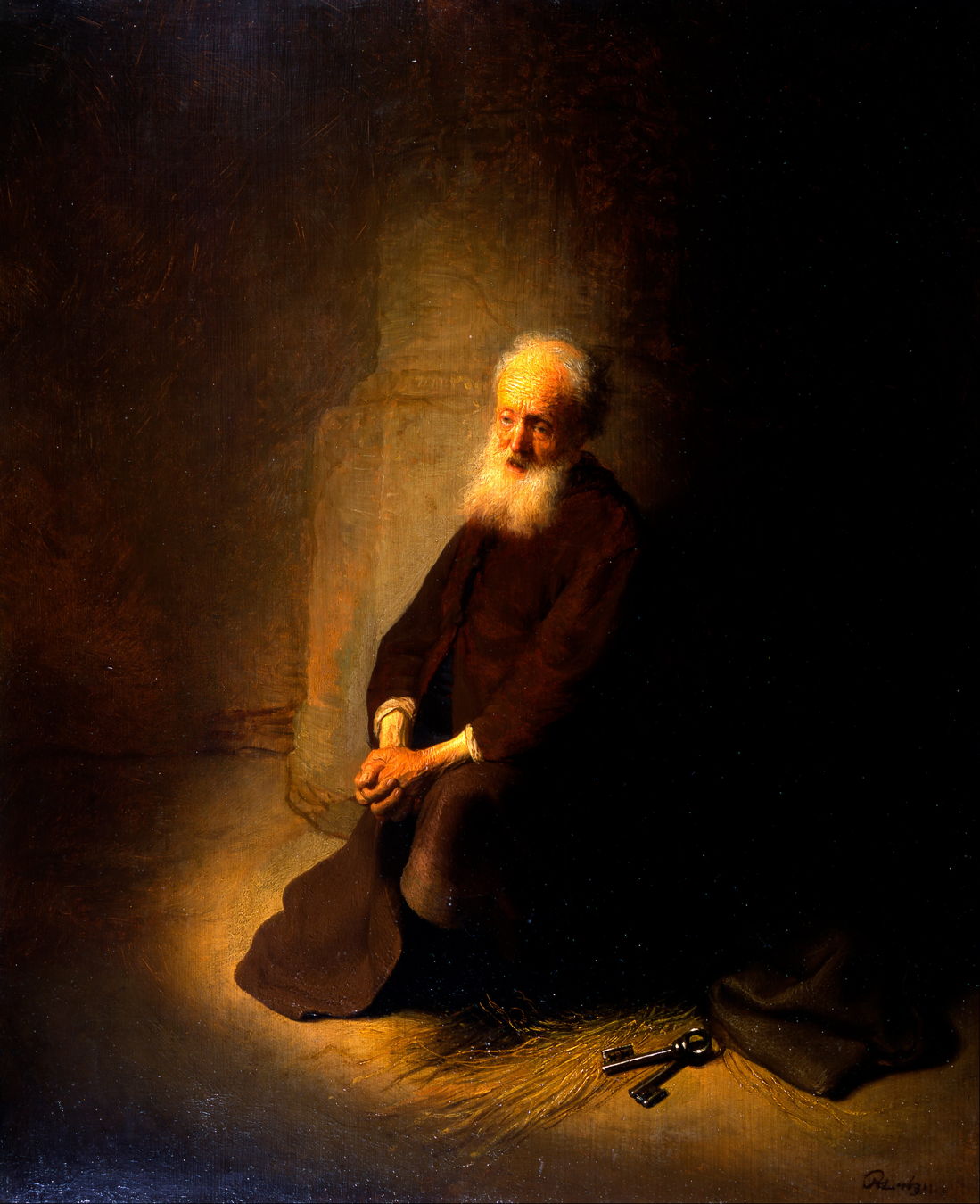
Although several of his best-known chiaroscuro paintings were made in his old age, Rembrandt had long used the technique when appropriate, here in Saint Peter in Prison (The Apostle Peter Kneeling) from 1631. As with Caravaggio and others, Rembrandt often used light sources at the upper left.

Rembrandt painted his group portrait of distinguished members of the Surgeons’ Guild of Amsterdam in this Anatomy Lesson of Dr. Nicolaes Tulp from 1632. Like its forerunner by the van Mierevelts above, the cadaver is lit well, but he has used generally diffused light to soften the shadows cast by its figures.
此内容由惯性聚合(RSS阅读器)自动聚合整理,仅供阅读参考。 原文来自 — 版权归原作者所有。