










This weekend, we published a new developer 🧑💻 website! 🥳
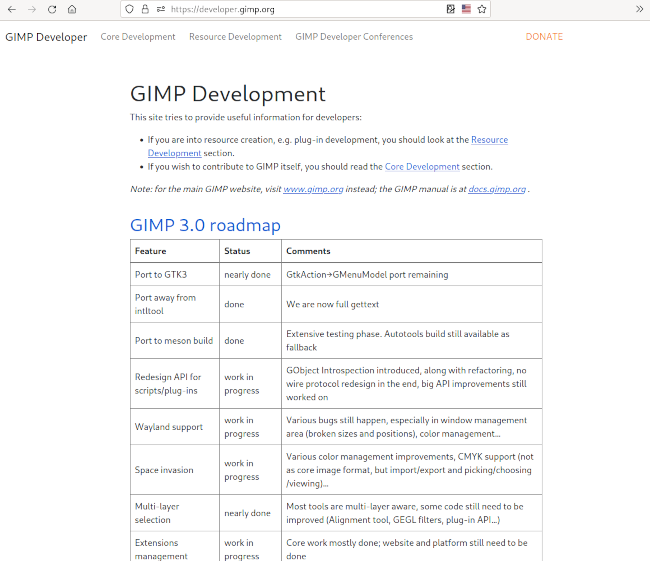
As the name indicates, it is targetted at developers, both core contributors (people making GIMP itself) and third-party developers (people making plug-ins and publishing them on the side). This is why the website has 2 main sections:
libgimp API, tutorials to make plug-ins…GIMP has had a developer website for at least 2 decades (the Internet Archive traces back an early page in 2001), yet mostly unmaintained ever since 2009, which is a shame.
Since then, documentation for developers was scattered on the general website, the source repository itself and 2 wikis (developer and GUI wiki). As you may know, the developer wiki encountered problems recently. As for the GUI wiki, it is still there, though we plan to merge both wikis into our new developer website.
Rather than having duplicate documents all over the place, we want to consolidate developer documentation into a single point of entry.
This new website is still a work-in-progress. Contents is still incomplete and often outdated. We decided to publish it in its current state and update it as we go, rather than wait forever.
As usual, we stick to only serving static pages, no server-side scripting. It’s simpler and safer as we don’t want to spend our time administering a webpage (we develop GIMP, not webpages).
What has been done so far:
libgimp library documentation, and
early error detection.gimp.org). Both websites will be
automatically published daily from their own branch and can be triggered
manually through Continuous Integration jobs on Gitlab.gimp.org website were
moved to developer.gimp.org or merged into others. For instance, we had
redundant pages about contributing code for GIMP. There is now (unless we
missed some) only a single tutorial:
Submit your first patch.More documents need to move, be rewritten or fixed. This is only a start.
Also the website style is currently pretty simple and bare. On one hand, maybe it’s not too bad for a development website. On the other hand, discussions have happened proposing to make the website look a little more lively and less austere 🧐. We’ll see!
By having a single point of entry, we hope it will feel less heavy for newcomers to understand where to go for building GIMP and contributing patches.
Now if anyone asks, tell them to look at the Core section of GIMP’s developer website.
We strive for a lively third-party plug-in ecosystem. For this to happen, we want to help third-party developers. There are a lot of documentation and tutorials about plug-in developement, but they are spread across the web, many links are dead, a good part of the documents are unmaintained and therefore partly outdated.
This new website doesn’t bring much yet on this side, though by making plug-in development one of the 2 main sections, we clearly intend to change this fact for the upcoming GIMP 3.0. You should not expect new tutorials for GIMP 2.10 plug-in development, but this is definitely where you should keep an eye on if you are interested by plug-in creation for GIMP 3.0: Resources section of GIMP’s developer website
The main work happened on the gimp-web-devel
repository.
Since mid-July, when we started the website renewal, the following contributors participated:
Some more work, unlisted here, happened on gimp-web (main website)
repository.
As usual, we remind that GIMP is Community, Free and Libre Software. It is what we all make of it, together. This is a main reason of such a developer website. Hopefully you will find it useful. If not, don’t remember that the website itself is community-made. So feel free to propose developer tutorials and fixes or updates to existing ones.
Last but not least, if GIMP is useful to you and you wish to fund development, you are very welcome to donate to the project and fund core GIMP developers, as a way to give back and accelerate the development of GIMP.
此内容由惯性聚合(RSS阅读器)自动聚合整理,仅供阅读参考。 原文来自 — 版权归原作者所有。