





Today, we’re announcing Trusted Remote Execution (Rex, for short) — an open source scripting runtime where every system operation is authorized by policy.
Scripts are written in Rhai, a lightweight language with no built-in system access. The only way to reach the host is through operations Rex explicitly provides, which are authorized against a Cedar policy upon invocation.
Our Journey
Running operations on production systems is a fact of life when managing software — reading logs, checking disk usage, restarting a service. The problem is that most script execution environments give a script whatever permissions the execution context has. A script intended to read a log file can just as easily delete one.
This gets worse with AI agents. When an agent generates and executes a script autonomously, there’s no human in the loop reviewing each system call. The usual safety nets — code review, approval workflows, allowlisted commands — don’t apply when the code is written at runtime.
We wanted a different model: one where an authorization policy — defined by the service owner, separate from the script — controls what the code is allowed to do at runtime. That’s what Trusted Remote Execution does.
How It Works
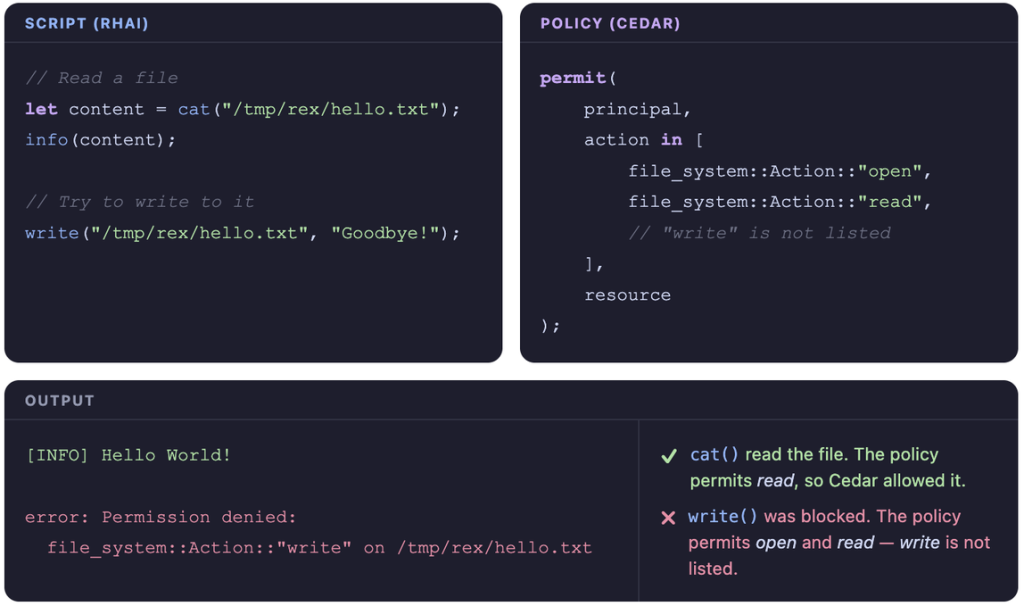
Trusted Remote Execution pairs every script with a Cedar policy. The script says what to do — the policy says what’s allowed. Every operation is checked against the policy before it runs.
When a script runs, the Rhai engine has no direct access to the host. The only way to reach the system is through Rex’s purpose-built SDK of operations — read, write, open, and so on — each of which evaluates the Cedar policy before performing the underlying system call. If the policy doesn’t permit the action, the script receives an error and the operation never executes.
Agentic Operations: A Case Study
Most agentic sandboxes constrain the agent. Rex constrains what the agent can do to the host — giving the host owner full control over which operations are permitted, regardless of what the agent requests.
If an agent generates a script that exceeds the policy — from hallucination, prompt injection, or an overly eager interpretation of the task — it receives a clear ACCESS_DENIED_EXCEPTION rather than causing unintended side effects. The agent can observe this, reason about it, and adjust.
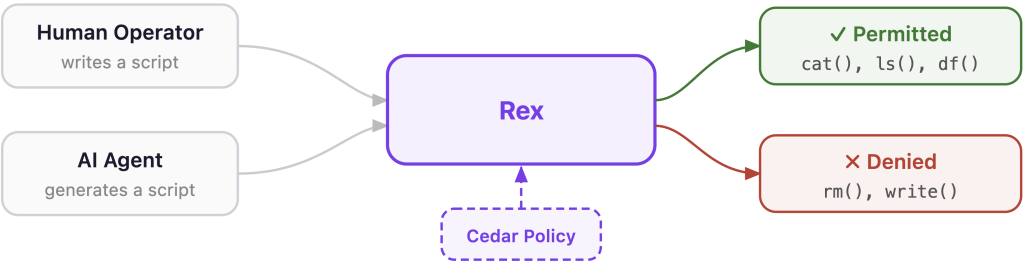
This makes it practical to give agents real operational access — reading logs, inspecting configurations, restarting services — while keeping a hard boundary around what they can touch. The policy creates a contract between the service owner and the agent, and Rex enforces it.
Want to learn how to enable agents to safely interface with your systems? See how to pair Rex with IAM and SSM.
Getting Started
Rex runs on Linux and macOS. You’ll need Rust installed — if you don’t have it yet, see rustup.rs.
Install rex-runner via Cargo:
cargo install rex-runner
Create a policy:
cat > policy.cedar << 'EOF'
permit(
    principal,
    action in [
        file_system::Action::"open",
        file_system::Action::"read",

        // Uncomment to allow the write command:
        //file_system::Action::"create",
        //file_system::Action::"write",
    ],
    resource
);
EOF
Create a script that writes a file, then reads it back and returns it as the script output:
cat > script.rhai << 'EOF'
write("/tmp/hello.txt", "Hello from Rex!");
cat("/tmp/hello.txt")
EOF
Run it:
rex-runner \
  --script-file script.rhai \
  --policy-file policy.cedar \
  --output-format human
The write fails because write and create are not in the policy:
error: Permission denied:
  file_system::Action::"create" on /tmp/hello.txt
Uncomment create and write in policy.cedar and run again — the script completes and prints Hello from Rex!. The script didn’t change; only the policy did.
For the full setup guide and more examples, visit the Getting Started guide or try the interactive playground.
Get Involved
Trusted Remote Execution is open source under the Apache 2.0 License. We’re excited to build in the open — contributions are welcome, whether that’s adding new SDK extensions, improving documentation, or sharing how you’re using it.