








Today we are introducing CLI Agent Orchestrator (CAO, pronounced “kay-oh”), an open source, multi-agent orchestration framework that transforms how developers work with AI-powered CLI tools such as Amazon Q CLI and Claude Code. While individual developer CLI tools excel at focused tasks with sophisticated reasoning and autonomous execution, complex enterprise development projects often require coordination across multiple disciplines—such as architecture design, parallel development, security reviews, performance optimization, and integration testing. This highlights the limitations of using a CLI tool as a single smart agent for complex, multi-disciplinary development work.
To address the challenges, CAO creates a hierarchical orchestration system where multiple specialized CLI AI agents work together under intelligent supervision. Each agent retains the full reasoning capabilities of their underlying CLI tool while contributing to coordinated workflows that exceed single-agent capacity. This enables users to tackle complex projects through intelligent task delegation, session-based isolation, and adaptive workflow patterns, and transforming CLI tool from a powerful individual agent into an orchestrated multi-agent powerhouse.
Consider modernizing a mainframe application: Rather than one CLI tool struggling to handle everything, CAO orchestrates four specialized agents working together: an Architecture agent designs the modern cloud structure, a Security agent updates authentication flows, a Performance agent optimizes critical bottlenecks, and a Test agent creates and validates those test cases. The orchestrator ensures these agents collaborate effectively, producing a cohesive modernization plan that would be impossible for a single agent to develop.
With CAO orchestration, developers now have access to coordinated multi-agent workflows for use cases like:
- Complex Software Development: Multi-service architectures requiring coordinated development, review, and integration
- Re-imagine Enterprise Transformations: Re-imagine large-scale migrations and modernization that required systematic planning with parallel implementation with CAO to accelerate
- Research and Analysis: Comprehensive studies requiring both sequential reasoning and parallel data processing
- Quality Assurance Workflows: Multi-stage review processes with different types of expertise at each stage
How CLI Agent Orchestrator Amplifies Q CLI’s Agentic Power
CLI Agent Orchestrator operates as a hierarchical multi-agent system with two primary components:
- A supervisor agent that manages overall workflow coordination, and specialized worker agents.
- Specialized worker agents that handle domain-specific tasks.
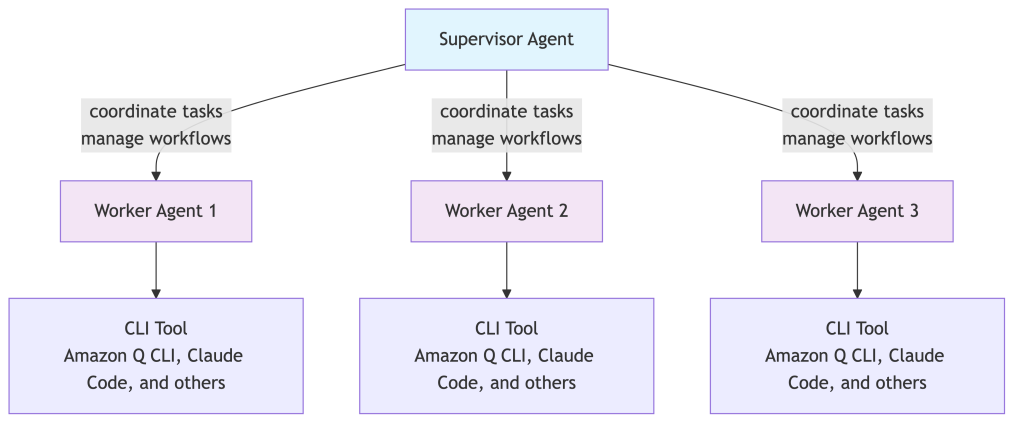
CLI Agent Orchestrator Conceptual Diagram
CLI Agent Orchestrator introduces the following features:
- Hierarchical orchestration – CAO’s supervisor agent coordinates workflow management and task delegation to specialized worker agents. The supervisor maintains overall project context while agents focus on their domains of expertise.
- Session-based isolation – Each agent operates in isolated tmux sessions, ensuring proper context separation while enabling seamless communication through Model Context Protocol (MCP) servers. This provides both coordination and parallel processing capabilities.
- Intelligent task delegation – CAO automatically routes tasks to appropriate specialists based on project requirements, expertise matching, and workflow dependencies. The system adapts between individual agent work and coordinated team efforts through three orchestration patterns:
- Handoff – Synchronous task transfer with wait-for-completion
- Assign – Asynchronous task spawning for parallel execution
- Send Message – Direct communication with existing agents
- Flexible workflow patterns – CAO supports both sequential coordination for dependent tasks and parallel processing for independent work streams. This allows optimization of both development speed and quality assurance processes. The new beta scheduled runs feature adds crontab-like scheduling, allowing automated execution of workflows at specified intervals.
- Flow – Scheduled runs – Automated execution of workflows at specified intervals using cron-like scheduling, enabling routine tasks and monitoring workflows to run unattended.
- Context preservation. The supervisor agent provides only necessary context to each worker agent, avoiding context pollution.
- Direct worker interaction and steering: The user can turn on the ability to interact directly with a worker agent to provide additional steering, which distinguishes from the sub-agents feature of Claude Code, which specialized expert AI assistants within Claude Code that handle specific parts of a larger task.
- Advanced CLI integration – CAO supports advanced features of the developer CLI, such as the sub-agents feature of Claude Code, Custom Agent of Amazon Q Developer for CLI and so on.
CLI Agent Orchestrator Privacy and Security Considerations
CAO maintains strong privacy and security practices by operating entirely within your local environment. All agent communications occur through local tmux sessions and MCP servers, with no external data transmission beyond standard CLI Tool interactions. Agent contexts and workflow configurations are stored locally, giving you complete control over sensitive project information.
The system supports profile-based agent isolation, ensuring that different agents can operate with appropriate access levels and contexts. Conversation tracking and logging provide full transparency into agent interactions while maintaining data locality and security.
Getting started with CLI Agent Orchestrator
To begin using CAO, please follow the README.md from the CLI Agent Orchestrator Github Repo. The repository also includes example workflows for you to quickly spin up your projects. CAO also provides a nice User Interface (UI) to easily navigate throughout interactions and orchestration.
Now Available
CAO is available today with support for the following CLI Developer Tools:
Additional support in Developer CLI tools such as OpenAI Codex CLI, Gemini CLI, Qwen CLI, Aiden are planned on the future project roadmap.
To learn more, visit the CAO GitHub repository and the documentation for your preferred developer CLI tool:
Try CAO with your preferred developer CLI tool now, and provide feedback through the respective support channels or the CAO GitHub repository.