


惯性聚合 高效追踪和阅读你感兴趣的博客、新闻、科技资讯
阅读原文 在惯性聚合中打开

推荐订阅源

WordPress大学
WordPress大学
D
Darknet – Hacking Tools, Hacker News & Cyber Security
Hacker News: Ask HN
Hacker News: Ask HN
N
News and Events Feed by Topic
Forbes - Security
Forbes - Security
The Last Watchdog
The Last Watchdog
TaoSecurity Blog
TaoSecurity Blog
Schneier on Security
SecWiki News
SecWiki News
V
Vulnerabilities – Threatpost
Project Zero
Project Zero
O
OpenAI News
W
WeLiveSecurity
Security Archives - TechRepublic
Exploit-DB.com RSS Feed
H
Hacker News: Front Page
Cisco Talos Blog
Cisco Talos Blog
Spread Privacy
Spread Privacy
Help Net Security
Help Net Security
P
Privacy & Cybersecurity Law Blog
K
Kaspersky official blog
S
Security @ Cisco Blogs
Latest news
Latest news
AWS News Blog
AWS News Blog
U
Unit 42
Martin Fowler
Martin Fowler
阮一峰的网络日志
阮一峰的网络日志
S
Secure Thoughts
CTFtime.org: upcoming CTF events
Application and Cybersecurity Blog
Know Your Adversary
Know Your Adversary
Scott Helme
Scott Helme
博客园 - 司徒正美
B
Blog RSS Feed
C
Check Point Blog
Hacker News - Newest:
Hacker News - Newest: "LLM"
D
Docker
Google Online Security Blog
Jina AI
Jina AI
aimingoo的专栏
aimingoo的专栏
Recent Commits to openclaw:main
Last Week in AI
Last Week in AI
月光博客
月光博客
C
CXSECURITY Database RSS Feed - CXSecurity.com
S
SegmentFault 最新的问题
NISL@THU
NISL@THU
T
The Blog of Author Tim Ferriss
C
Cisco Blogs
Attack and Defense Labs
小众软件
小众软件

The Leading Enterprise Content Platform | WordPress VIP

Enterprise SEO: Complete Guide | WordPress VIP Secure MCP Is the Access Model Enterprise AI Agents Have Been Missing | WordPress VIP Enterprise WordPress Security Best Practices | WordPress VIP Composable CMS: Embrace Flexibility Without the Chaos | WordPress VIP The Future of The Website As AI Builds Trust | WordPress VIP Enterprise Website Redesign: Complete Guide for 2026 | WordPress VIP How enterprise brands lose customer trust through over-automation (and how to fix it) | WordPress VIP Building Your Website Into a Trust Validation Layer for Both Humans and AI | WordPress VIP ‘AI Is Killing Web Traffic’ Is The Wrong Narrative. Here’s The Right One | WordPress VIP How Publishers Can Balance AI Adoption While Continuing To Earn Audience Trust Agent-Ready Content Infrastructure: What It Is And How It Will Help AI Adoption Meet the Moment: How Enterprise Nonprofits Are Modernizing Digital Platforms WordPress Workflow Automation: Enterprise Guide to Streamlining Operations WordPress VIP Earns Secure Hosting Alliance Certification WordPress Scalability: How to Scale to Enterprise Enterprise Digital Transformation: Strategy, Requirements, and Best Practices Enterprise Ecommerce: Definition, Platforms, and Selection Guide The AI ‘Marketing Recipes’ Enterprises Need for High-Performing Content Operations test animation What Is An AI CMS? How Artificial Intelligence Is Changing Content Management Agent Experience (AX) in Content Operations: Helping AI Agents Succeed Enterprise WordPress Migration Guide WordPress Accessibility and Compliance Guide AI Isn’t Killing WordPress — It’s Raising the Bar for Enterprise CMS Enterprise Content Management Strategy: A Practical Guide The 10 Best Enterprise CMS Platforms in 2026 Enterprise CMS: A Complete Guide Headless CMS for Enterprise: Choosing the Right Architecture Without Sacrificing Editorial Control How to Choose Between Headless and Hybrid WordPress Content Intelligence Tools: A Guide for Enterprise Teams When WordPress Shouldn’t Be Headless: Evaluating Headless WordPress Tradeoffs Before You Decouple Your CMS Headless WordPress for Omnichannel Apps and Devices: Use Cases and Reference Architectures (with Real Enterprise Examples) Content Marketing KPIs That Matter: What to Track and How to Report It Risk & Compliance for AI-Generated Content: Governing AI Safely at Enterprise Scale
Enterprise WordPress AI Plugins Guide | WordPress VIP
Shane Schick · 2026-04-22 · via The Leading Enterprise Content Platform | WordPress VIP

Enterprise WordPress AI integration is becoming so simple that the distance between pilot projects and fully scaled deployments has never looked shorter.

According to research from Deloitte, the number of companies with more than 40% of AI projects in production is set to double over the next six months. At the senior leadership level, however, a McKinsey survey shows 86% feel their organizations are not very prepared to adopt AI in day-to-day operations.

Those C-suite members may not have the technical background to understand the gap, but it has a lot to do with how AI tools and a platform like WordPress VIP communicate with each other.

Until recently, those in enterprise functions like development or marketing typically installed isolated plugins with separate API keys for OpenAI, Google’s Gemini, or Anthropic’s Claude. This meant plugins for optimizing SEO, generating images, or writing would proliferate in an ad hoc way, raising both costs and governance implications.

The Abilities API was a critical first step in solving this issue. A trio of dedicated AI plugins will make enterprise WordPress AI coordinated, flexible, and standardized, and turn the technology into reusable CMS infrastructure. This move to native AI capabilities will reshape how enterprise sites are built, managed, and optimized.

The Abilities API: Setting the stage

Handling API integrations in a one-off fashion doesn’t let you realize the full potential of AI in your website. It can require extensive customization or rely on third-party business automation tools.

As announced at WordPress VIP’s AI Day, the Abilities API changed that in WordPress 6.9 by offering a shared registry that makes plugins discoverable, validates them, and provides a shared interface to execute them. This will be available out of the box as a core feature in WordPress 7.0.

Think of walking into a public library: its catalog not only tells you where each book is, but what they’re about and details like who wrote and published them. The Abilities API provides the same clarity for AI assistants that enterprises want to plug into their websites, defining inputs, outputs, permission rules, and execution logic.

This was a huge leap forward in making enterprise WordPress sites AI-ready, connecting workflows and preventing integrations from breaking whenever a plugin gets an update. It builds on the momentum of the WordPress MCP Adapter, which connects AI tools to your website and other systems in your tech stack, like a CRM or CDP.

Instead of having to reinvent the wheel every time you want to add more AI functionality to an enterprise WordPress site, these innovations let you keep moving in the direction you want to go.

Official WordPress API provider plugins: From features to a foundation

The official WordPress API plugins for OpenAI, Claude, and Gemini will not only lower integration costs and save developers time. They’ll also let enterprises roll out AI capabilities faster across multiple sites while centralizing governance and improving an organization’s security posture.

The capabilities these AI plugins make available inside enterprise WordPress sites include:

  • Text generation: For marketing teams, the ability to support content production is essential to keeping up with business demands. This not only includes using AI to help with social copy, for example, but also chores like metadata and even user experience (UX) design assets.
  • Image creation and editing: In an increasingly visual culture, marketers need to work harder than ever to compel their audiences’ attention. All major AI providers offer features to support this work, which WordPress AI plugins will enable.
  • Function calling: Instead of leaving a post in drafts, the AI plugins will let AI tools add tags as required, check for SEO optimization, and alert stakeholders who may need to review it. This helps organizations achieve a more automated publication pipeline.
  • Web search and contextual augmentation: Want AI to check the web for brand mentions, analyze competitor content, or do some basic fact-checking? The WordPress API plugins will connect you to the provider of your choice to take those tasks on, too.

Remember that these plugins are also backed by the WordPress core team, which means organizations can count on a long-term commitment to the ecosystem.

Key WordPress AI plugin use cases for large organizations

Common enterprise AI marketing goals include managing content at scale, whether that’s generating drafts faster, localizing content, or personalizing it for specific audiences. It’s also a great tool for streamlining tasks like SEO optimization by automating schema and internal linking. The WordPress AI plugins are valuable in part because they take an open approach to using AI for these purposes.

Based on some early experimentation and testing, you may have decided that Claude works well for reasoning-heavy workflows. It’s the tool your team has settled on to check content for brand safety or legal risk and immediately route it to the appropriate stakeholder for review.

When it comes time to update photos, spec sheets, or demo videos in the CMS, though, you may have determined that Gemini is particularly good at multimodal tasks such as flagging content for accessibility issues or brand guideline violations. The WordPress AI plugins mean you can switch from one provider to another without extensive rework.

If costs, performance, or your corporate policy change, you can switch again. Developers can choose the AI provider they prefer to handle code generation or debugging. Marketing teams can use a different provider to summarize content or run compliance checks. Testing and benchmarking these providers lets you move workloads based on economic or compliance needs, rather than being locked in.

Governance, risk, and compliance considerations

Even as more organizations embed AI into daily operations, some core principles should remain:

  • You still need to develop websites in a way that safeguards data privacy, especially when you’re using third-party models.
  • Brand safety and content accuracy are still your responsibility, not AI’s. Humans need to continue reviewing and approving assets before they go live.
  • Effective access controls and user permissions will avoid unnecessary cybersecurity risks. This thinking should be extended to the permissions AI agents are given as more organizations adopt agentic AI.
  • Auditability is everything: You should be able to track the development, publication, and distribution of AI-generated vs. human-created content at all times.
  • Regulatory bodies are catching up to AI, so expect changes to laws such as GDPR and other industry-specific rules.

Having dedicated WordPress AI plugins supports better governance by simplifying credential management. Instead of API keys fragmenting and being hard to pin down, you can use plugins to configure Claude, OpenAI, or Gemini once, and then let compatible plugins share that connection.

The rise of AI-powered content experience platforms

The work WordPress is doing with the Abilities API, MCP Adapter, and dedicated WordPress AI plugins will benefit businesses of every size. But for organizations that encompass many brands, locations, teams, and websites, WordPress VIP is the content experience platform (CXP) you need to accelerate their AI journey.

AI’s potential is not based on a particular tool or capability. It’s not tied to a single model or provider’s approach. Business and technology leaders need to think holistically about the value they want to deliver and ensure execution is stable and well integrated. Now that platform-level enterprise WordPress AI infrastructure has arrived, they can.

Related content

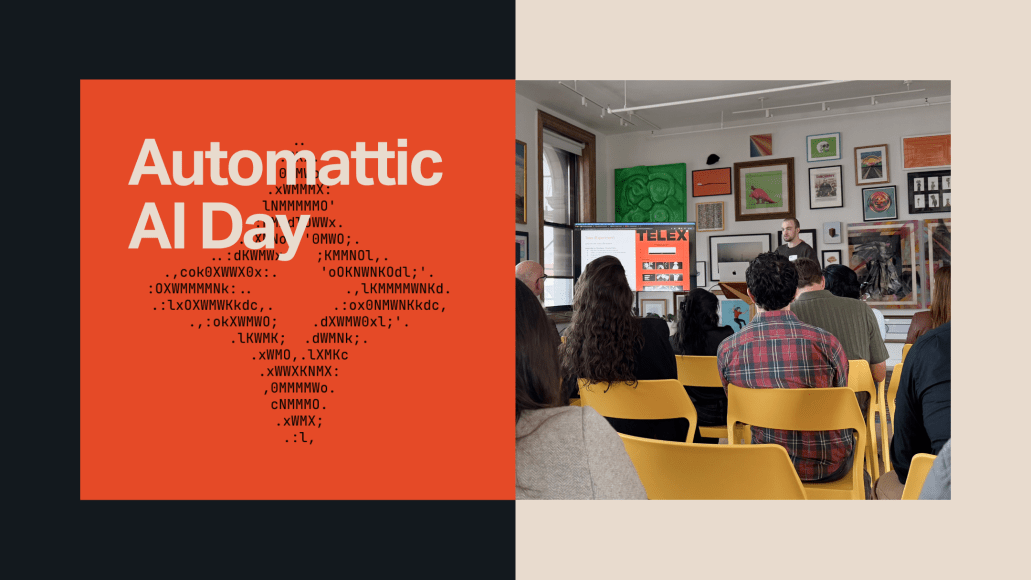
A split-panel image promoting Automattic AI Day. The left side shows the text “Automattic AI Day” over a light background with an abstract shape made of AI-style code characters. The right side shows a speaker presenting to an audience in a brightly lit room with yellow chairs and colorful framed artwork on the walls.

Building the Open, Intelligent Web: How Automattic and WordPress VIP are Shaping the Future of AI

Author

Headshot of writer, Shane Schick

Shane Schick

Founder, 360 Magazine

Shane Schick is a longtime technology journalist serving business leaders ranging from CIOs and CMOs to CEOs. His work has appeared in Yahoo Finance, the Globe & Mail and many other publications. Shane is currently the founder of a customer experience design publication called 360 Magazine. He lives in Toronto.