








There are now YouTube clips, blog posts, and mentions across LinkedIn all asking the same thing: Will AI kill WordPress?
The thinking behind the question is obvious. As generative and agentic artificial intelligence (AI) become more sophisticated, everyday business professionals can now “vibe code” an application rather than turn to a developer. Why shouldn’t it be just as easy to use AI to to build a website?
In many cases, it is easy to generate a draft website. But running a secure, scalable, compliant digital platform is a very different challenge.
This is not the first time innovation has put the fate of WordPress in some existential crosshairs. People once wondered whether the mobile web and apps would kill WordPress. An influx of competitors in the content management system (CMS) space once looked like potential WordPress killers, too.
AI is similar to other technological sea changes, but different in one crucial aspect. Rather than killing WordPress, AI is increasingly becoming a layer within WordPress, changing how it functions, opening new possibilities to creating and managing content for everyone.
At enterprise scale, a website is not just generated output. It is a governed digital asset that must be structured, maintained, secured, and reused across teams and channels.
Those working in large enterprises need to help their senior leadership teams and other stakeholders understand how WordPress uses AI, rather than assuming it means anyone can now prompt their way to building a viable website. Businesses that support high-traffic websites and require strong security can’t afford to be misled by hype and rampant speculation.
This post is to help clarify how AI will change the way teams create and manage content, while maintaining the need for a CMS like WordPress VIP that is open, extensible, governed, and trusted at enterprise scale.
The ‘AI will kill off WordPress’ argument assumes launching a website is all it takes to develop and maintain a strong digital presence that represents your brand. That misses what a CMS actually does inside an enterprise: it governs how content is created, reviewed, published, reused, and measured over time.
Experienced digital marketing leaders, web admins, and content teams know otherwise. In reality, enterprises are managing content operations, approval flows, brand standards, localization, integrations, and performance across a much broader digital ecosystem.
Websites, particularly at the enterprise level, are the hub of high-volume content operations. WordPress VIP has helped by offering tools to support rapid content authoring and streamline editorial workflows. The modular Gutenberg Block Editor, meanwhile, simplified the creation of website sections, landing pages, and other content assets without requiring technical expertise.
AI fits into that environment best when it supports the existing system of record rather than bypassing it.
Generative AI has brought additional capabilities to help with drafting, personalization, search, and workflow automation. That usually means marketers will produce more content and more variants, not fewer. WordPress VIP has responded by bringing in AI for headline testing,personalized content recommendations through Parse.ly, and JetPack AI to easily edit and modify text.
These are meaningful gains, but they work best when paired with the controls, workflows, and content structure that enterprises already depend on.
Large businesses also still need an enterprise-grade CMS to control permissions, publishing, structure, and reuse across digital channels. WordPress is adapting AI while keeping its core platform model intact.
Rather than stand still and risk becoming redundant, the WordPress ecosystem is moving toward deeper AI support. This started with an AI website builder that allowed solopreneurs and small businesses to quickly build a professional WordPress.com site using simple prompts.
This momentum has continued with the WordPress AI assistant, which allows those same professionals to write, edit, and run their WordPress.com sites using agentic AI. These features are all contained within WordPress, which means you don’t have to cobble together AI point solutions or suffer from integration headaches.
Large enterprises turn to WordPress VIP because any use of generative and agentic AI has to build upon an open, intelligent, and secure foundation. It’s worth walking through each of these areas in detail as organizations plan their AI journey.
Like social media platforms, online marketplaces, and traditional search engines, many AI startups are taking highly proprietary approaches to the products and services they offer. WordPress has always been different by focusing on giving web users greater flexibility and choice.
Open matters not only because WordPress is open source, but because enterprises need the freedom to integrate and evolve their AI stack without being trapped in a single vendor’s infrastructure or roadmap.
An open approach also means enterprises running WordPress VIP also enjoy portability across hosting environments, thanks to a native Docker-based local development tool that lets your content move with you.
WordPress VIP combines that openness with enterprise-scale capabilities. This includes options to develop and run sites based on a headless or hybrid CMS architecture. As more organizations look at deploying AI across multiple touchpoints, WordPress VIP is helping promote omnichannel digital experiences.
“Intelligent” is about helping marketers create faster and publish with less developer dependency. Even once everyone can use AI to publish and manage content, enterprise marketers still have a lot of work to do in setting up and running campaigns, localizing content, and ensuring content is well-governed.
WordPress VIP’s growing AI feature set will accelerate content generation, but it already acts as the critical system of record for approvals, governance, and reuse.
Intelligence in this case can also refer to recognizing the role of human intelligence. Even for WordPress.com users, AI-written blog posts appear as drafts first. That kind of thinking recognizes the powerful role of giving people the oversight needed for AI outputs. This is even more important for large, multi-site organizations.
Cybercriminals are just as interested in AI as everybody else, and they are already weaponizing it to try to steal corporate data. That makes WordPress VIP’s vulnerability management, DDoS investigation, security testing, and patch management services table stakes for enterprises that want to fend off future AI-powered cyber threats.
As AI heightens risk, WordPress VIP provides a layer of IT governance controls and oversight that supports organizations that focus on maintaining disciplined operations, controlled change management, and clear accountability for what gets shipped.
Internally, AI continues to pose myriad risks, including errors, hallucinations, bias, and the potential to expose orgs to data breaches or to accidental misuse of data. WordPress VIP helps by providing log auditing, code and plugin scans, and controlled changes to any code updates.
These services matter even more as AI tools become part of everyday workflows. In other words, AI does not “solve” security. It increases the need for review workflows, access controls, auditability, and platform-level guardrails.
The real question isn’t whether AI will kill WordPress, but what other CMS can absorb AI without losing control, speed, or trust?
One final point: Most third-party AI tools are good at the basics but show diminishing returns when questions and tasks become more complex. Enterprises have to develop websites with many nuances and considerations, including their industry, the audience they serve, performance requirements, and legal rules and regulations.
When debugging and troubleshooting issues emerge, generative answer engines won’t give large organizations the kind of help they need. WordPress VIP customers know first-hand the value of having best-in-class CMS support people who can be reached 24/7 and have full, unmatched platform expertise.
AI changes how content gets made. WordPress VIP determines how it gets governed, scaled, and secured.
No, AI is not replacing WordPress, but it is becoming part of the core capabilities in products like WordPress VIP, which supports large organizations that need greater flexibility, intelligence, and security as part of their enterprise content management strategy.
Yes, WordPress VIP is continually adding AI capabilities to help enterprises running high-traffic sites or multiple sites leverage AI across headline testing, content recommendations, metadata generation, and more.
Yes, WordPress has features to assist with website development, but large enterprises should also consider services and capabilities such as those offered by WordPress VIP that are important to keeping a corporate website stable, secure, and trustworthy.
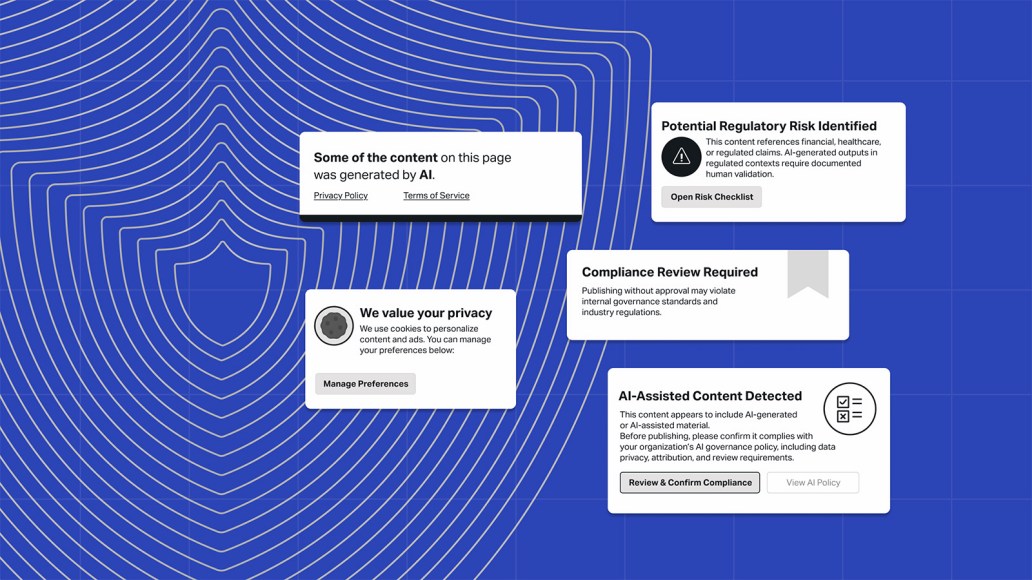
Risk & Compliance for AI-Generated Content: Governing AI Safely at Enterprise Scale
Author

Shane Schick
Founder, 360 Magazine
Shane Schick is a longtime technology journalist serving business leaders ranging from CIOs and CMOs to CEOs. His work has appeared in Yahoo Finance, the Globe & Mail and many other publications. Shane is currently the founder of a customer experience design publication called 360 Magazine. He lives in Toronto.
此内容由惯性聚合(RSS阅读器)自动聚合整理,仅供阅读参考。 原文来自 — 版权归原作者所有。