
惯性聚合 高效追踪和阅读你感兴趣的博客、新闻、科技资讯
阅读原文 在惯性聚合中打开

推荐订阅源

F
Fortinet All Blogs
S
Secure Thoughts
月光博客
月光博客
美团技术团队
雷峰网
雷峰网
Exploit-DB.com RSS Feed
奇客Solidot–传递最新科技情报
奇客Solidot–传递最新科技情报
N
News and Events Feed by Topic
freeCodeCamp Programming Tutorials: Python, JavaScript, Git & More
Forbes - Security
Forbes - Security
W
WeLiveSecurity
P
Proofpoint News Feed
阮一峰的网络日志
阮一峰的网络日志
爱范儿
爱范儿
G
GRAHAM CLULEY
cs.AI updates on arXiv.org
AI
AI
Last Week in AI
Last Week in AI
Google Online Security Blog
Schneier on Security
云风的 BLOG
云风的 BLOG
Threat Intelligence Blog | Flashpoint
Recent Announcements
Webroot Blog
Webroot Blog
T
Tor Project blog
Cisco Talos Blog
Cisco Talos Blog
N
News and Events Feed by Topic
罗磊的独立博客
The Register - Security
Blog — PlanetScale
Blog — PlanetScale
T
Threat Research - Cisco Blogs
博客园 - 【当耐特】
Apple Machine Learning Research
人人都是产品经理
人人都是产品经理
T
The Exploit Database - CXSecurity.com
www.infosecurity-magazine.com
B
Blog
腾讯CDC
Microsoft Azure Blog
酷 壳 – CoolShell
酷 壳 – CoolShell
H
Hacker News: Front Page
Application and Cybersecurity Blog
Engineering at Meta
Engineering at Meta
Latest news
Latest news
IT之家
IT之家
D
DataBreaches.Net
博客园 - 司徒正美
N
Netflix TechBlog - Medium
V
V2EX
钛媒体:引领未来商业与生活新知
钛媒体:引领未来商业与生活新知

Rapid7 Cybersecurity Blog

Sunsetting the Public AttackerKB Platform | Rapid7 Rapid7 Rapid7 Labs: Investigating Persistence Mechanisms in AWS Rapid7 CVE-2026-55040: Microsoft SharePoint JWT Token Authentication Bypass (FIXED) Rapid7 and Mindware Partner Across the Middle East Rapid7 Security Teams Are Ready To Become More Preemptive. What’s Holding Them Back? A Day With Your Vector Command Red Team Pod Rapid7 Formalizing Red Teaming Offensive Methodology as a Multi-Agent AI Architecture 5 Myths About AI in the SOC Security Teams Need to Rethink Modernizing Global Vulnerability Standards For The Age Of AI Rapid7 Why AI and Compliance Are Forcing A New Security Operating Model, with Rapid7's Corey Thomas & Sabeen Malik Why SIEM is Moving Toward Unified Security Operations: Rapid7 Named a Major Player in IDC MarketScape Rapid7 Why Security Teams Need To Start Earlier: New eBook on the Need for Preemptive Security Malware à la Mode: Tracking Dropping Elephant Tradecraft Through a China-Themed Loader Chain NIS2 is raising the bar. Here’s how to turn readiness into resilience. Does Your Security Programme Align With NIS2 Requirements? Beyond the Score: Using AI to Translate CVEs into Real-World Business Risk Weekly Metasploit Update: New Kerberos/Certificate tracing options, and multiple new modules Active Exploitation of Oracle PeopleSoft Zero-Day (CVE-2026-35273) Automated Threat Hunting: Turning Threat Intelligence into Executable Hunt Plans Criminal AI-as-a-Service in 2026: How the Underground Market Is Operationalizing Cybercrime CVE-2026-10520, CVE-2026-10523 - Multiple critical vulnerabilities affecting Ivanti Sentry Patch Tuesday - June 2026 Critical Check Point VPN Zero-Day Exploited in the Wild (CVE-2026-50751) Weekly Metasploit Update: Apache ActiveMQ RCE, Gogs Rebase RCE, and Windows Kernel Pointer Enum How the “Swiss Cheese” model can help you choose the right MDR provider A Day in the Life of an MDR Analyst: Inside the Modern SOC Rapid7 Gains Access To Anthropic’s Project Glasswing To Explore Frontier AI For Cybersecurity CVE-2026-0826: How an Old Bug Can Feed AI-Powered Impersonation CVE-2026-0826: Critical unauthenticated stack buffer overflow in HP Poly VVX and Trio VoIP Phones (FIXED) Rapid7 and Exclusive Networks Expand Partnership Across the Nordics Metasploit Wrap Up 05/29/2026 Rapid7 Observed Exploitation of PAN-OS GlobalProtect Authentication Bypass Vulnerability (CVE-2026-0257) Experts on Experts: Why Compliance is becoming Continuous CVE-2026-52806: Authenticated RCE via Argument Injection in Gogs (FIXED as of June 7, 2026) How Security Leaders Cut Through Complexity to Drive Better Outcomes Metasploit Wrap Up 05/22/2026 Q1 2026 Threat Landscape Report: Zero-clicks, geopolitical tensions, and some wins for law enforcement Operationalizing CTEM Faster: Build Surface Command Dashboards in Minutes Rapid7’s 2026 Global Cybersecurity Summit: Key Takeaways for Security Leaders Metasploit Wrap-Up 05/15/2026 CVE-2026-0265: Authentication Bypass in Palo Alto Networks PAN-OS CVE-2026-20182: Critical authentication bypass in Cisco Catalyst SD-WAN Controller (FIXED) When Network Controllers Become "God Mode" for Attackers Pluribus and the Path to Domain Compromise: A ModeloRAT Case Study Rapid7 Drives Partner Impact with Stevie Award-Winning Certifications Patch Tuesday - May 2026 Last Chance to Join the Rapid7 Global Cybersecurity Summit Metasploit Wrap-Up 05/08/2026 How Rapid7 is Bringing Cyber GRC Closer To Security Operations Scaling Detection Engineering at the Speed of Software, with Detection As Code Rapid7 and OpenAI: Advancing AI For Preemptive Security Why Security in 2026 Requires Continuous Threat and Exposure Management (CTEM) at Scale Critical Buffer Overflow in Palo Alto Networks PAN-OS User-ID Authentication Portal (CVE-2026-0300) Muddying the Tracks: The State-Sponsored Shadow Behind Chaos Ransomware A Walkthrough of the 2026 Global Cybersecurity Summit Agenda Metasploit Wrap-Up 05/01/2026 Five Things we Took Away from Gartner SRM Sydney 2026 CVE-2026-41940: cPanel & WHM Authentication Bypass Experts on Experts: The 2026 Threat Landscape is Moving Faster than Defenders Expect Get Motivated: What to Expect from Our Keynote at Rapid7's Global Cybersecurity Summit MDR Selection is a Partnership Decision Metasploit Wrap-Up 04/25/2026 3 Reasons to Attend our Global Cybersecurity Summit if you’re Focused on AI, Threats, and CTEM AI is Changing Vulnerability Discovery and your Software Supply Chain Strategy has to Change with it Kyber Ransomware Double Trouble: Windows and ESXi Attacks Explained From Bulk Export to AI-ready Security Workflows: Introducing Rapid7’s Open-Source MCP Server and Agent Skill Project Glasswing and the Next Challenge for Defenders: Turning Faster Discovery into Faster Action Metasploit Wrap-Up 04/17/2026 CVE-2026-33032: Nginx UI Missing MCP Authentication Rapid7 Analysis: ClickFix-style Phishing Campaign Uses Fake Claude Installer Rapid7 Exposure Command and Remediation Hub: A Clearer Path from Exposure to Patch Patch Tuesday - April 2026 Your Cloud Detection Strategy in 2026: What to Expect at the Global Cybersecurity Summit Turning Log Lines into Answers: Instant Clarity for SOC Teams Metasploit Wrap-Up 04/10/2026 Project Glasswing: What Security Leaders Should Know and Do Now What’s New in Rapid7 Products and Services: Q1 2026 in Review Investigating FortiGate CVE-2025-59718 Exploitation: IR Tales from The Field A First Look at Our Speaker Lineup and Agenda for the Rapid7 2026 Global Cybersecurity Summit Metasploit Wrap-Up 04/03/2026 You Don’t Have a Security Problem, You Have a Visibility Problem New Whitepaper: Stealthy BPFDoor Variants are a Needle That Looks Like Hay What CISOs Should Expect from AI Powered MDR in 2026, According to Rapid7 CEO Corey Thomas Initial Access Brokers have Shifted to High-Value Targets and Premium Pricing Red Teaming in 2026: What to Expect at our 2026 Global Cybersecurity Summit Metasploit Wrap-Up 03/27/2026 From Vectors to Verdicts: Web App Testing with Vector Command Rapid7 Completes BSI C5 Type 2 Examination: Stronger Cloud Security for DACH Organizations New Whitepaper: Exploiting Cellular-based IoT Devices CVE-2026-3055: Citrix NetScaler ADC and NetScaler Gateway Out-of-Bounds Read Metasploit Wrap-Up 03/20/2026 Negotiating with the Board: Translating Active Risk into Financial Exposure
Why CVSS is No Longer Enough for Exposure Management
2026-03-27 · via Rapid7 Cybersecurity Blog

For years, cybersecurity professionals have relied on a familiar metric to dictate their day-to-day priorities: the Common Vulnerability Scoring System (CVSS). In today’s hyper-connected, sprawling IT environments, utilizing a static severity score as the ultimate arbiter of risk creates opportunities for threat actors. While defenders chase down theoretical, high-scoring alerts, adversaries are quietly targeting the truly exploitable, business-critical exposures that slip through the cracks.

In a recent report, Gartner® highlighted a projection: 

"By 2028, organizations that prioritize exposures using threat intelligence, asset context, exploitability modeling and security control validation will reduce breach likelihood by at least 70% compared to peers relying primarily on CVSS-based vulnerability prioritization." [1]

This affirms what many seasoned practitioners have suspected for years: there’s an abundance of vulnerability findings, but a lack of actionable context.

Static scores. Reactive security.

Most vulnerability management programs evolved during a time when the attack surface was relatively static, adversary tooling was rudimentary, and remediation capacity generally exceeded the volume of new disclosures. Today, enterprises are confronted with vulnerabilities scattered across complex cloud architectures, SaaS applications, and intricate supply chains.

In this modern threat landscape, CVSS alone is insufficient because it measures theoretical severity, does not factor in whether an attacker is actually using the vulnerability in the wild, or consider the business value of any affected assets. According to Gartner®, fewer than 10% of vulnerabilities are exploited, yet most are treated as urgent [1]. This all leads to prioritization paralysis, where security teams spend countless hours patching vulnerabilities that pose low material risk to the business. The legacy approach rewards what is auditable rather than what is genuinely impactful.

The path toward smarter prioritization

To break free from endless patching and ineffective risk reduction practices, security professionals are shifting toward a context-driven model. As Gartner notes, strong exposure prioritization requires integrating four critical elements: threat intelligence, asset context, data science, and security control validation. Organizations are approaching these elements in a few practical ways:

Threat intelligence to establish relevance

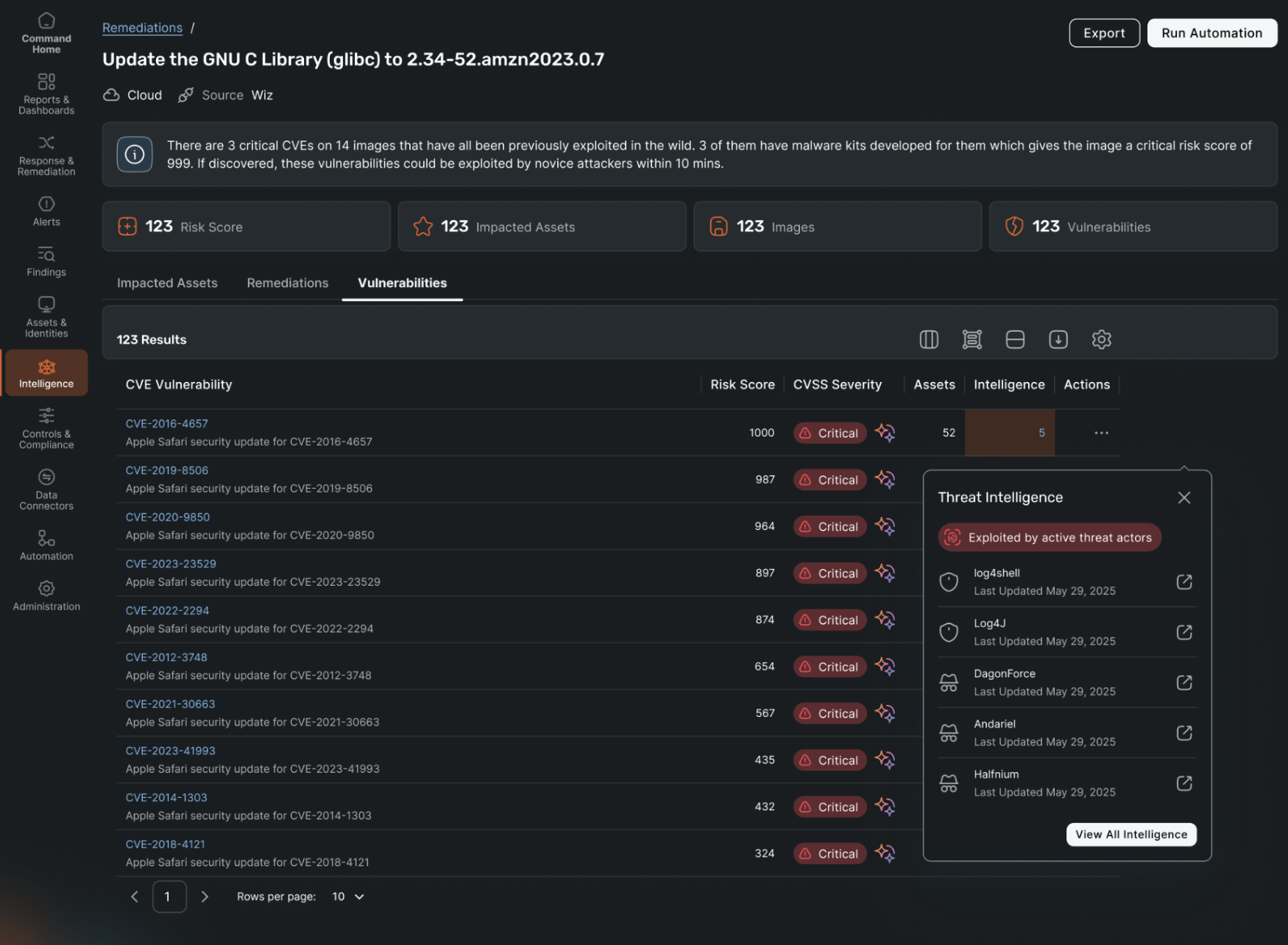
Instead of just asking how severe a vulnerability is, modern exposure management asks whether an exposure is relevant to a threat actor who is capable of exploiting it right now. By embedding threat intelligence into each vulnerability finding, teams shift the focus from theoretical to risk active exploitation. It introduces the adversary's perspective by identifying known exploited vulnerabilities, public or private exploit availability, and targeted campaigns. By filtering out exposures with no evidence of attacker interest, organizations can instantly collapse large vulnerability backlogs and focus only on relevant threats.
Rapid7-threat-intelligence-remediation-hub.png

Asset context and business criticality to define impact

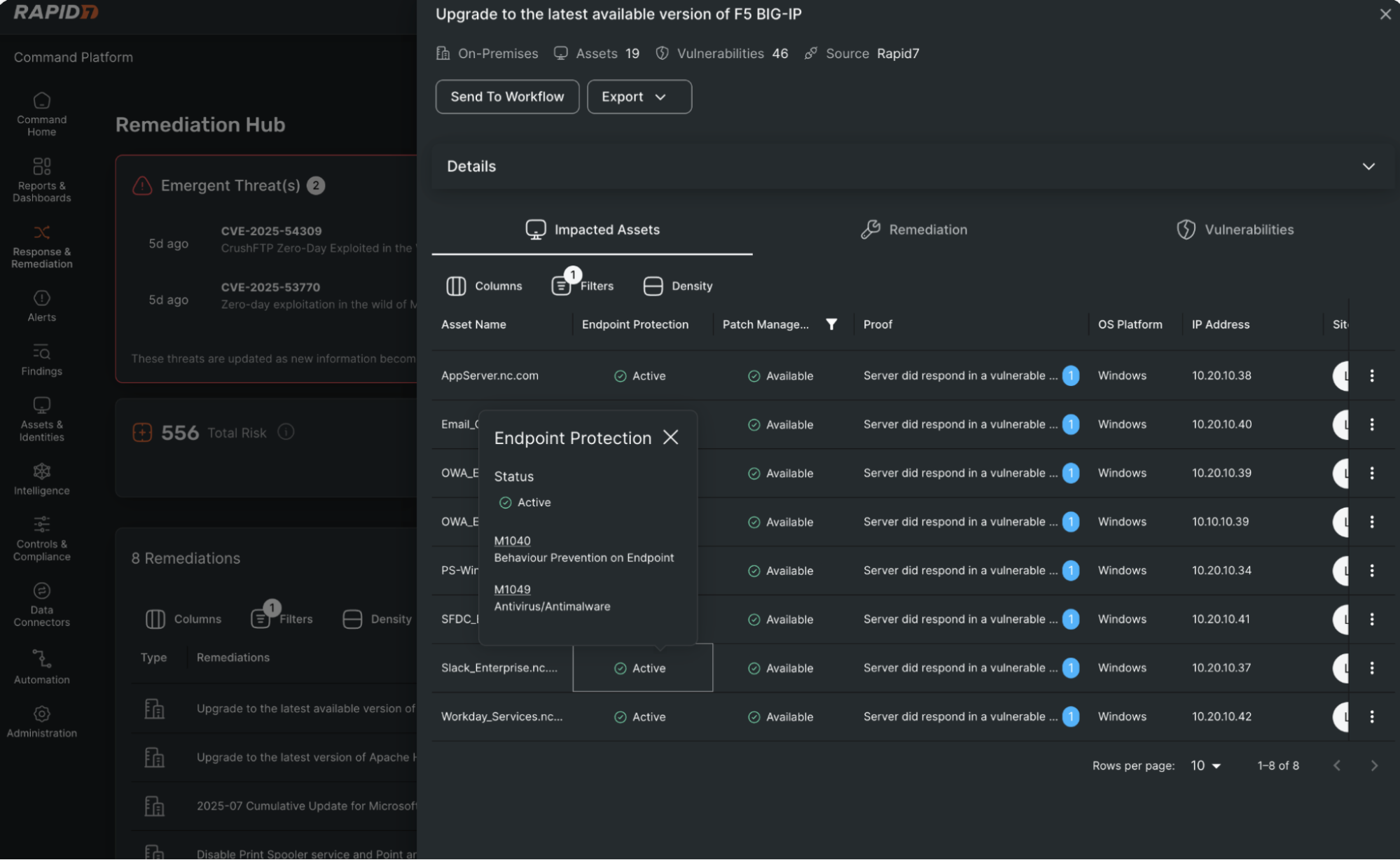
Not all assets are created equal. A critical vulnerability on an isolated, internal test server is vastly different from the same vulnerability on a public-facing cloud workload processing customer sensitive data. Asset context enriches exposure data with crucial business information: what the asset is, its external accessibility, and its relationship to core business functions. Without this context, security teams waste disproportionate effort on low-impact systems, treating every critical alert as an equal emergency.
Endpoint-protection-Rapid7-remediation-hub.png

Exploitability modeling for predicting breach likelihood

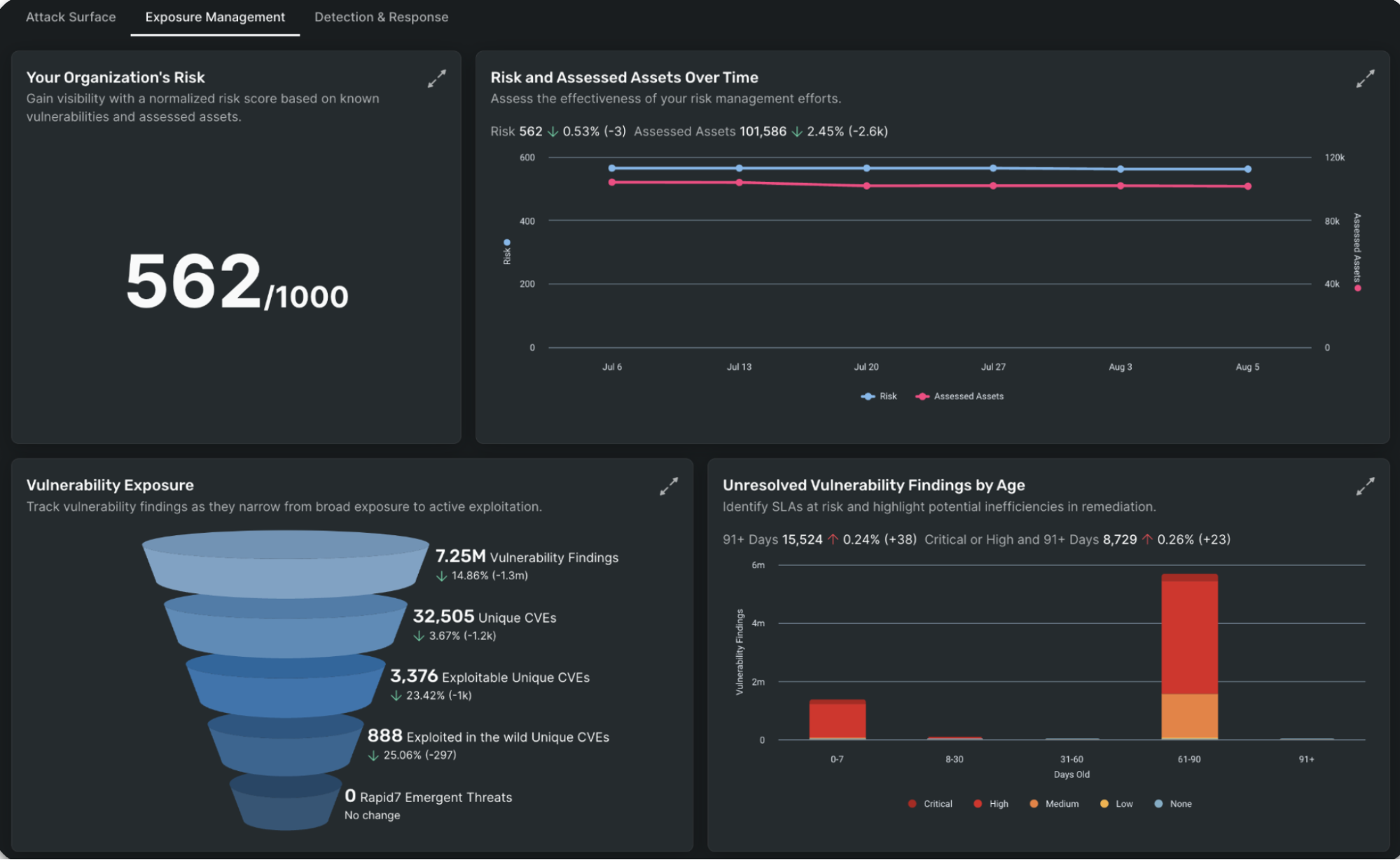
Security analysts often struggle to assess exploitability given the overwhelming volume of vulnerabilities. By using predictive models like the Exploit Prediction Scoring System (EPSS), organizations can analyze large datasets of historical exploitation to identify latent risks. Exposure assessment platforms should display this data alongside each exposure finding to make it easier to predict the vulnerabilities most likely to become attacks.
Rapid7-vulnerability-risk-score-exposure.png

Security control validation

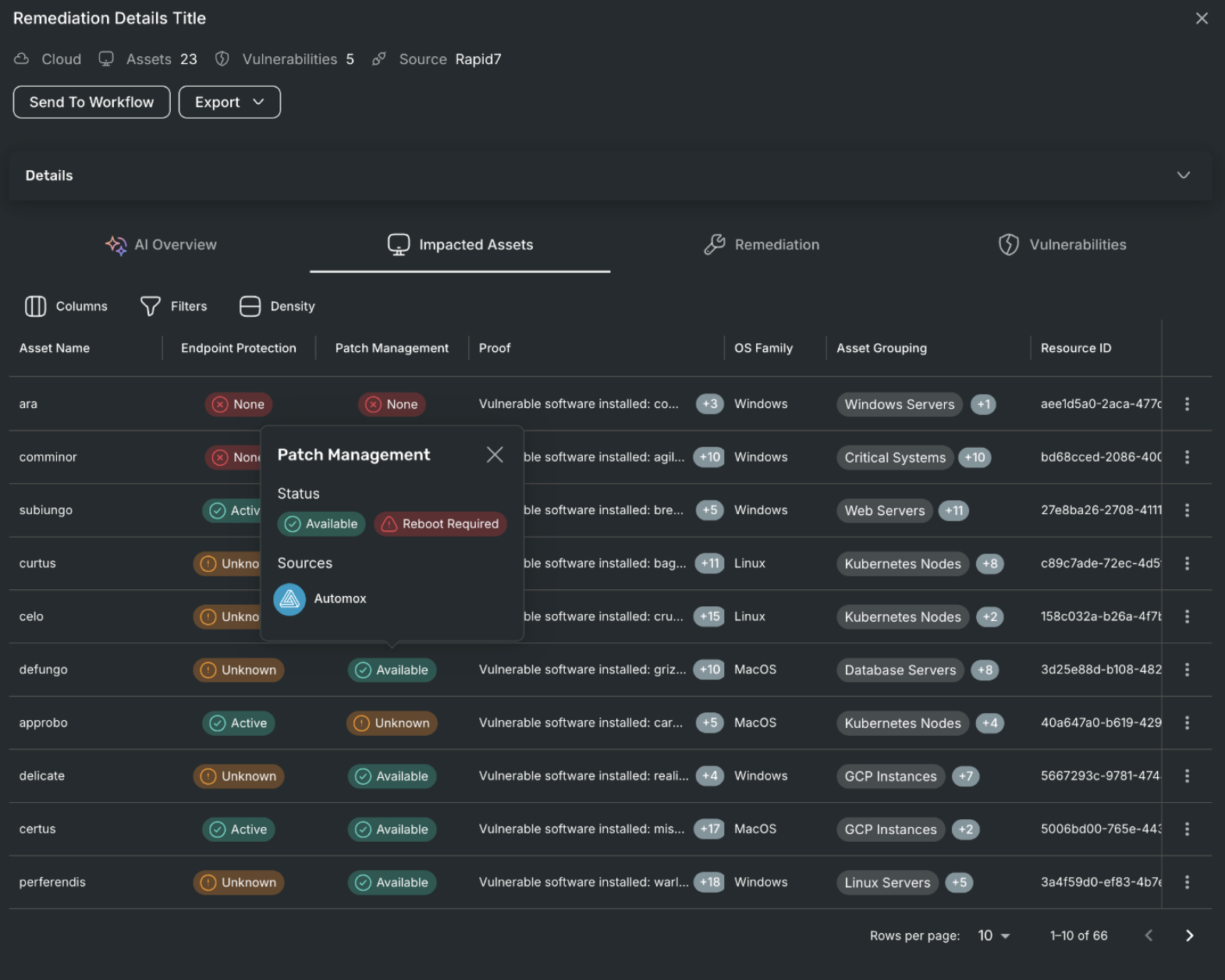
An exposure that appears highly exploitable in theory might be neutralized by existing defenses. By integrating security and policy controls, you can evaluate exposures in the context of endpoint protection and identity management. This passive validation confirms whether an attacker can realistically exploit the exposure in your specific environment.
Rapid7-remediation-details.png

Unified exposure management

Individually, each element highlighted above provides incremental value, but when integrated, they fundamentally transform how prioritization decisions are made. This integrated model ensures that remediation efforts are mobilized only after priorities have been validated in the context of the business and the current threat landscape. It transitions vulnerability management from a purely technical, tool-centric exercise into a strategic, process-driven risk decision.

Security leaders must measure success not by the sheer number of vulnerabilities closed, but by the demonstrable reduction of exploitable exposures and the alignment of remediation efforts with actual attacker behavior. Operationalizing these four elements requires a unified platform that eliminates the silos between vulnerability management, cloud security, and threat intelligence. You cannot manually stitch together disconnected spreadsheets and hope to outpace modern adversaries. This is where forward-thinking organizations are leaning on comprehensive, end-to-end solutions like Rapid7 Exposure Command that seamlessly aggregate visibility across on-premises and dynamic cloud environments. With deep, native integration of Rapid7 Cloud Security capabilities, teams can instantly map asset criticality and external accessibility within complex, ephemeral cloud architectures. Furthermore, by infusing world-class threat intelligence and active exploit data directly into exposure findings, Rapid7 enables security teams to cut through the noise, validate security controls, and pinpoint the exact exposures that matter most—all with minimal friction.

[1] Gartner, Prioritize What Attackers Will Exploit: 4 Elements of Strong Exposure Prioritization, Jonathan Nunez, 5 March 2026.