



惯性聚合 高效追踪和阅读你感兴趣的博客、新闻、科技资讯
阅读原文 在惯性聚合中打开

推荐订阅源

S
Schneier on Security
F
Fortinet All Blogs
博客园_首页
The GitHub Blog
The GitHub Blog
V
Visual Studio Blog
D
DataBreaches.Net
aimingoo的专栏
aimingoo的专栏
爱范儿
爱范儿
B
Blog
Cyber Security Advisories - MS-ISAC
N
Netflix TechBlog - Medium
阮一峰的网络日志
阮一峰的网络日志
P
Proofpoint News Feed
D
Docker
Engineering at Meta
Engineering at Meta
大猫的无限游戏
大猫的无限游戏
The Cloudflare Blog
罗磊的独立博客
云风的 BLOG
云风的 BLOG
Microsoft Azure Blog
T
The Exploit Database - CXSecurity.com
博客园 - 三生石上(FineUI控件)
量子位
The Last Watchdog
The Last Watchdog
MyScale Blog
MyScale Blog
钛媒体:引领未来商业与生活新知
钛媒体:引领未来商业与生活新知
T
The Blog of Author Tim Ferriss
Exploit-DB.com RSS Feed
小众软件
小众软件
Cloudbric
Cloudbric
博客园 - 司徒正美
H
Help Net Security
人人都是产品经理
人人都是产品经理
Application and Cybersecurity Blog
L
LangChain Blog
Latest news
Latest news
M
MIT News - Artificial intelligence
T
Threat Research - Cisco Blogs
博客园 - Franky
S
Security Affairs
W
WeLiveSecurity
F
Full Disclosure
Know Your Adversary
Know Your Adversary
Google DeepMind News
The Hacker News
The Hacker News
Cyberwarzone
Cyberwarzone
美团技术团队
PCI Perspectives
PCI Perspectives
C
Check Point Blog
Spread Privacy
Spread Privacy

Sanity.io

A Board Game agent built using Sanity Context and Vercel's AI SDK | Sanity Build a prototype with Claude Code that your whole team can edit | Sanity What’s New - May 2026 | Sanity I built a London pub guide with v0 and the Sanity MCP in six hours. Here's what I learned. | Sanity Build a conference concierge with Agent Context and Anthropic | Sanity Build a content-aware Telegram agent with Vercel AI SDK and Chat SDK | Sanity How I used Agent API to generate photos for my family’s recipes | Sanity What’s New April - 2026 | Sanity Better context, better matches: An AI love story (for dogs) | Sanity How to write for an agent | Sanity Content Agent, meet Slack: AI content operations in your workflow | Sanity Structure powers intelligence | Sanity Your agent needs better content. Here's how to give it. | Sanity How to serve content to agents (a field guide) | Sanity Sanity TypeGen GA: Automatic TypeScript types for content and GROQ | Sanity Sanity is now available on the Vercel Marketplace | Sanity The logo soup problem (and how to solve it) | Sanity Content Releases: From scattered updates to coordinated publishing | Sanity What's New - February 2026 | Sanity How we solved the agent memory problem | Sanity v0 Builder Challenge: The winners | Sanity Introducing: Sanity Agent Skills | Sanity Content Agent: Days of work in one conversation | Sanity Our Sanity Values | Sanity Open Source Pledge 2025: Stepping up when it matters | Sanity v0 builder challenge: $3000 in prizes | Sanity Why AI Breaks Without Structured Content Operations | Sanity What’s New January - 2026 | Sanity BFCM 2025: What teams built when infrastructure stopped being the problem | Sanity How AI shaped holiday shopping and what it means for content in 2026 | Sanity Sanity Studio v5: Embracing React 19 | Sanity You’ll need a CMS eventually. Let your agent set it up. | Sanity “You should never build a CMS” | Sanity AI Content Operations: A 30-Day Implementation Guide | Sanity What’s New December - 2025 | Sanity Scheduled Drafts: Stop manually publishing content at midnight | Sanity What’s New November - 2025 | Sanity Everything *[NYC] 2025 recap: A day of AI, Content Operations, and Culture | Sanity Clankers and content operations | Sanity Content Agent: AI that understands your structured content is here | Sanity Why design-driven content modeling creates technical debt, not velocity | Sanity What's New October - 2025 | Sanity From studio to inbox: How Kevin Green eliminated email campaign friction | Sanity The content editor's guide to content operations [E-commerce edition] | Sanity styled-components maintenance mode: A 40% faster fork | Sanity First attempt will be 95% garbage: A staff engineer's 6-week journey with Claude Code | Sanity Internationalization is more than translating words | Sanity What's New - September 2025 | Sanity We just deleted our 35k-member community Slack | Sanity What's New - August 2025 | Sanity The engineer's guide to content operations [E-commerce edition] | Sanity SEO for AI: Evolving from Web Pages to the Content Lake | Sanity What's New - July 2025 | Sanity Sanity Studio v4: A major version bump for a minor reason | Sanity What's New - June 2025 | Sanity Dashboard and Insights: Your New Content HQ | Sanity Canvas: AI-accelerated, context-aware, freeform authoring | Sanity Agent Actions: AI building blocks for structured content | Sanity Functions: Life beyond pressing publish | Sanity A new era for content applications with Sanity App SDK | Sanity The end of CMS era and our $85M Series C. | Sanity What's New – May 2025 | Sanity Introducing the Sanity Model Context Protocol (MCP) server | Sanity What's New – April 2025 | Sanity Pushing all the envelopes with ambitious content | Sanity Self-hosting is only free if your time is worth nothing | Sanity Content that lasts: Scaling beyond your frontend | Sanity The Live Content API is now Generally Available | Sanity The future beyond AI chat bots | Sanity Learning the new skill of working with AI | Sanity What's New - March 2025 | Sanity Give it in plain text: Making your content AI-Ready | Sanity No More 'DO NOT PUBLISH': Introducing Content Releases | Sanity React in 2025, what's next? | Sanity The final boss of front-end: block editors | Sanity Introducing Sanity for Startups | Sanity A block content editor that loves you back | Sanity A Black Friday Snooze Fest: Massive Traffic, No Drama | Sanity How to make a recipe site that scales well | Sanity The Sanity Winter Release 2024 | Sanity AVIF Arrives, Sanity’s Promise Fulfilled | Sanity Sanity joins the Open Source Pledge | Sanity Your content is now Live by default | Sanity Begin Team to Join Sanity | Sanity Sanity Digest - September '24 Edition | Sanity Sanity partners with Google. Now live on the Google Cloud Marketplace. | Sanity Sanity Digest - August ‘24 Edition | Sanity Now playing: the latest Mux Video Input plugin for Sanity | Sanity Community Digest - June ‘24 Edition | Sanity Community Digest - May ‘24 Edition | Sanity Guide to Sanity's newest product announcements | Sanity AI and Content Creation: A Leader's Guide | Sanity Of course, you should be able to type your content quickly! | Sanity New to AI Assist: translation, reference suggestions, image generation | Sanity Speak the language of your editors: Sanity Studio UI localization | Sanity Introducing the new Sanity Growth plan to serve collaborative teams | Sanity Presentation: Work faster than ever with structured content | Sanity Goodbye Feedback Frenzy, Hello Sanity Studio Comments! | Sanity Easing into the App Router with the Sanity Toolkit for Next.js | Sanity Making website updates easier with structured content | Sanity
From zero code to a live website in 7 hours (thanks, Cursor!) | Sanity
Sanita Tripane · 2025-09-04 · via Sanity.io

My day job is to find and help the Sanity team hire excellent people. I also enjoy making pottery, but as everyone who put clay in a kiln on a regular basis knows: You end up with a lot of ceramics.

So I wanted to have a website where I could display and maybe even sell my creations. And since "AI" and "vibe coding" has been on everyone's lips in this industry, I thought I could give it a try.

I went into this project with:

  • Zero experience in building anything like this
  • Zero knowledge of where to start
  • First time setting up Sanity Studio
  • First time creating a GitHub account
  • First time creating a Vercel account
  • First time using Cursor

…and somehow, after 86 messages of back-and-forth, ~100 deployments, and 7 hours of non-stop trial and error, I ended up with a live ceramics portfolio website. Still work-in-progress (like all websites are).
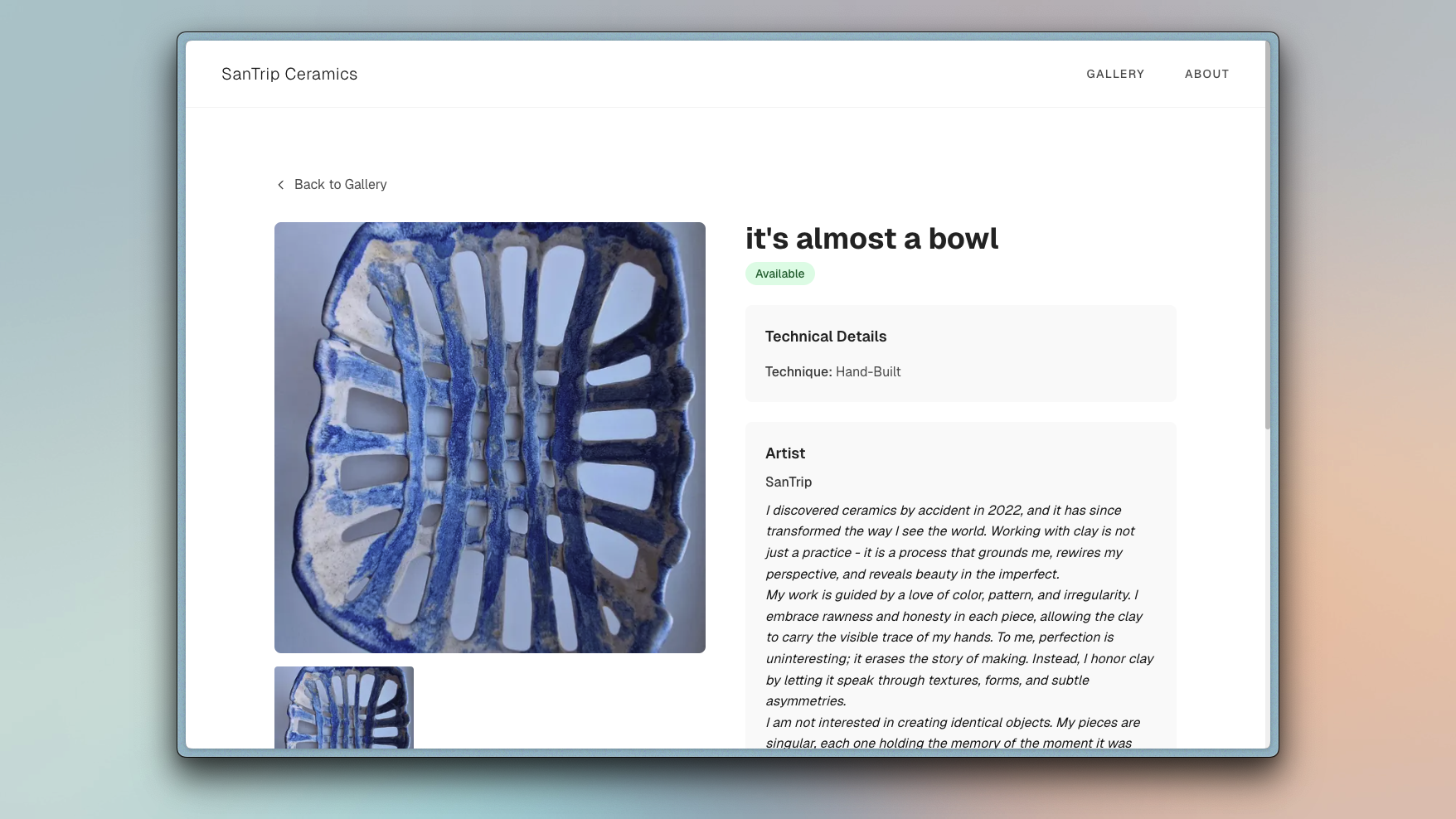
A product landing page

My starting point

I just wanted a simple place to show my ceramics. No coding background. No idea what “deploying” even meant.

The first step was installing Sanity Studio locally, where I could create and manage my content. Then deployed online with 𝗌𝖺𝗇𝗂𝗍𝗒 𝖽𝖾𝗉𝗅𝗈𝗒.

When I initially set up Sanity Studio, I created content schemas/models that define the structure of the data - essentially templates for different types of content.

My main schemas included a 𝖯𝗈𝗍𝗍𝖾𝗋𝗒 𝖯𝗂𝖾𝖼𝖾 model (with fields for title, images, description, technique, materials, price, status, etc.) and a 𝗉𝖾𝗋𝗌𝗈𝗇 model (with name, bio, and image fields for my About page), which allowed me to manage all my ceramics and personal content through the Studio interface.

Then came the realization: I have a live CMS where I can manage all the content without touching code, but a CMS is not a website. I needed a frontend.

Building the frontend

For the frontend, I chose Next.js 15 with TypeScript and Tailwind CSS. Well, Cursor suggested it, and I’d heard the combo works well, so I decided to trust the advice and go for it.

This was my first real exposure to React components, file structures, and data fetching. Using @sanity/client and GROQ queries, I connected the site to my Sanity content:

  • Gallery → dynamic pottery pieces with images and descriptions
  • About page → bio and photo, editable from the Sanity Studio
  • Footer → kept it minimal with just an Instagram link

Every piece of content came from Sanity - no static text hardcoded. This is the most meaningful decision you can make.

Deployment pipeline

The next hurdle was making the site public. That’s where GitHub and Vercel came in:

  • Push local code to GitHub
  • Vercel auto-deploys every commit
  • Domain goes live at santrip-ceramics.vercel.app

It sounds simple now, but at the time it was a lot. I hit caching issues, broken imports, and old commits redeploying, and yes, I maxed out Vercel’s daily limit of 100 deployments just trying to fix things.

My biggest struggles

  • Deployment failures: syntax errors, TypeScript issues, mismatched queries
  • GitHub confusion: didn’t realize pushing via web UI vs CLI mattered
  • File structure problems: where does a component go? Why isn’t it rendering?

More than half of my time was spent debugging. Each fix meant reading logs, Googling errors, and trying again. Cursor and I just kept going. It was so much fun. Somewhere in the digital void, Cursor and I high-fived. Victory was ours.

What helped me get through

Cursor

My code editor with AI assistance. This tool was a lifesaver. It suggested fixes, helped with imports, and explained error messages. Without Cursor, I would not be able to achieve any of this.

Persistence

Even after the 20th failed deployment, I kept going. Yes, until 4 AM. 🥱

Simplicity

Every time Cursor tried to overcomplicate things, I trusted my gut (this shouldn’t be this complicated, should it?) and pushed back. Later, when I asked Cursor to analyze what I did well, this was one of the things it called out - I trusted my gut to push back in moments when Cursor suggested overly complicated routes.

Where Cursor changed everything

Setup: Cursor explained Sanity schema errors, guided me through imports, and fixed TypeScript type issues as they happened.

Frontend: While wiring Sanity content into Next.js, Cursor auto-suggested correct GROQ queries and React component structures.

Debugging: Most of my ~100 Vercel deployment failures came down to syntax errors, typos (𝖾𝗌𝗂𝗆𝗉𝗈𝗋𝗍 instead of 𝗂𝗆𝗉𝗈𝗋𝗍 🙃), or file placement. Cursor flagged and fixed them locally before redeploying.

Workflow learning: It taught me Git basics inside the editor (why pushing commits mattered, how repo structure worked).

Design tweaks: Tailwind suggestions, component renaming, fixing CSS conflicts — all solved faster with AI assistance.

Cursor, my new friend, you are an absolutely incredible tool!

The stats

  • 86 messages
  • ~100 deployments (hit Vercel’s daily limit!)
  • 7 hours total build time
  • 4 phases: setup → debugging → design → refinements

The result

A professional, Sanity-powered, minimal ceramics portfolio website that I can update anytime without coding. You can check it out at santrip-ceramics.vercel.app.

What I learned

If I'm to sum up what I learned from this experience, it's something like this:

  • Zero experience in all of this is the exact level of experience required to achieve something great.
  • You don’t need experience to build something real.
  • You really just have to start. Confidence will come after the first few successful deployments.
  • Debugging is 60% of the work - and that’s okay. Eventually, you will fix things, and everything will work.
  • Tools like Sanity, GitHub, Vercel, and Cursor make it possible for absolute beginners to build production-ready sites fast. Incredible tools like these keep you awake at night just because you're having fun, even if you're struggling or feel like you're hitting your head against the wall - IT IS SO MUCH FUN!
  • Remember to keep Cursor prompts/goals specific (one issue at a time works best)
  • Don’t hardcode content if you’ve invested in a CMS - Sanity is the best for that (but of course)
  • Cursor + persistence = the key to success

This was my first web project, and it’s live. And I did it all in one go. If you’ve been putting off building something because you “don’t know how,” I’m proof that you can figure it out as you go.

Learning by doing

Here's the thing: I built something that works using tools I barely understand. Without Cursor, I couldn't even explain what I'd built, let alone write this post. After finishing, I had to ask Cursor to walk me through my own project: what I struggled with, which mistakes I kept making, what actually worked.

The magic? Cursor and I somehow understood each other, even when I didn't understand the tech. It translated my intentions into working code, turning "make this look nice" into proper Tailwind classes and "why won't this show up?" into fixed GROQ queries.

That's the real breakthrough here: I didn't have to learn to code first to make it happen. The tools met me where I was.

As a beginner, you can really walk continents in hours, with incredible tools like Sanity, Next.js, Vercel, GitHub, and Cursor. All I did was to take the first step.

Now it’s your turn.

---

👋 Knut from the developer education team here: if you're curious why Sanity makes AI-assisted development particularly effective: it's all code-based configuration. Schemas, workflows, and even the editorial UI are defined in TypeScript, which means AI tools can actually understand and generate the entire stack. No clicking through web UIs to configure things. Here's a course on that specific workflow if you want to go deeper.

And back to our regular programming.