


惯性聚合 高效追踪和阅读你感兴趣的博客、新闻、科技资讯
阅读原文 在惯性聚合中打开

推荐订阅源

美团技术团队
W
WeLiveSecurity
Stack Overflow Blog
Stack Overflow Blog
L
LangChain Blog
S
SegmentFault 最新的问题
Apple Machine Learning Research
Google DeepMind News
F
Full Disclosure
奇客Solidot–传递最新科技情报
奇客Solidot–传递最新科技情报
The Register - Security
G
Google Developers Blog
C
Check Point Blog
GbyAI
GbyAI
A
About on SuperTechFans
V
Vulnerabilities – Threatpost
T
The Blog of Author Tim Ferriss
T
Tor Project blog
AWS News Blog
AWS News Blog
Cyberwarzone
Cyberwarzone
C
CERT Recently Published Vulnerability Notes
MongoDB | Blog
MongoDB | Blog
Latest news
Latest news
aimingoo的专栏
aimingoo的专栏
U
Unit 42
Y
Y Combinator Blog
P
Privacy International News Feed
Cisco Talos Blog
Cisco Talos Blog
S
Securelist
S
Schneier on Security
雷峰网
雷峰网
cs.CV updates on arXiv.org
Attack and Defense Labs
P
Proofpoint News Feed
C
Cisco Blogs
Webroot Blog
Webroot Blog
T
Troy Hunt's Blog
Google Online Security Blog
月光博客
月光博客
P
Privacy & Cybersecurity Law Blog
Security Archives - TechRepublic
罗磊的独立博客
Cloudbric
Cloudbric
钛媒体:引领未来商业与生活新知
钛媒体:引领未来商业与生活新知
Recent Commits to openclaw:main
Application and Cybersecurity Blog
Hacker News: Ask HN
Hacker News: Ask HN
H
Hackread – Cybersecurity News, Data Breaches, AI and More
博客园 - 司徒正美
freeCodeCamp Programming Tutorials: Python, JavaScript, Git & More
Microsoft Security Blog

Sanity.io

A Board Game agent built using Sanity Context and Vercel's AI SDK | Sanity Build a prototype with Claude Code that your whole team can edit | Sanity What’s New - May 2026 | Sanity I built a London pub guide with v0 and the Sanity MCP in six hours. Here's what I learned. | Sanity Build a conference concierge with Agent Context and Anthropic | Sanity Build a content-aware Telegram agent with Vercel AI SDK and Chat SDK | Sanity How I used Agent API to generate photos for my family’s recipes | Sanity What’s New April - 2026 | Sanity Better context, better matches: An AI love story (for dogs) | Sanity How to write for an agent | Sanity Content Agent, meet Slack: AI content operations in your workflow | Sanity Structure powers intelligence | Sanity Your agent needs better content. Here's how to give it. | Sanity How to serve content to agents (a field guide) | Sanity Sanity TypeGen GA: Automatic TypeScript types for content and GROQ | Sanity Sanity is now available on the Vercel Marketplace | Sanity The logo soup problem (and how to solve it) | Sanity Content Releases: From scattered updates to coordinated publishing | Sanity What's New - February 2026 | Sanity How we solved the agent memory problem | Sanity v0 Builder Challenge: The winners | Sanity Introducing: Sanity Agent Skills | Sanity Content Agent: Days of work in one conversation | Sanity Our Sanity Values | Sanity Open Source Pledge 2025: Stepping up when it matters | Sanity v0 builder challenge: $3000 in prizes | Sanity Why AI Breaks Without Structured Content Operations | Sanity What’s New January - 2026 | Sanity BFCM 2025: What teams built when infrastructure stopped being the problem | Sanity How AI shaped holiday shopping and what it means for content in 2026 | Sanity Sanity Studio v5: Embracing React 19 | Sanity You’ll need a CMS eventually. Let your agent set it up. | Sanity “You should never build a CMS” | Sanity AI Content Operations: A 30-Day Implementation Guide | Sanity What’s New December - 2025 | Sanity Scheduled Drafts: Stop manually publishing content at midnight | Sanity What’s New November - 2025 | Sanity Everything *[NYC] 2025 recap: A day of AI, Content Operations, and Culture | Sanity Clankers and content operations | Sanity Content Agent: AI that understands your structured content is here | Sanity Why design-driven content modeling creates technical debt, not velocity | Sanity What's New October - 2025 | Sanity From studio to inbox: How Kevin Green eliminated email campaign friction | Sanity The content editor's guide to content operations [E-commerce edition] | Sanity styled-components maintenance mode: A 40% faster fork | Sanity From zero code to a live website in 7 hours (thanks, Cursor!) | Sanity First attempt will be 95% garbage: A staff engineer's 6-week journey with Claude Code | Sanity Internationalization is more than translating words | Sanity What's New - September 2025 | Sanity We just deleted our 35k-member community Slack | Sanity What's New - August 2025 | Sanity The engineer's guide to content operations [E-commerce edition] | Sanity SEO for AI: Evolving from Web Pages to the Content Lake | Sanity What's New - July 2025 | Sanity Sanity Studio v4: A major version bump for a minor reason | Sanity What's New - June 2025 | Sanity Dashboard and Insights: Your New Content HQ | Sanity Canvas: AI-accelerated, context-aware, freeform authoring | Sanity Agent Actions: AI building blocks for structured content | Sanity Functions: Life beyond pressing publish | Sanity A new era for content applications with Sanity App SDK | Sanity The end of CMS era and our $85M Series C. | Sanity What's New – May 2025 | Sanity Introducing the Sanity Model Context Protocol (MCP) server | Sanity What's New – April 2025 | Sanity Pushing all the envelopes with ambitious content | Sanity Self-hosting is only free if your time is worth nothing | Sanity Content that lasts: Scaling beyond your frontend | Sanity The Live Content API is now Generally Available | Sanity The future beyond AI chat bots | Sanity Learning the new skill of working with AI | Sanity What's New - March 2025 | Sanity Give it in plain text: Making your content AI-Ready | Sanity No More 'DO NOT PUBLISH': Introducing Content Releases | Sanity React in 2025, what's next? | Sanity The final boss of front-end: block editors | Sanity Introducing Sanity for Startups | Sanity A block content editor that loves you back | Sanity A Black Friday Snooze Fest: Massive Traffic, No Drama | Sanity How to make a recipe site that scales well | Sanity The Sanity Winter Release 2024 | Sanity AVIF Arrives, Sanity’s Promise Fulfilled | Sanity Sanity joins the Open Source Pledge | Sanity Your content is now Live by default | Sanity Begin Team to Join Sanity | Sanity Sanity Digest - September '24 Edition | Sanity Sanity partners with Google. Now live on the Google Cloud Marketplace. | Sanity Sanity Digest - August ‘24 Edition | Sanity Now playing: the latest Mux Video Input plugin for Sanity | Sanity Community Digest - June ‘24 Edition | Sanity Community Digest - May ‘24 Edition | Sanity Guide to Sanity's newest product announcements | Sanity AI and Content Creation: A Leader's Guide | Sanity Of course, you should be able to type your content quickly! | Sanity New to AI Assist: translation, reference suggestions, image generation | Sanity Speak the language of your editors: Sanity Studio UI localization | Sanity Introducing the new Sanity Growth plan to serve collaborative teams | Sanity Presentation: Work faster than ever with structured content | Sanity Goodbye Feedback Frenzy, Hello Sanity Studio Comments! | Sanity Easing into the App Router with the Sanity Toolkit for Next.js | Sanity
How we manage community support with Sanity | Sanity
Peter Hofstee · 2020-04-27 · via Sanity.io

Today we are making our community management studio and Slack integration publicly available. It has become an essential tool for how we manage all the questions raised in the community Slack. We wanted to share it with you for inspiration, and use it as an occasion to talk about how we approach community, and how we use Sanity to build Sanity.

Get the code on GitHub!

The Sanity community

One of the best things about building Sanity.io is to get to be a part of the delightful community. Currently, we are over 3.000 members in the community Slack workspace. It’s the place where we ask questions, share our experiences, everything from particular framework integration to content modeling insights. When someone launches a new project, or perhaps a new plugin, they present it in #i-made-this, and we get to write about it in the weekly community digest. We also get significant input on feature requests, suggestions, bug reports, and all those things that make it possible for us to build stuff that people need.
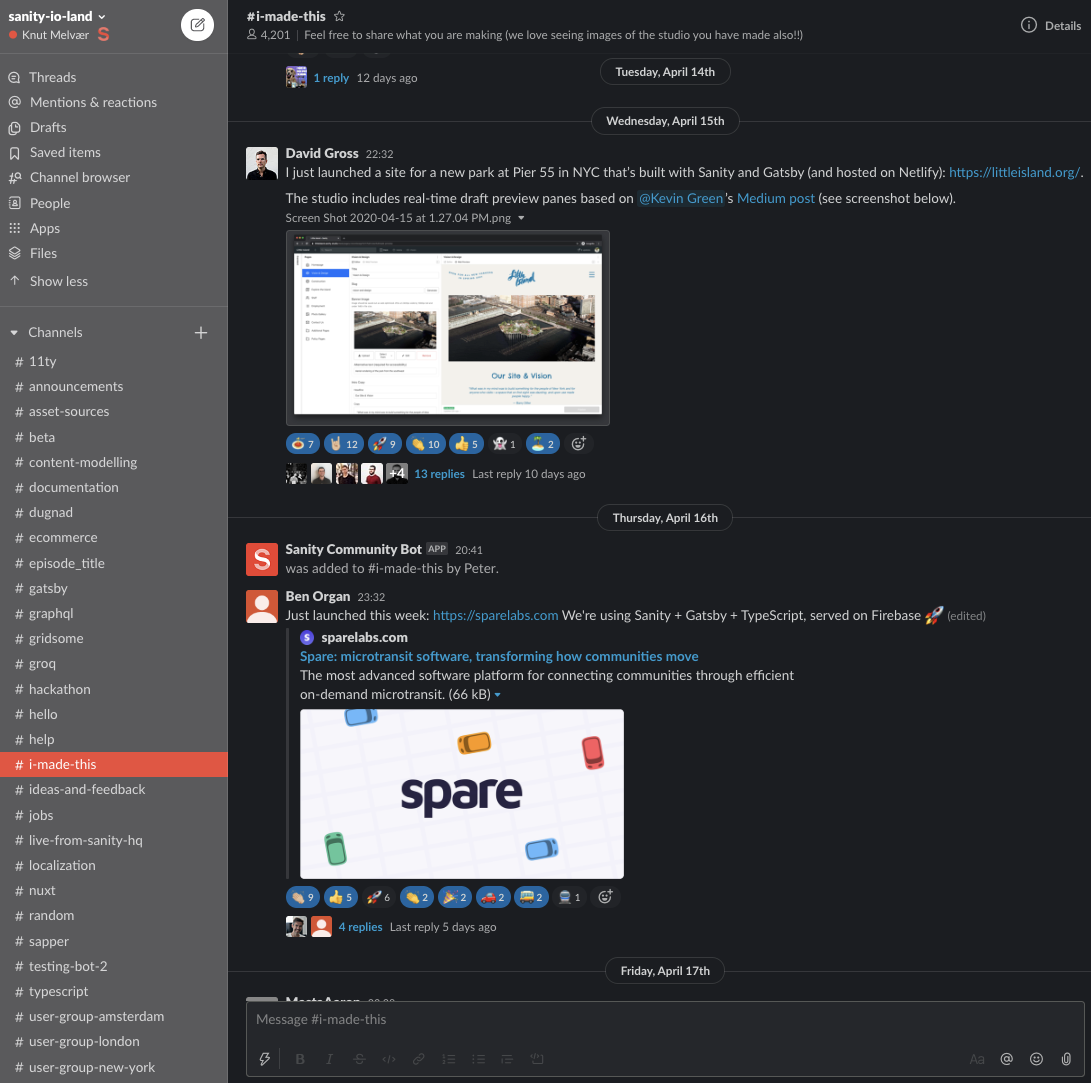
The #i-made-this channel in the community Slack

Making sure that you get great help in an environment that is tolerant of different experience levels and backgrounds are important. We're not just saying that because it sounds good, it‘s something we prioritize and have in our goals. Community experience is a core part of the platform we‘re building.

Growing pains

It becomes more challenging to stay on top of everything that goes on as the community grows, especially of all the questions that people have. And although people help each other, we, as the team at Sanity HQ, are also there to shed light on things.

Back before we launched the Slack workspace in 2018, we looked into all the available options at the time and landed on Slack as where we wanted to start. They all had pros and cons, and at the time, Slack was the one that made the most sense for us.

We have a free Slack workspace, and naturally, that comes with some constraints. The main one being message retention, which pushes “old” messages out of history. That is particularly painful when it comes to doing support and knowledge sharing because stuff disappears. We wanted to remedy that, as well as having a sensible approach to keep track of conversations and get a proper signal that we could use to analyze the feedback and engagement people have.

The off-the-shelf solution

Last fall, we tested out an off-the-shelf support solution for Slack that made it possible for us to register messages as tickets and store the conversation afterward. It wasn’t built for our use in a community (but customer support situation). It created a lot of additional messages and notifications, which burned up the retention rate even faster. So we figured out it wasn't for us.
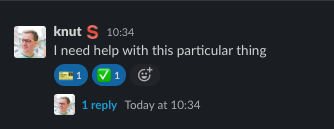
The emoji reactions that creates and resolves a ticket

Dogfooding in the mountains

At the all-hands gathering at Kvitfjell in January 2020, the team got a day for dogfooding. The task was to build useful internal tooling with Sanity. One of the groups decided to recreate the slack bot and leave out the parts we didn't like. In less than a day, the Minimal Delightful Product was up and running with capabilities like registering and resolving with emoji reactions from the Sanity team. They also set up a custom ticket board in the studio with a comprehensive overview with different filters and orderings.

We tested the implementation for our dedicated customer support channels, and it seemed to work great.

The custom ticket board in Sanity Studio
The custom ticket board

Bringing the Sanity-powered bot to the community

It was pretty clear to us that we wanted to bring this app to the community and replace it with the solution that was costing us hundreds of dollars each month. Our system would also allow us to customize further and add features as needed, as well as give us proper queryable data for insights.

We added some more features, like support for keeping track of threads, custom desk structure with personalized views, and Single-Sign-On for all Sanity team members. Now we want to continue developing it in the open.

Tickets by tag in the community studio

The value of structured content

We think this is a perfect example of why Sanity and structured content isn‘t just for your websites. It can also be the operational content that flows through your organization. We now own our community content. It‘s ready to go when we need it to do more or want to innovate with new efforts.

The community studio is at the moment mostly tied to the Slack functionality, but nothing keeps us from expanding it to holding other community-related content too. We hope you'll take a look at it and be inspired to make useful tools also. And of course, when you do, let us know in #i-made-this!