
惯性聚合 高效追踪和阅读你感兴趣的博客、新闻、科技资讯
阅读原文 在惯性聚合中打开

推荐订阅源

Engineering at Meta
Engineering at Meta
T
Threatpost
P
Palo Alto Networks Blog
NISL@THU
NISL@THU
O
OpenAI News
Project Zero
Project Zero
G
GRAHAM CLULEY
P
Privacy International News Feed
A
Arctic Wolf
Microsoft Azure Blog
H
Help Net Security
M
MIT News - Artificial intelligence
T
Threat Research - Cisco Blogs
S
Security @ Cisco Blogs
Google DeepMind News
B
Blog RSS Feed
D
Docker
aimingoo的专栏
aimingoo的专栏
博客园 - 【当耐特】
N
Netflix TechBlog - Medium
云风的 BLOG
云风的 BLOG
雷峰网
雷峰网
W
WeLiveSecurity
P
Proofpoint News Feed
腾讯CDC
Cloudbric
Cloudbric
S
Secure Thoughts
C
Check Point Blog
博客园 - Franky
T
The Exploit Database - CXSecurity.com
T
Troy Hunt's Blog
GbyAI
GbyAI
Security Archives - TechRepublic
Application and Cybersecurity Blog
月光博客
月光博客
C
Cyber Attacks, Cyber Crime and Cyber Security
I
Intezer
TaoSecurity Blog
TaoSecurity Blog
L
Lohrmann on Cybersecurity
V
Visual Studio Blog
F
Fortinet All Blogs
博客园 - 叶小钗
C
CXSECURITY Database RSS Feed - CXSecurity.com
CTFtime.org: upcoming CTF events
Recorded Future
Recorded Future
C
Cisco Blogs
博客园 - 司徒正美
Stack Overflow Blog
Stack Overflow Blog
Y
Y Combinator Blog
Apple Machine Learning Research

Sanity.io

A Board Game agent built using Sanity Context and Vercel's AI SDK | Sanity Build a prototype with Claude Code that your whole team can edit | Sanity What’s New - May 2026 | Sanity I built a London pub guide with v0 and the Sanity MCP in six hours. Here's what I learned. | Sanity Build a conference concierge with Agent Context and Anthropic | Sanity Build a content-aware Telegram agent with Vercel AI SDK and Chat SDK | Sanity How I used Agent API to generate photos for my family’s recipes | Sanity What’s New April - 2026 | Sanity Better context, better matches: An AI love story (for dogs) | Sanity How to write for an agent | Sanity Content Agent, meet Slack: AI content operations in your workflow | Sanity Structure powers intelligence | Sanity Your agent needs better content. Here's how to give it. | Sanity How to serve content to agents (a field guide) | Sanity Sanity TypeGen GA: Automatic TypeScript types for content and GROQ | Sanity Sanity is now available on the Vercel Marketplace | Sanity The logo soup problem (and how to solve it) | Sanity Content Releases: From scattered updates to coordinated publishing | Sanity What's New - February 2026 | Sanity How we solved the agent memory problem | Sanity v0 Builder Challenge: The winners | Sanity Introducing: Sanity Agent Skills | Sanity Content Agent: Days of work in one conversation | Sanity Our Sanity Values | Sanity Open Source Pledge 2025: Stepping up when it matters | Sanity v0 builder challenge: $3000 in prizes | Sanity Why AI Breaks Without Structured Content Operations | Sanity What’s New January - 2026 | Sanity BFCM 2025: What teams built when infrastructure stopped being the problem | Sanity How AI shaped holiday shopping and what it means for content in 2026 | Sanity Sanity Studio v5: Embracing React 19 | Sanity You’ll need a CMS eventually. Let your agent set it up. | Sanity “You should never build a CMS” | Sanity AI Content Operations: A 30-Day Implementation Guide | Sanity What’s New December - 2025 | Sanity Scheduled Drafts: Stop manually publishing content at midnight | Sanity What’s New November - 2025 | Sanity Everything *[NYC] 2025 recap: A day of AI, Content Operations, and Culture | Sanity Clankers and content operations | Sanity Content Agent: AI that understands your structured content is here | Sanity Why design-driven content modeling creates technical debt, not velocity | Sanity What's New October - 2025 | Sanity From studio to inbox: How Kevin Green eliminated email campaign friction | Sanity The content editor's guide to content operations [E-commerce edition] | Sanity styled-components maintenance mode: A 40% faster fork | Sanity From zero code to a live website in 7 hours (thanks, Cursor!) | Sanity First attempt will be 95% garbage: A staff engineer's 6-week journey with Claude Code | Sanity Internationalization is more than translating words | Sanity What's New - September 2025 | Sanity We just deleted our 35k-member community Slack | Sanity What's New - August 2025 | Sanity The engineer's guide to content operations [E-commerce edition] | Sanity SEO for AI: Evolving from Web Pages to the Content Lake | Sanity What's New - July 2025 | Sanity Sanity Studio v4: A major version bump for a minor reason | Sanity What's New - June 2025 | Sanity Dashboard and Insights: Your New Content HQ | Sanity Canvas: AI-accelerated, context-aware, freeform authoring | Sanity Agent Actions: AI building blocks for structured content | Sanity Functions: Life beyond pressing publish | Sanity A new era for content applications with Sanity App SDK | Sanity The end of CMS era and our $85M Series C. | Sanity What's New – May 2025 | Sanity Introducing the Sanity Model Context Protocol (MCP) server | Sanity What's New – April 2025 | Sanity Pushing all the envelopes with ambitious content | Sanity Self-hosting is only free if your time is worth nothing | Sanity Content that lasts: Scaling beyond your frontend | Sanity The Live Content API is now Generally Available | Sanity The future beyond AI chat bots | Sanity Learning the new skill of working with AI | Sanity What's New - March 2025 | Sanity Give it in plain text: Making your content AI-Ready | Sanity No More 'DO NOT PUBLISH': Introducing Content Releases | Sanity React in 2025, what's next? | Sanity The final boss of front-end: block editors | Sanity Introducing Sanity for Startups | Sanity A Black Friday Snooze Fest: Massive Traffic, No Drama | Sanity How to make a recipe site that scales well | Sanity The Sanity Winter Release 2024 | Sanity AVIF Arrives, Sanity’s Promise Fulfilled | Sanity Sanity joins the Open Source Pledge | Sanity Your content is now Live by default | Sanity Begin Team to Join Sanity | Sanity Sanity Digest - September '24 Edition | Sanity Sanity partners with Google. Now live on the Google Cloud Marketplace. | Sanity Sanity Digest - August ‘24 Edition | Sanity Now playing: the latest Mux Video Input plugin for Sanity | Sanity Community Digest - June ‘24 Edition | Sanity Community Digest - May ‘24 Edition | Sanity Guide to Sanity's newest product announcements | Sanity AI and Content Creation: A Leader's Guide | Sanity Of course, you should be able to type your content quickly! | Sanity New to AI Assist: translation, reference suggestions, image generation | Sanity Speak the language of your editors: Sanity Studio UI localization | Sanity Introducing the new Sanity Growth plan to serve collaborative teams | Sanity Presentation: Work faster than ever with structured content | Sanity Goodbye Feedback Frenzy, Hello Sanity Studio Comments! | Sanity Easing into the App Router with the Sanity Toolkit for Next.js | Sanity Making website updates easier with structured content | Sanity
A block content editor that loves you back | Sanity
Mark Michon · 2024-12-19 · via Sanity.io

Ever spent hours wrangling a WYSIWYG editor that just doesn’t get you?

Building rich text editors is notoriously hard—especially when they need to support real-time collaboration, AI integrations, and massive documents while performing smoothly across browsers, devices, and locales.

Sanity Studio has always shipped with the Portable Text Editor, built on top of Slate.js, to let thousands of creators author structured, presentation-agnostic block content. But producing customizable data wasn’t enough—we also needed a format that avoids storing HTML strings while being easy to render across apps, websites, or even print.

Enter Portable Text: an open-source, JSON-based specification for block content. It works seamlessly with modern frameworks by letting you map content as data to components, thus eliminating awkward HTML injections and giving you full control over your content structure. In other words, it never makes you do silly things like passing a string of HTML into dangerouslySetInnerHTML.

Until now, Portable Text authoring has only been possible inside Sanity Studio. That changes today. The standalone Portable Text Editor is here, ready to integrate into any React-based project. In fact, we have been using the standalone Portable Text Editor extensively to create Sanity Create, your new free-form content authoring tool.

We’ve also included the beta of the Behavior API, which lets you hook into editor events and customize its… well, behavior. It’s powerful. It’s flexible. And you can start exploring it right now on the new documentation site on portabletext.org.

Keep reading to see what it can do—or dive into the docs and start building!

The standalone Portable Text Editor

The standalone Portable Text Editor is a React-based customizable block content editor that you can now use independently of Sanity Studio, enabling you to integrate rich text and block content authoring capabilities into any application that supports React components.

Install @portabletext/editor and compose your editor exactly how you need it. Here is a minimal example:

At a high level, the editor consists of these parts:

  • <EditorProvider /> that takes a schema for your rich text and blocks content
  • <EditorEventListener /> that lets you access the editor's state
  • <PortableTextEditable /> provides the area that you can type into

In addition to this, the package gives you hooks that you can use to access its state:

Below is an example to make a toolbar for decorators (for example, strong and emphasis):
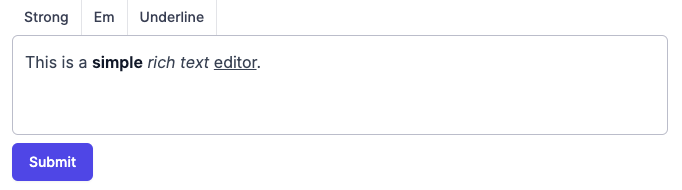
A screenshot of a simple rich text editor interface. The text input area contains the sentence: “This is a simple rich text editor.” where “simple” is bold, “rich” is italicized, and “editor” is underlined. Above the text input are formatting options labeled Strong, Em, and Underline for bold, italic, and underline styling, respectively. Below the input area, there is a purple Submit button.
Add a bit of styling and you can have a rich text editor like this

Adding affordances for rich text formatting is a must. Where the Portable Text Editor shines is its flexibility in defining how it works with the new Behavior API.

Behavior API: Custom shortcuts, bespoke editing maneuvers, and precise paste handling

The Portable Text Editor also has a new Behavior API, currently in beta. It allows you to customize the editor's behavior to fit your specific use cases. This could include things like:

  • Defining custom keyboard shortcuts
  • Handling paste events to support pasting HTML, Markdown, or other formats
  • Add affordances like slash-commands, :emoji: shortcuts, and auto-completion of brackets

Below is an example of a behavior that auto-closes parenthesis and places your cursor in-between, like you are used to from code editors:

The Behavior API treats the editor like a state machine. You'll recognize the patterns if you are familiar with the XState APIs.

We're excited about the new Behavior API's possibilities for tailoring the editor experience to your needs. While the API is currently in beta, we look forward to stabilizing it and leveraging it to enable even more powerful customization options for the Portable Text Editor for the Sanity Studio.

Gherkin and Racejar: Testing suite for the Portable Text Editor

Content editing reliability is no joke. Few things are more infuriating than a text editing interface that doesn't quite work how you expected or just fails you. That's why we have invested heavily in an extensive testing suite for the Portable Text Editor to ensure a reliable and consistent editing experience.

Our testing approach leverages the Gherkin syntax, a human-readable language for specifying test scenarios. To make it easier to set up these tests with modern web tooling, we developed Racejar, a powerful testing tool that allows us to define and run end-to-end tests for the editor with libraries like Jest and Vitest.

This combination enables us to:

  • Write test scenarios in plain English that are easy to understand and maintain
  • Automatically generate a comprehensive set of test cases from these scenarios
  • Run the tests against the editor to verify its behavior and catch any regressions

By continuously running this test suite, we can ensure that the Portable Text Editor delivers a rock-solid editing experience across various use cases, input methods, and edge cases. You can have confidence that the editor will work as expected, allowing you to focus on building great content-driven experiences.

The test for making sure that collaborative editing and undo/redo actions work as expected looks like this:

The Road Ahead: Bringing It All Back Home

With the standalone Portable Text Editor now available, we're curious to see what you build with it. And we're excited about bringing these innovations—including the new Behavior API and enhanced customization options—back to Sanity Studio in upcoming releases. Whether you're using the standalone editor in your React applications or working with the full power of Studio, our goal remains the same: making structured content editing more powerful and enjoyable. Try it out at portabletext.org, and let us know what you think!