
惯性聚合 高效追踪和阅读你感兴趣的博客、新闻、科技资讯
阅读原文 在惯性聚合中打开

推荐订阅源

H
Heimdal Security Blog
P
Privacy International News Feed
S
Schneier on Security
P
Proofpoint News Feed
L
Lohrmann on Cybersecurity
Spread Privacy
Spread Privacy
P
Privacy & Cybersecurity Law Blog
D
Darknet – Hacking Tools, Hacker News & Cyber Security
Scott Helme
Scott Helme
K
Kaspersky official blog
大猫的无限游戏
大猫的无限游戏
freeCodeCamp Programming Tutorials: Python, JavaScript, Git & More
aimingoo的专栏
aimingoo的专栏
Simon Willison's Weblog
S
Securelist
Help Net Security
Help Net Security
B
Blog
H
Hackread – Cybersecurity News, Data Breaches, AI and More
Security Archives - TechRepublic
云风的 BLOG
云风的 BLOG
The GitHub Blog
The GitHub Blog
N
News and Events Feed by Topic
Hacker News: Ask HN
Hacker News: Ask HN
cs.CV updates on arXiv.org
CTFtime.org: upcoming CTF events
M
MIT News - Artificial intelligence
雷峰网
雷峰网
博客园 - 司徒正美
V
V2EX
AWS News Blog
AWS News Blog
Know Your Adversary
Know Your Adversary
N
News | PayPal Newsroom
T
Tor Project blog
Cisco Talos Blog
Cisco Talos Blog
OSCHINA 社区最新新闻
OSCHINA 社区最新新闻
PCI Perspectives
PCI Perspectives
Google DeepMind News
Threat Intelligence Blog | Flashpoint
U
Unit 42
C
Cybersecurity and Infrastructure Security Agency CISA
P
Palo Alto Networks Blog
G
Google Developers Blog
T
Threat Research - Cisco Blogs
博客园 - Franky
I
InfoQ
D
DataBreaches.Net
爱范儿
爱范儿
Y
Y Combinator Blog
博客园 - 叶小钗
奇客Solidot–传递最新科技情报
奇客Solidot–传递最新科技情报

Sanity.io

A Board Game agent built using Sanity Context and Vercel's AI SDK | Sanity Build a prototype with Claude Code that your whole team can edit | Sanity What’s New - May 2026 | Sanity I built a London pub guide with v0 and the Sanity MCP in six hours. Here's what I learned. | Sanity Build a conference concierge with Agent Context and Anthropic | Sanity Build a content-aware Telegram agent with Vercel AI SDK and Chat SDK | Sanity How I used Agent API to generate photos for my family’s recipes | Sanity What’s New April - 2026 | Sanity Better context, better matches: An AI love story (for dogs) | Sanity How to write for an agent | Sanity Content Agent, meet Slack: AI content operations in your workflow | Sanity Structure powers intelligence | Sanity Your agent needs better content. Here's how to give it. | Sanity How to serve content to agents (a field guide) | Sanity Sanity TypeGen GA: Automatic TypeScript types for content and GROQ | Sanity Sanity is now available on the Vercel Marketplace | Sanity The logo soup problem (and how to solve it) | Sanity Content Releases: From scattered updates to coordinated publishing | Sanity What's New - February 2026 | Sanity How we solved the agent memory problem | Sanity v0 Builder Challenge: The winners | Sanity Introducing: Sanity Agent Skills | Sanity Content Agent: Days of work in one conversation | Sanity Our Sanity Values | Sanity Open Source Pledge 2025: Stepping up when it matters | Sanity v0 builder challenge: $3000 in prizes | Sanity Why AI Breaks Without Structured Content Operations | Sanity What’s New January - 2026 | Sanity BFCM 2025: What teams built when infrastructure stopped being the problem | Sanity How AI shaped holiday shopping and what it means for content in 2026 | Sanity Sanity Studio v5: Embracing React 19 | Sanity You’ll need a CMS eventually. Let your agent set it up. | Sanity “You should never build a CMS” | Sanity AI Content Operations: A 30-Day Implementation Guide | Sanity What’s New December - 2025 | Sanity Scheduled Drafts: Stop manually publishing content at midnight | Sanity What’s New November - 2025 | Sanity Everything *[NYC] 2025 recap: A day of AI, Content Operations, and Culture | Sanity Clankers and content operations | Sanity Content Agent: AI that understands your structured content is here | Sanity Why design-driven content modeling creates technical debt, not velocity | Sanity What's New October - 2025 | Sanity From studio to inbox: How Kevin Green eliminated email campaign friction | Sanity The content editor's guide to content operations [E-commerce edition] | Sanity styled-components maintenance mode: A 40% faster fork | Sanity From zero code to a live website in 7 hours (thanks, Cursor!) | Sanity First attempt will be 95% garbage: A staff engineer's 6-week journey with Claude Code | Sanity Internationalization is more than translating words | Sanity What's New - September 2025 | Sanity We just deleted our 35k-member community Slack | Sanity What's New - August 2025 | Sanity The engineer's guide to content operations [E-commerce edition] | Sanity SEO for AI: Evolving from Web Pages to the Content Lake | Sanity What's New - July 2025 | Sanity Sanity Studio v4: A major version bump for a minor reason | Sanity What's New - June 2025 | Sanity Dashboard and Insights: Your New Content HQ | Sanity Canvas: AI-accelerated, context-aware, freeform authoring | Sanity Agent Actions: AI building blocks for structured content | Sanity Functions: Life beyond pressing publish | Sanity A new era for content applications with Sanity App SDK | Sanity The end of CMS era and our $85M Series C. | Sanity What's New – May 2025 | Sanity Introducing the Sanity Model Context Protocol (MCP) server | Sanity What's New – April 2025 | Sanity Pushing all the envelopes with ambitious content | Sanity Self-hosting is only free if your time is worth nothing | Sanity Content that lasts: Scaling beyond your frontend | Sanity The Live Content API is now Generally Available | Sanity The future beyond AI chat bots | Sanity Learning the new skill of working with AI | Sanity What's New - March 2025 | Sanity Give it in plain text: Making your content AI-Ready | Sanity No More 'DO NOT PUBLISH': Introducing Content Releases | Sanity React in 2025, what's next? | Sanity The final boss of front-end: block editors | Sanity Introducing Sanity for Startups | Sanity A block content editor that loves you back | Sanity A Black Friday Snooze Fest: Massive Traffic, No Drama | Sanity How to make a recipe site that scales well | Sanity The Sanity Winter Release 2024 | Sanity AVIF Arrives, Sanity’s Promise Fulfilled | Sanity Sanity joins the Open Source Pledge | Sanity Your content is now Live by default | Sanity Begin Team to Join Sanity | Sanity Sanity Digest - September '24 Edition | Sanity Sanity partners with Google. Now live on the Google Cloud Marketplace. | Sanity Sanity Digest - August ‘24 Edition | Sanity Now playing: the latest Mux Video Input plugin for Sanity | Sanity Community Digest - June ‘24 Edition | Sanity Community Digest - May ‘24 Edition | Sanity Guide to Sanity's newest product announcements | Sanity AI and Content Creation: A Leader's Guide | Sanity Of course, you should be able to type your content quickly! | Sanity New to AI Assist: translation, reference suggestions, image generation | Sanity Speak the language of your editors: Sanity Studio UI localization | Sanity Introducing the new Sanity Growth plan to serve collaborative teams | Sanity Presentation: Work faster than ever with structured content | Sanity Goodbye Feedback Frenzy, Hello Sanity Studio Comments! | Sanity Easing into the App Router with the Sanity Toolkit for Next.js | Sanity
Blazing fast development with Gatsby and Sanity.io | Sanity
Knut Melvær · 2019-01-17 · via Sanity.io

We would prefer everything to be real-time. So we built the Sanity studio and backend from the ground up to enable real-time collaboration, and made sure there were real time-client APIs from day one. We always wanted Sanity front-ends to also reflect content changes in real-time, we just didn't know of a cost effective way to accomplish this for everyday needs.

Then someone showed us Gatsby Preview. A general way to get real-time preview that did not involve a great deal of custom plumbing! Our new Sanity Gatsby Source Plugin uses the Sanity real-time API to instantly rebuild when content changes. When developing this means a group of people can freely work together on content models, UI design and the content itself. In real-time. Without rebuilds. It feels great!

You can experience it with the example company website we built for this launch. We ship it in a monorepo along with a Sanity project that has models for things like case studies and blogging. It's pretty minimal to make it easier to extend.

The box contains:

A company website built with Gatsby

  • 📡 Real-time content preview in development
  • ⏱ Fast & frugal builds
  • 🗃 No accidental missing fields/types
  • 🧰 Full Render Control with Portable Text
  • 📸 gatsby-image support
  • 🔧 Minimal configuration

Sanity Studio with schemas for

  • 🏢 Company info
  • 📃 Pages
  • 👨🏼‍🎨 Projects
  • 👩🏾‍💻 People
  • 📰 Blog posts

Read the guide to setting up the Gatsby.js + Sanity sample site

Watch a walk-through of setting it up:

About the Gatsby Source Plugin for Sanity

You add the source plugin to your Gatsby project

with npm i gatsby-source-sanity, and explore the configuration options in the GitHub repo:

Check out our source plugin on GitHub

Minimal Configuration

Gatsby provides one of the easiest ways to create a React front-end for your Sanity.io project. The source plugin gives you a comprehensive GraphQL API in Gatsby to all your content – right out of the box. We strongly recommend using the GraphiQL explorer to test queries and get familiar with the schema documentation. It's super useful!

To get started with the Gatsby source plugin, install it in your Gatsby project:

yarn add gatsby-source-sanity# or npm install gatsby-source-sanity --save

Once installed, add this configuration to gatsby-config.js:

If you start Gatsby in developer mode (npm run dev or yarn dev) you can query your content from the Sanity content API using GraphiQL located at http://localhost:8000/___graphql.

Preview content changes with watch mode

Two persons on laptops editing a website

Static site generators have benefits in terms of a fast end-user experience. Yet a trade-off is that the site needs to rebuild every time you make edits to the code or the content. Gatsby has already solved the development aspect of this by doing hot module replacement when code is changed – but this doesn't include updated content that's been made available through APIs.

When watchMode: true in the plugin configuration, the Sanity source plugin will set up a listener and inject any changes. If you add additionally add a token with reading permissions and set overlayDrafts: true, you will get all editing changes live. Besides being from the future, this also makes it tenable for a team to collaborate on design, code, and content at the same time, across multiple devices.

Fast, yet frugal builds

The source plugin uses Sanity.io’s export API and it streams all your documents in one go. It's not only very fast, it's also just one API request for all the content – with a single additional request for the schema when you build. Independently of document number of size. This means that you can build your Gatsby site thousands of times each month on the free developer plan (you can add your card to the dev plan for an affordable pay-as-you-go option should you happen to blow past the generous base quotas).

No accidentally missing fields or types

Most source plugins generate a GraphQL schema inferred from whatever content is available at any given moment. This means that types and fields can be missing if the content is present or not. This can get a bit cumbersome to work with, and doesn't encourage a more controlled way of planning your content models.

If you deploy a GraphQL API for your Sanity project (sanity graphql deploy in your project folder), the plugin will automatically fetch the schema definition to make sure that all your types and fields are present.

The schema definition prevents your site from accidentally breaking if you delete a document which had the last occurrence of content for a given field. As far as we know, no other source plugin solves this problem right now, but it should be noted that there's some awesome work being done in the Gatsby community to provide an official and better solution for this down the road.

The Power of Portable Text

While we understand the appeal of Markdown (react-markdown is the child of one of our lead developers), it comes with limitations. Even cool permutations like MDX and processors like remarked have some important constraints when it comes to how easy it is to sustain and reuse that content across projects.

That's why with Sanity.io, rich text content is stored as Portable Text, deeply typed and highly structured. Not only does this enable you to offer a WYSIWYG experience for yourself and your authors without all the bloody mess, but you also can get rid of dangerouslyInsertInnerHTML in your Gatsby templates, and have total and effortless control of how different parts of your rich text content should be rendered. We provide you with a handy library for React that takes care of the default HTML and lets you override whatever parts of the text content with your own React components.
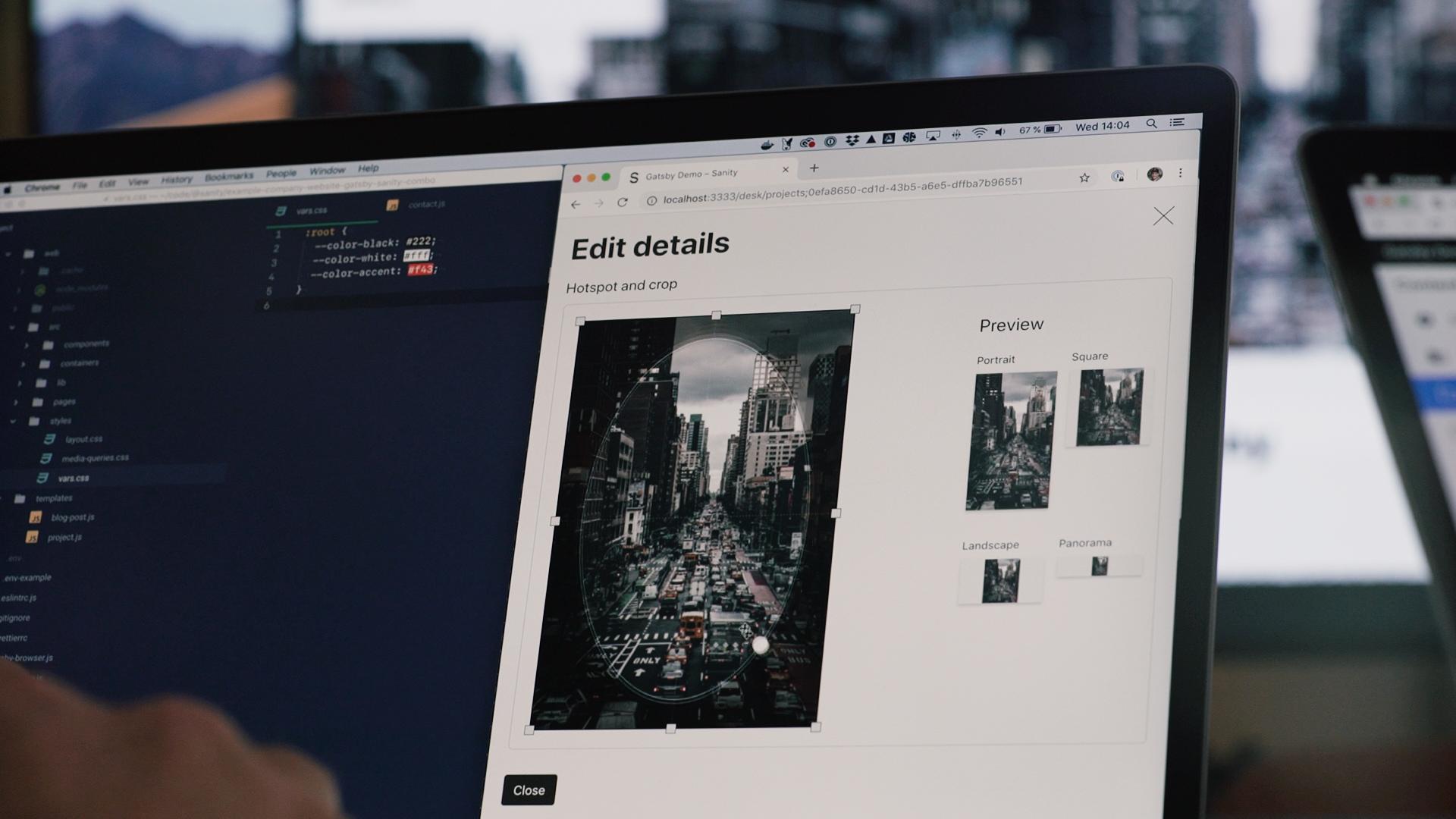
Full gatsby-image support

Close up of Sanity Studio with hotspot editing

Sanity already comes with a capable and easy to use image pipeline on a superfast CDN with transforms on demand, but if you want to use the same frontend components with a mix of remote or local sources or prefer the functionality of the gatsby-image library, we have made it easy for you to leverage that. Additionally, you'll have access to all that handy image metadata, like aspect ratios, dimensions, color palettes, the optional EXIF data and geotags via the API.

Sanity.io + Gatsby.js = Perfect JAMstack companions

Gatsby has already set some high standards for developer experience by striking the nice balance between code and configuration. We have worked hard to make it as nice and effortless as possible to use Sanity.io as a content backend with Gatsby, and we hope that you will enjoy building websites with this combo.

If you quickly want to get started with a full JAMstack combo, check out the company website example we put up. It features both a Studo configuration and a website template with projects, blog, people, and pages. You should be up in minutes.

We're very excited to see whatever you do with it and welcome you to come with all your questions, feedback, and ideas in our developer community.

A side by side view of a schema, a Gatsby front-end and the Sanity Studio